

Global payment-card fraud reached $33.83 billion in 2023. Effective e commerce fraud detection must therefore do more than block suspicious orders, it must reduce fraud losses while recovering revenue from legitimate customers who would otherwise be declined.
That distinction matters in payment operations. A rejected transaction can look like a successful fraud-prevention event in a dashboard, even when the shopper was genuine, the order was profitable, and the customer would have bought again. For subscription, direct-to-consumer, digital-goods, and high-risk businesses, the right objective is recovered customer lifetime value, not the highest possible decline rate.
Online fraud also doesn't stop at authorization. A merchant may face account takeover, card testing, delivery abuse, refund manipulation, subscription disputes, and chargebacks long after the payment has been approved. The strongest programs connect checkout decisions with fulfillment, payment retries, authentication, customer messaging, and dispute evidence.
The Economic Reality of Online Fraud
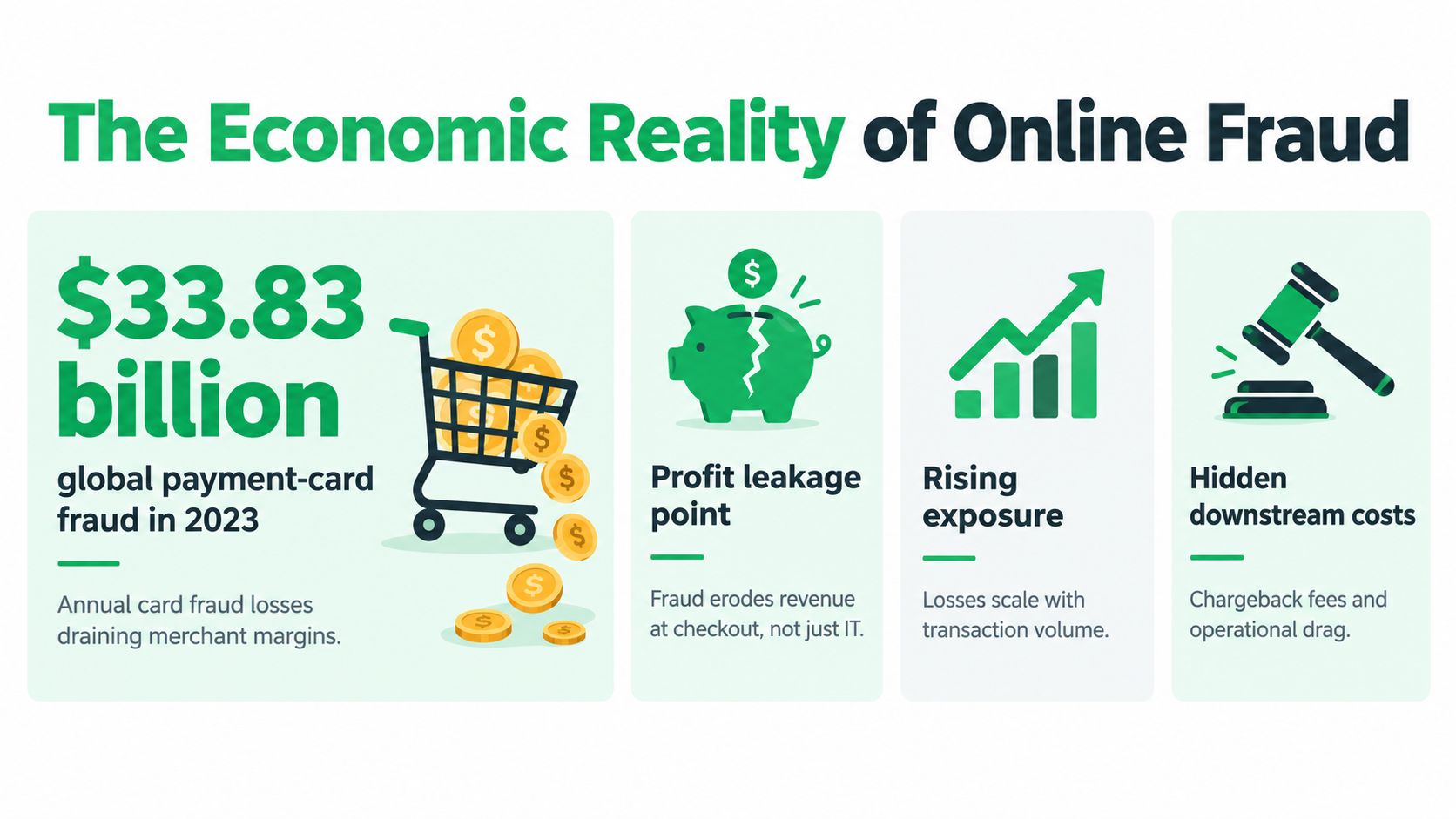
Global payment-card fraud losses reached $33.83 billion in 2023. The Nilson Report's analysis of global card fraud also recorded a worldwide loss rate of 6.58 cents per $100 of card volume, down from 6.81 cents per $100 in 2022, or roughly 0.0658% of total card volume. Those figures put fraud detection inside the finance function, where every decision affects margin and customer retention.
The cost is distributed across issuers, merchants, and acquiring institutions, including e-commerce transactions. A merchant may lose the order value, then absorb replacement shipping, investigation time, dispute handling, and payment-network consequences. The missed future purchases from a rejected legitimate customer can be harder to see, yet that lost customer lifetime value may exceed the original fraud loss.
Why remote transactions carry more risk
Card-not-present transactions remain the highest-risk category in every world region, particularly in the United States. The merchant cannot inspect the physical card or meet the customer, so the decision depends on identity, device, payment credentials, behavior, location, and the relationships among those signals.
The United States accounted for 25.29% of worldwide card spending and cash volume in 2023, but 42.32% of global card-fraud losses, according to the same Nilson Report analysis cited above. That difference shows why one global rule can reject good customers in one market while missing abuse in another. A device pattern, payment method, or address mismatch can mean different things depending on the market, processor, product, and customer history.
Subscription and DTC merchants also need controls after checkout. Real-time scoring, adaptive authentication, velocity checks, and post-transaction monitoring should cover retries, account changes, and recurring payments. A legitimate customer may change device, location, or payment credential. A compromised account may still look credible because it contains a valid stored card.
Practical rule: Measure fraud exposure across the customer lifecycle, including recoverable revenue and future customer value, rather than optimizing for the highest possible decline rate.
Common E-Commerce Fraud Vectors
Criminal payment fraud is the most familiar category. A fraudster uses stolen card credentials, fabricated details, or a compromised payment account to place an order. Card testing can appear as repeated low-value attempts, while a successful test may precede a larger purchase. Basic velocity controls can identify repetition, but they work best when combined with device, IP, email, card-token, and session context.
Account takeover creates a different problem. The transaction may come from a legitimate account with a valid payment method, which makes a simple card check less useful. The attacker may add a new delivery address, change account details, use a stored payment credential, or exploit an established customer profile. A login that looks normal in isolation can become suspicious when paired with an unfamiliar device, unusual behavior, or rapid changes to fulfillment information.
One journey can contain several attack signals
Fraud vectors rarely operate in neat categories. A credential-stuffing attack can lead to account takeover, the attacker can add a new address, and a stolen card can then be used against the account. A bot can test multiple payment credentials while imitating normal checkout behavior. A refund request can follow a fraudulent order before the merchant receives a chargeback notification.
That sequence has an important operational implication: don't evaluate each event independently. The risk engine should connect the customer, session, device, payment token, address, order history, and fulfillment events. A single billing and shipping mismatch may be harmless, especially for gifts. The same mismatch combined with rapid attempts, a new device, and a newly created account deserves a different response.
First-party disputes need a separate lens
Friendly fraud and first-party misuse sit outside the usual stolen-card narrative. A customer may fail to recognize a billing descriptor, a family member may have made the purchase, or a buyer may dispute a valid transaction after receiving the product. Other customers deliberately exploit refund, cancellation, or delivery policies.
These cases shouldn't be forced into the same workflow as criminal payment fraud. Criminal fraud calls for stronger authorization and identity controls. Confusion calls for clearer descriptors and customer communication. Repeated policy abuse may call for account-level controls and evidence review. The transaction can look identical in the payment network while requiring a very different merchant response.
Rules vs. Machine Learning in Fraud Detection
Rules and machine learning solve different operational problems. A rule is explicit, fast, and easy to explain. Machine learning can identify combinations of signals that a human analyst might not encode manually, but it requires reliable labels, disciplined validation, and continuous monitoring.
| Approach | Best For | Limitations |
|---|---|---|
| Static rules | Known patterns, hard limits, immediate controls, and compliance requirements | They become brittle when attackers change behavior and can create overlapping exceptions |
| Machine learning | Nuanced scoring across device, payment, behavior, and account context | It needs quality training data, careful validation, and explanations that analysts can act on |
| Hybrid decisioning | Combining transparent controls with adaptive risk scoring | It requires ownership of thresholds, feedback loops, and escalation paths |
Rules remain valuable for obvious patterns. A merchant may want to limit repeated attempts by the same card, email, IP, or device, or require additional verification when a high-risk combination appears. Those controls can stop a known attack quickly and give the operations team a clear reason for the action.
The weakness is rule accumulation. Teams often add a new block after every incident, then add an exception when legitimate customers complain. Over time, the rule set becomes difficult to test, and one market or processor may inherit assumptions that don't apply to another.
Machine learning is more useful when risk is contextual. It can weigh velocity, device consistency, payment-token history, behavioral timing, billing and shipping relationships, prior outcomes, and other signals together. It still shouldn't operate as an untouchable black box. Analysts need reason codes, cohort reporting, threshold controls, and a way to send confirmed outcomes back into the model-development process.
For teams assessing how automation can support broader commerce operations, Tagada's overview of AI in e-commerce provides relevant context. Fraud scoring should sit inside a wider workflow that includes payment routing, authentication, customer messaging, and post-purchase monitoring.
The practical answer: Use rules for certainty and machine learning for context. Let neither one make every decision alone.
A hybrid system can approve low-risk orders without friction, challenge ambiguous transactions, and stop high-confidence abuse. The quality of that system depends less on whether the label says “AI” and more on whether the merchant measures outcomes by market, payment method, processor, device, subscription stage, order value, and customer history.
Building a Real-Time Risk Architecture
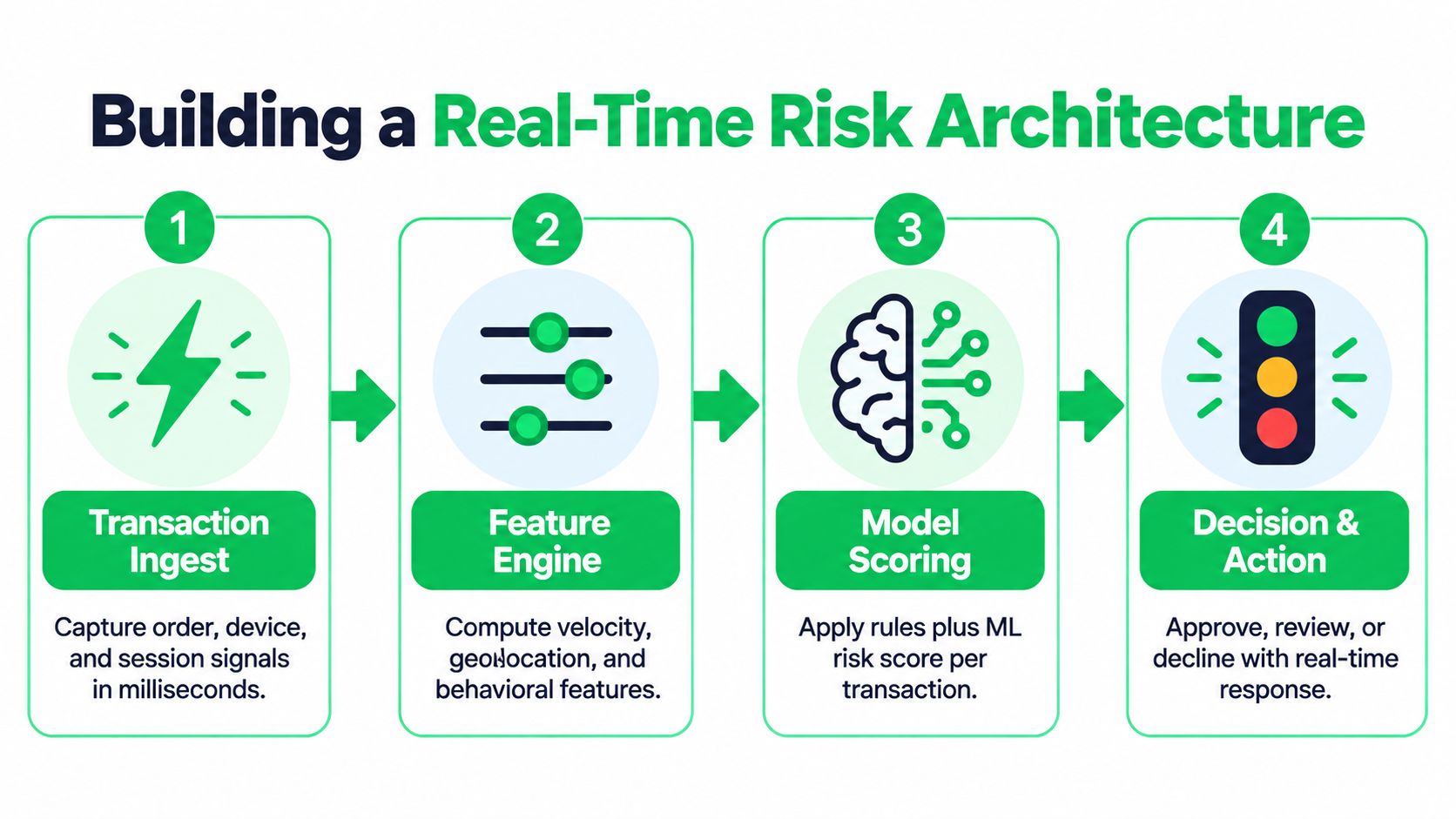
A production fraud system needs a clear path from event capture to action. The following architecture keeps the decision close to the transaction while preserving enough context for later review.
Capture the transaction context
Start with the order, payment attempt, customer account, session, device, IP context, address relationship, and prior payment history. Capture events before authorization where possible, then continue collecting information through fulfillment, refunds, renewals, and disputes.
The feature layer should calculate signals such as transaction velocity, device and IP consistency, payment-token history, billing and shipping mismatch, behavioral timing, and prior chargeback outcomes. No single signal proves fraud. The risk comes from the combination and from the change relative to the customer's normal behavior.
Score, route, and learn
A calibrated risk score should feed a decision policy with at least three outcomes:
- Low risk receives frictionless approval. The merchant protects conversion and avoids asking trusted customers to prove themselves repeatedly.
- Medium risk receives step-up verification or review. The customer may complete 3-D Secure, confirm account details, or wait for an analyst to inspect the order.
- High risk receives a decline or delayed fulfillment. The merchant can avoid shipping while preserving the option to investigate rather than automatically discarding every order.
Model evaluation must reflect the imbalance between legitimate and fraudulent transactions. In an e-commerce study using 151,112 records, 14,151 transactions were labeled fraudulent. Applying SMOTE to rebalance training data increased average F1 from 67.9% to 94.5% and G-Mean from 73.5% to 84.6%, as reported in the e-commerce machine-learning study.
Those results don't justify oversampling without controls. Synthetic samples should be generated only inside training folds to prevent validation leakage. Production reporting should also segment results by country, payment method, processor, device, subscription lifecycle, and transaction value. Aggregate accuracy can conceal a model that performs well overall while declining too many legitimate international buyers or missing risk in one processor route.
A real-time analytics layer can help teams connect these signals to operational outcomes. Merchants also need a separate business continuity plan for incidents, which may include reviewing resources such as ABS Insurance Brokers cyber cover when assessing broader cyber and payment exposure.
<iframe width="100%" style="aspect-ratio: 16 / 9;" src="https://www.youtube.com/embed/VBvj7hDWaKk" frameborder="0" allow="autoplay; encrypted-media" allowfullscreen></iframe>
For merchants operating across multiple processors, Tagada's real-time analytics platform is relevant to the measurement problem because routing changes can alter approval, fraud, and review outcomes at the same time. The architecture should record which processor, authentication path, rule, model score, and customer intervention produced each result.
The Hidden Cost of False Positives
The most dangerous fraud program is not always the one that lets too much fraud through. It can also be the one that blocks valuable customers so aggressively that the merchant loses more contribution margin than it saves.
J.P. Morgan reports that actual fraud losses represent an estimated 7% of total fraud cost, while false-positive losses account for 19%. It also cites cases in which up to 35% of rejected orders were ultimately legitimate, according to its analysis of card-not-present fraud prevention.

A decline is not a free fraud win
A false decline can remove the first order, the next order, and the customer's willingness to try again. The cost is especially difficult to see in subscription and DTC businesses, where a new customer may have generated future renewals, referrals, and support interactions. A dashboard that reports “fraud prevented” won't show that lost value unless the team links fraud decisions to customer outcomes.
Measure the control against more than chargebacks:
- Approval rate: Track the percentage of legitimate payment attempts that complete, segmented by market, processor, device, and payment method.
- Repeat purchase rate: Observe whether challenged or declined customers return through another payment path.
- Customer lifetime value: Compare recovered margin and future purchasing behavior against the cost of fraud and review.
- Post-decline recovery: Record whether a retry, payment-method change, support message, or step-up challenge rescued the order.
A binary approve-or-block policy wastes useful middle ground. Low-risk transactions should move quickly. Medium-risk orders can receive adaptive friction. High-risk orders can be declined or held while fulfillment teams confirm information. Thresholds should account for expected margin, chargeback cost, review cost, and conversion loss.
Optimize the intervention, not only the score
The same risk score may justify different actions for different businesses. A physical product with immediate fulfillment may need delayed shipment. A digital download may require stronger authentication before access. A recurring payment may benefit from a payment retry or customer message rather than an immediate account block.
A fraud decision is also a customer-experience decision. Record the intervention and its commercial outcome, not just whether the model was right.
Cohort monitoring matters because a processor migration, new authentication rule, or routing change can increase false declines without obvious warning. The goal isn't to make every transaction look safe. It's to protect profitable customer relationships while making criminal abuse expensive and difficult.
Distinguishing Friendly Fraud from Criminal Abuse
A chargeback records a payment event, not the customer's intent. Treating every dispute as criminal fraud can lead a merchant to send hostile messages to a confused customer, block a household account after an innocent purchase, or lose future revenue from a subscription relationship.
Recent reporting states that first-party fraud represented 36% of global fraud cases in 2026, compared with 15% in 2023, while 64% of merchants reported that first-party misuse was increasing, according to the e-commerce fraud statistics report. The figures describe a mixed group: deliberate abuse, misunderstanding, and failures in merchant communication. That distinction matters because an unnecessary block can cost more than the disputed order by ending a profitable customer relationship.
Classify the dispute before choosing the response
Review the available evidence against the customer's likely explanation:
- Unrecognized descriptor: The customer may not recognize the merchant name on the statement. Clear billing descriptors and a direct clarification message can resolve the dispute without escalating it.
- Family-member purchase: A household member may have placed the order without the cardholder's immediate knowledge. Account history, delivery details, and customer communication help establish context.
- Subscription misunderstanding: The buyer may have forgotten a renewal date or misunderstood cancellation timing. Consent records, cancellation timestamps, renewal notices, and accessible account controls support a fair decision.
- Friendly fraud: The customer received the goods or service but disputes the charge, either intentionally or because the transaction is no longer remembered.
- Deliberate abuse: Repeated refund manipulation, false non-delivery claims, or systematic policy exploitation may justify account-level restrictions.
- True unauthorized use: Evidence indicates that a third party used compromised payment credentials or accessed the account.
Match the evidence to the question being asked. Delivery confirmation can support a dispute response, but it does not prove that the account holder authorized the purchase. Login and device history can show continuity. Consent records and cancellation timestamps carry particular weight for recurring billing. Customer messages may expose confusion that a risk model would otherwise classify as hostility or abuse.
Use proportionate post-purchase controls
A post-purchase risk layer can monitor address changes, delivery events, refund requests, subscription cancellations, and dispute patterns. Send clarification when the issue appears to be confusion. Route ambiguous cases to human review. Apply policy controls and retain an evidence trail when repeated abuse forms a pattern. For confirmed unauthorized activity, secure the account and payment method.
Do not treat every repeat dispute as proof of criminal intent. Automatic threats and account blocks can increase disputes, reduce trust, and remove customers who would otherwise keep buying. Fair classification protects recoverable revenue, improves evidence quality, and gives legitimate customers a path back to the service. Track the resulting retention and recovered customer value, not only the immediate dispute outcome.
Navigating Payment Network Monitoring Programs
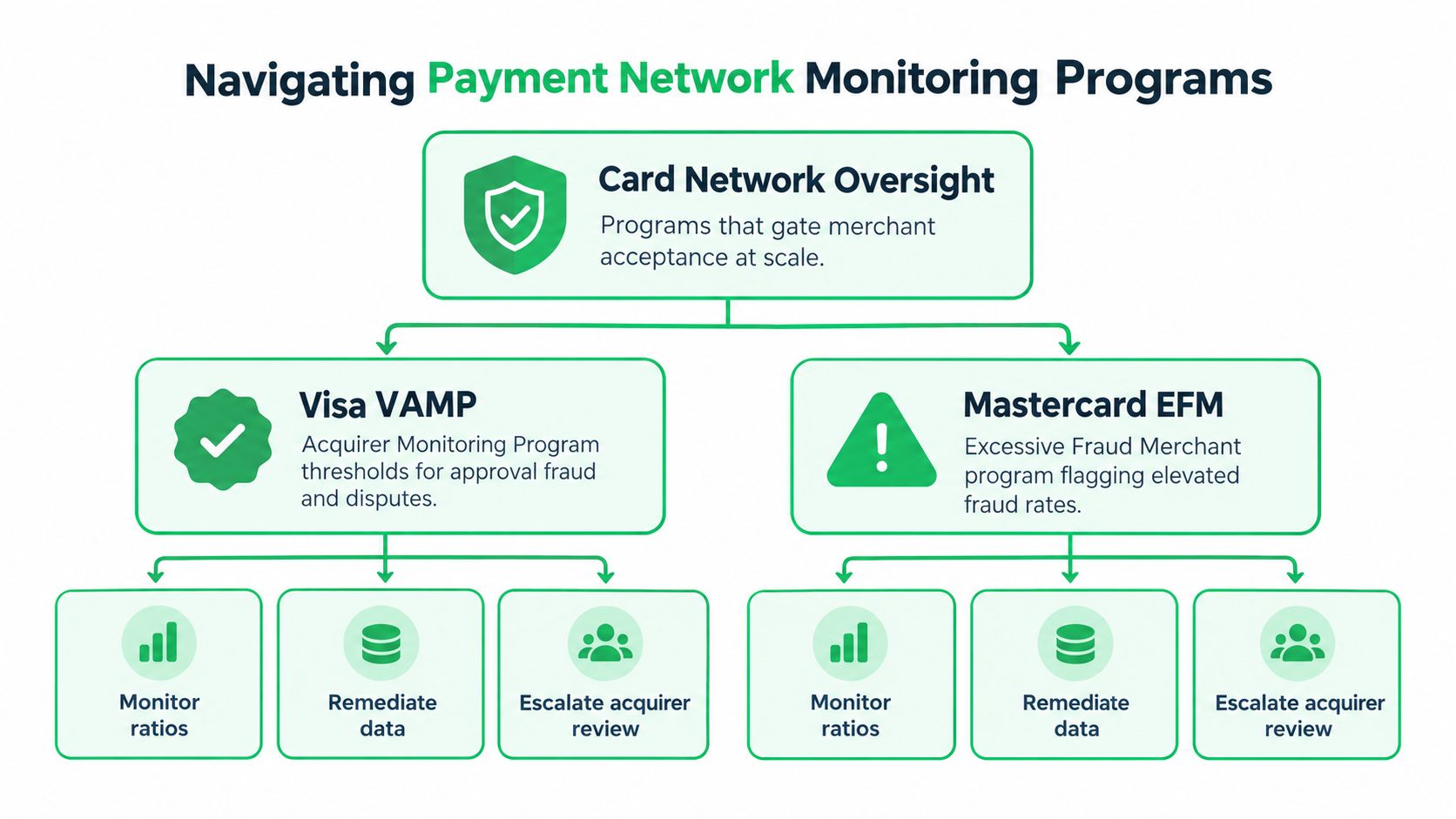
Fraud management also protects the merchant's ability to process payments. Card networks evaluate fraud reports, disputes, transaction volume, and authentication coverage at portfolio level. A merchant that monitors only individual orders can miss the operational risk building across processors or legal entities.
Visa VAMP
Visa's Acquirer Monitoring Program, introduced in April 2025, combines fraud reports and disputes into one monitoring ratio. For merchants processing at least 1,500 combined TC15 non-fraud and TC40 fraud reports in a month, the calculation uses qualifying incidents minus applicable exceptions, divided by total settled transactions. In the Asia-Pacific, Canada, European Union, and United States regions, the excessive-merchant threshold is reported as 2.2% in initial program materials, with potential financial consequences for merchants above the applicable threshold, as described in Stripe's dispute monitoring documentation.
The denominator matters. A growing merchant can see absolute reports rise while the ratio remains stable, or experience the opposite if settled volume changes. Operations teams should reconcile settled transactions, fraud reports, disputes, exclusions, and processor reporting rather than relying on a single dashboard number.
Mastercard EFM and chargeback categories
Mastercard's Excessive Fraud Merchant program uses multiple conditions. A merchant must process at least 1,000 Mastercard sales transactions in the previous month, incur at least USD 50,000 or EUR 50,000 in fraud-related chargebacks under reason code 4837, reach a fraud-chargeback-to-sales ratio of at least 0.50%, and have 3-D Secure adoption below 10% in non-regulated countries or below 50% in regulated countries, according to Mastercard program guidance summarized by Checkout.com.
That structure shows why checkout screening alone isn't enough. Fraud volume, fraud rate, and authentication coverage can expose a merchant together. A strong control program therefore tracks 3-D Secure adoption alongside fraud outcomes and routing behavior.
Mastercard also separates ordinary chargeback exposure from fraud-specific exposure. Its Excessive Chargeback Merchant category applies at 100 to 299 chargebacks in a month with a chargeback-to-transaction ratio between 1.5% and 2.99%. The High Excessive Chargeback Merchant category applies at 300 or more chargebacks and a ratio of at least 3%, based on the Visa and Mastercard monitoring thresholds.
Use a dedicated chargeback monitoring programs glossary to standardize terminology across finance, payments, support, and risk teams. Then assign owners to daily ratio checks, weekly cohort reviews, exception validation, and acquirer escalation.
Finalizing Your Fraud Prevention Playbook
A durable e commerce fraud detection program should answer four questions for every important payment event:
- What signals were available? Store device, IP, velocity, payment-token, account, address, behavioral, and prior-outcome data.
- What decision was made? Record the rule, model score, authentication path, processor, and action.
- What happened afterward? Connect authorization to fulfillment, refund, renewal, cancellation, dispute, and customer-support outcomes.
- What did the decision cost? Measure fraud loss, review effort, conversion loss, repeat purchasing, and recovered customer lifetime value.
Use real-time scoring for context, rules for clear controls, and step-up authentication for transactions that need more evidence. Route across processors when reliability, local payment methods, or approval behavior justify it, but measure each route against fraud and false-decline outcomes. For subscriptions, connect dunning and payment retries to risk decisions rather than treating every failed renewal as abuse.
Finally, review the system continuously. Attackers change patterns, customers change devices, processors change performance, and network programs change their requirements. The merchant that keeps a clean decision trail can tune thresholds without guessing which intervention damaged conversion.
Tagada connects checkout, payment routing, authentication, subscription management, messaging, and chargeback-aware risk workflows in one commerce operating layer. Visit Tagada to see how its payment orchestration can help your team improve approval decisions while keeping fraud controls aligned with customer lifetime value.