
False Declines: Why Good Customers Get Turned Away
What causes false declines, how to tell your fraud rules from the bank, how to measure them, and what Visa's retry rules allow after a decline.

Article summary
TL;DR
A false decline is a legitimate payment refused as if it were fraud, by your own fraud rules, your processor or the card issuer. Find which one said no before acting: loosen or narrow your own rules, send complete card data, use 3D Secure on doubtful orders, and retry only within Visa's limits.
- A false decline can come from three places: your rules, your processor's risk model or the issuer. Each needs a different fix.
- A payment your processor blocks never reaches the bank. That part of the problem is in your hands.
- Visa never allows a retry after a category 1 decline, and caps other codes at 20 attempts in 30 days.
- On a retry, Visa forbids changing the MCC, the merchant country, the acquiring identifier or the ecommerce indicator.
- Routing to a second processor helps when the first one blocked the payment or failed technically, not when the issuer refused the card.
 ChatGPT
 Claude
 Perplexity
 Grok
On this page
A false decline is the opposite of fraud: a real customer, a real card, and a payment refused anyway. You lose the order, and often the customer with it. The fix depends on who said no, because a payment can be stopped by your own rules, by your processor or by the card issuer.
What is a false decline?
A false decline, also called a false positive, is a legitimate payment refused because a fraud check judged it risky. Stripe sorts failed payments into three types: issuer declines, blocked payments and invalid API calls.1Stripe Docs, Declines, read November 2, 2026 False declines live in the first two.
Fig. 1Two of three gates can refuse a good customer
approved declined or closed routing step
- CheckoutInvalid data: wrong number, CVC or expiry
- checked byYour rules and processorBlocked: the bank is never askedDeclined
- sent toCard issuerDeclined, with a codeDeclined
find the gate before you fix anything
The difference matters. When Stripe blocks a payment, "it doesn't obtain authorization from the card issuer."1Stripe Docs, Declines, read November 2, 2026 That decline is yours to fix. When the issuer declines, its models weigh "spending habits, account balance, and card data (expiration date, address information, and CVC)."1Stripe Docs, Declines, read November 2, 2026 You can't change its model, but you can change what you send it.
What causes false declines
Most false declines come from a rule or a model meeting a payment that looks unusual but isn't. The table sorts the common causes by who makes the call.
| Cause | Who says no | What it looks like | What to do |
|---|---|---|---|
| Large purchase or many payments in a short time | Issuer | Generic or suspected-fraud code2Stripe Docs, Card declines, read November 2, 2026 | Customer confirms with the bank; offer another card |
| Card issued in another country than your account | Issuer | Higher decline rate on foreign cards2Stripe Docs, Card declines, read November 2, 2026 | Process locally in your main markets |
| CVC, expiry or address mismatch | Issuer | Data-quality codes, failed checks2Stripe Docs, Card declines, read November 2, 2026 | Ask the customer to re-enter the details |
| Rule too broad, such as all foreign cards | Your rules | Outcome "blocked", no network code1Stripe Docs, Declines, read November 2, 2026 | Narrow the rule, or review instead of block |
| CVC or postal code block rules | Your rules | Blocked even though the issuer approved3Stripe Docs, Fraud prevention rules (Radar), read November 2, 2026 | Use the risk-based version of the rule |
| Processor tightens during an attack | Processor | More "elevated" payments blocked4Stripe Docs, Risk setting and risk controls (Radar), read November 2, 2026 | Expected; check that it relaxes afterwards |
| Payment unlikely to be authorized | Processor | "Unlikely to be authorized" block1Stripe Docs, Declines, read November 2, 2026 | Expected on IC+ pricing at Stripe; it avoids retry costs |
| Timeouts and system errors | Network | Issuer or switch inoperative, system malfunction5Visa Core Rules and Visa Product and Service Rules, edition of October 24, 2026: section 1.7.2.1 (pp. 131 to 132), section 7.3.6.3 and table 7-2 (pp. 547 to 549), table 5-21 (p. 471) | Retry soon, within Visa's limit |
Stripe notes that a CVC or address check can fail and the issuer still approves, because issuers "evaluate numerous risk factors."3Stripe Docs, Fraud prevention rules (Radar), read November 2, 2026 A rule that blocks every failed check refuses payments the bank was ready to accept. Stripe's own example of a block rule that is "too broad" is if :card_country: != 'US'; its fix adds and :risk_level: = 'elevated'.3Stripe Docs, Fraud prevention rules (Radar), read November 2, 2026
Why high-risk merchants see more false declines
The same profile that makes processors careful also trips fraud checks. Signals that look like fraud are part of normal business for many direct-to-consumer brands.
- Big first orders from ad trafficA new customer, no history, a large basket3D Secure on those orders rather than a block
- Customers abroad paying with home cardsCard country and account country differLocal processing in your largest markets
- Declined renewals on saved cardsOff-session, no customer to authenticateCard account updater, a written notice and 7 days to pay
- Block rules added after a fraud spikeRules written in a hurry stay onReview each rule's false positive rate every month
The last one is the most common trap. Visa's VAMP ratio counts fraud reports as well as disputes, and in Asia Pacific Visa's MERP program also looks at authorization declines.7Stripe Docs, Dispute and fraud card monitoring programs, read November 2, 2026
Under that pressure, merchants add block rules and never remove them. The fraud stops, and so do some good customers. Thresholds and what counts in the ratio: fraud and 3D Secure for high-risk merchants.
What false declines cost
The order is the visible part. The customer who gets refused may try another card, or leave. In Baymard Institute's survey, 10% of US shoppers who abandoned a checkout for a reason other than browsing said their card was declined.6Baymard Institute, Cart abandonment rate statistics, updated September 22, 2025
The sale
Lost unless the customer tries again. You still paid to acquire the visit.
The customer
A refused customer has a reason to buy elsewhere next time, and a subscriber may never start.
The data
Every good order you block is one your rules never learn from.
Fraud-tool vendors publish yearly cost estimates for false declines, but each uses its own method and they don't agree. We don't repeat them here. Your own numbers are more useful.
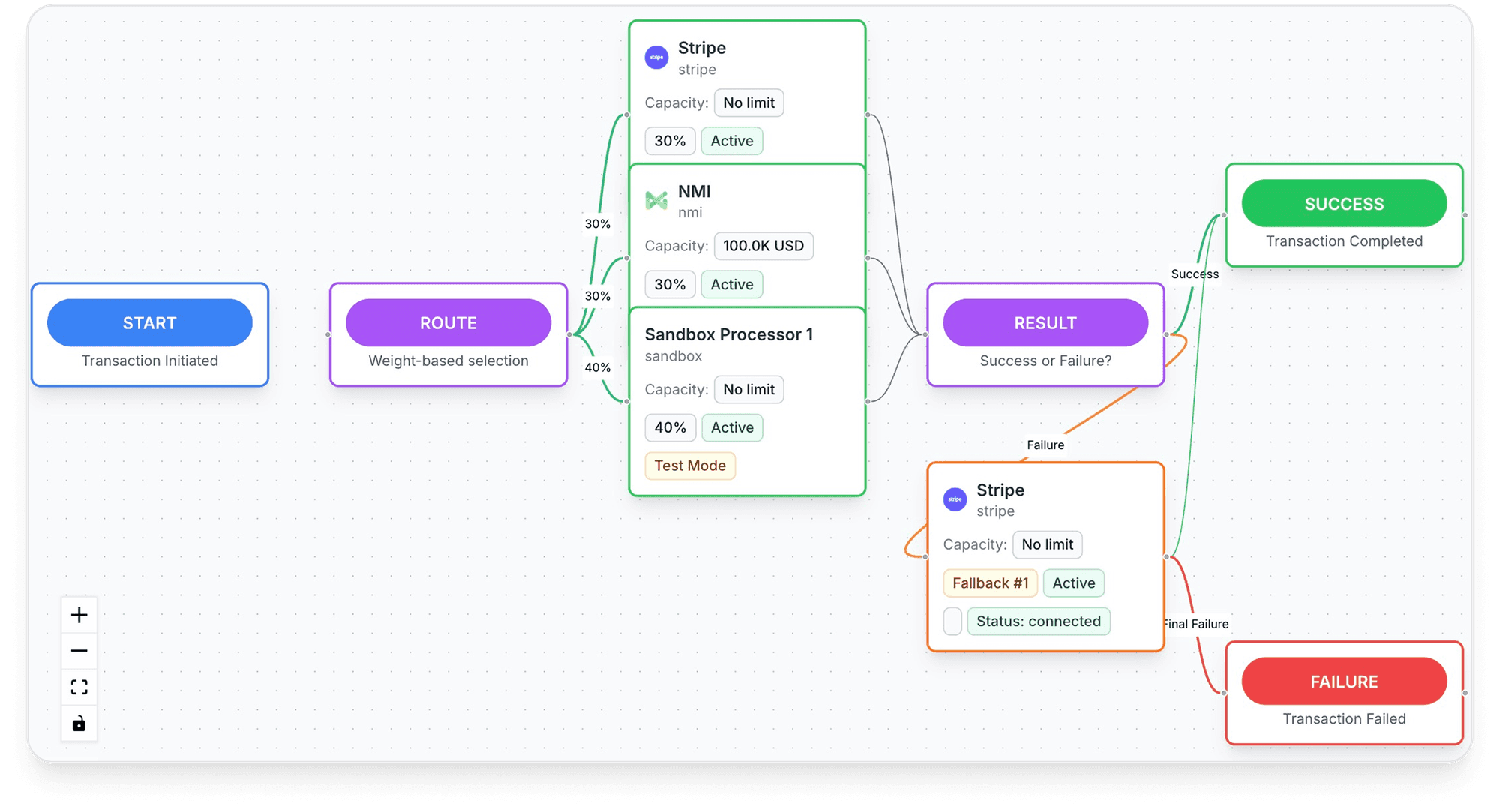
Inside Tagada
See every payment's route, processor by processor
Set the order your processors are tried in, per store, per country or per product.
How to measure false declines
You rarely hear about a false decline: the customer just leaves. So measure it on purpose.
- Count unique payments, not attempts. Stripe advises analyzing unique declines and excluding failed retries.1Stripe Docs, Declines, read November 2, 2026 On Stripe, the card fingerprint helps group repeat attempts.2Stripe Docs, Card declines, read November 2, 2026
- Split by failure type. Blocked, issuer declined, invalid. Each has its own owner.1Stripe Docs, Declines, read November 2, 2026
- Read your rule metrics. Stripe shows an "Est. false positive rate" for Radar block rules, the estimated share of non-fraudulent payments they blocked.3Stripe Docs, Fraud prevention rules (Radar), read November 2, 2026
- Sample blocked orders by hand. Check order history, device, delivery address and email. Contact a few customers when in doubt.
- Track the confirmed share monthly. Blocked or declined orders you confirm as legitimate, over all blocked or declined orders reviewed.
Method based on Stripe Docs, Declines and Fraud prevention rules, read November 2, 2026.
There is no official benchmark for a false decline rate. Visa and Mastercard don't publish one. Compare yourself month to month, and after every rule change.
How to reduce false declines
Start where you have control: your own rules. Then improve what the issuer sees.
| Move | Why it works | Source |
|---|---|---|
| Review before you block | Stripe advises a review rule first, then a block rule once you've checked for false positives | Stripe3Stripe Docs, Fraud prevention rules (Radar), read November 2, 2026 |
| Narrow broad rules | Add a risk condition to country, card type or amount rules | Stripe3Stripe Docs, Fraud prevention rules (Radar), read November 2, 2026 |
| Test rules on part of the traffic | Radar can apply a rule to a percentage of matching payments, or 0% to evaluate it without acting | Stripe3Stripe Docs, Fraud prevention rules (Radar), read November 2, 2026 |
| Ask for 3D Secure instead of blocking | The bank authenticates the doubtful customer; liability for fraud usually shifts to the issuer | Stripe3Stripe Docs, Fraud prevention rules (Radar), read November 2, 2026 |
| Collect CVC and postal code | Stripe's first advice against declines for suspected fraud | Stripe2Stripe Docs, Card declines, read November 2, 2026 |
| Allow-list known customers | "Add to allow list" stops your rules from blocking matching payments | Stripe1Stripe Docs, Declines, read November 2, 2026 |
| Keep saved cards current | Expired cards are a data-quality decline, not a fraud one | Visa5Visa Core Rules and Visa Product and Service Rules, edition of October 24, 2026: section 1.7.2.1 (pp. 131 to 132), section 7.3.6.3 and table 7-2 (pp. 547 to 549), table 5-21 (p. 471) |
| Process locally | Cards issued abroad see more declines; local accounts in big markets help | Stripe2Stripe Docs, Card declines, read November 2, 2026 |
Allow rules cut both ways
Allow rules override all your other rules and Stripe's own risk assessment. Stripe recommends keeping them narrow and adding and :risk_level: != 'highest' to each one.3Stripe Docs, Fraud prevention rules (Radar), read November 2, 2026
3D Secure deserves care. Stripe warns that "indiscriminate use of 3DS might lower conversion rates," and suggests requesting it on elevated-risk payments above an amount, while letting off-session renewals and wallets like Apple Pay through.3Stripe Docs, Fraud prevention rules (Radar), read November 2, 2026 Used that way, it turns a block into a question the bank answers. More on the trade-off: fraud and 3D Secure and 3D Secure.
Retrying a declined payment: what Visa allows
A retry can rescue a false decline, or make things worse. Visa's table 7-2 sorts every decline code into four categories and sets the limit for each.5Visa Core Rules and Visa Product and Service Rules, edition of October 24, 2026: section 1.7.2.1 (pp. 131 to 132), section 7.3.6.3 and table 7-2 (pp. 547 to 549), table 5-21 (p. 471)
0
Retries allowed on the same card after a Visa category 1 decline
20 in 30 days
Visa limit for categories 2, 3 and 4
8
Maximum retries per charge recommended by Stripe
7 days
Visa minimum to let the customer pay another way after a declined renewal
Category 1 means "issuer will never approve": lost or stolen card, closed account, invalid number, stop-payment orders. After one of those, a merchant "must never resubmit" for the same card.5Visa Core Rules and Visa Product and Service Rules, edition of October 24, 2026: section 1.7.2.1 (pp. 131 to 132), section 7.3.6.3 and table 7-2 (pp. 547 to 549), table 5-21 (p. 471)
Categories 2 to 4 cover funds and limits, suspected fraud (code 59), data quality and generic codes such as 05 "do not honor." Each allows up to 20 attempts in 30 days.5Visa Core Rules and Visa Product and Service Rules, edition of October 24, 2026: section 1.7.2.1 (pp. 131 to 132), section 7.3.6.3 and table 7-2 (pp. 547 to 549), table 5-21 (p. 471)
Stripe recommends at most 8 retries per charge, because issuers "might see creating additional retries as potential fraud."2Stripe Docs, Card declines, read November 2, 2026
An Acquirer, a Merchant, a Payment Facilitator, or a VisaNet Processor that reattempts an Authorization Request following a Decline Response [...] must not intentionally manipulate any data elements from the original Authorization Request.
The listed elements include the acquiring identifier, the acquirer and merchant country, the MCC, the POS fields and the Electronic Commerce Indicator.5Visa Core Rules and Visa Product and Service Rules, edition of October 24, 2026: section 1.7.2.1 (pp. 131 to 132), section 7.3.6.3 and table 7-2 (pp. 547 to 549), table 5-21 (p. 471)
For saved cards, Visa adds one more duty: if a merchant-initiated payment is declined, notify the cardholder in writing and give them at least 7 calendar days to pay by other means.5Visa Core Rules and Visa Product and Service Rules, edition of October 24, 2026: section 1.7.2.1 (pp. 131 to 132), section 7.3.6.3 and table 7-2 (pp. 547 to 549), table 5-21 (p. 471) Every code and what to do with it: declined payments. Retry timing for renewals: smart retries.
Can routing fix false declines?
Sometimes. Routing sends a payment to another processor when the first path fails. Whether that helps depends on where the refusal came from.
Fig. 2When a second processor helps
Issuer said no
- CheckoutCustomer pays
- routes toProcessor ASent to the bank
- asksIssuerDeclined: stolen card, category 1Declined
Same card, same bank: follow Visa's category
Path failed
- CheckoutCustomer pays
- routes toProcessor ATimeout or own risk blockDeclined
- falls throughProcessor BSent to the bank, approvedApproved
Order paid on the second path
it fixes the path, not the card
Routing helps when the problem is the path: a processor's own block, a technical failure, or a cross-border payment that does better through a local acquirer.2Stripe Docs, Card declines, read November 2, 2026 It doesn't help when the issuer refused the card.
A category 1 code stays final whichever processor asks next, and a code 59 "suspected fraud" needs the customer to call their bank. Visa also lists the acquiring identifier among the data a merchant must not manipulate on a reattempt after a decline, so a cascade is not a way around the issuer's answer.5Visa Core Rules and Visa Product and Service Rules, edition of October 24, 2026: section 1.7.2.1 (pp. 131 to 132), section 7.3.6.3 and table 7-2 (pp. 547 to 549), table 5-21 (p. 471)
How routing logic works: dynamic payment routing and cascading payments. The wider method to raise approvals: payment acceptance rate.
How Tagada helps
Approve real customers, block the rest
- Native 3DS2, device intelligence and a rules engine: "approve real customers, block the rest."
- Approval routing: "Every transaction is scored against your live MID network in real time." Payments go to the processor most likely to approve them, with a retry on decline and no engineering required. TagadaPay reports a +18% approval uplift.
- Routing across Stripe, NMI, Checkout.com and Airwallex with one vault and automatic cascade. Setup and fallback order: Tagada routing docs.8Tagada Docs, Multi-processor routing, read November 2, 2026
- Your vault: "Your PCI-tokenized cards, your customer profiles, your subscription data, all portable." Switch processors without re-onboarding customers.
- From 2.9% + $0.29, no setup fees, no monthly minimums. High-risk verticals and edge cases are priced case by case.
- 24/7 human support on Slack Connect.
Tagada follows Visa and Mastercard rules and the laws that apply to payments.
Frequently asked questions
What is a false decline?
What is the difference between a false decline and a hard decline?
How do I know if my payments are being falsely declined?
Can I retry a payment that was falsely declined?
Does 3D Secure reduce false declines?
What is a good false decline rate?
Sources
Checked November 2, 2026- Stripe Docs, Declines, read November 2, 2026
- Stripe Docs, Card declines, read November 2, 2026
- Stripe Docs, Fraud prevention rules (Radar), read November 2, 2026
- Stripe Docs, Risk setting and risk controls (Radar), read November 2, 2026
- Visa Core Rules and Visa Product and Service Rules, edition of October 24, 2026: section 1.7.2.1 (pp. 131 to 132), section 7.3.6.3 and table 7-2 (pp. 547 to 549), table 5-21 (p. 471)
- Baymard Institute, Cart abandonment rate statistics, updated September 22, 2025
- Stripe Docs, Dispute and fraud card monitoring programs, read November 2, 2026
- Tagada Docs, Multi-processor routing, read November 2, 2026
TagadaPay
Stop turning good customers away
Tell us what you sell and how you sell it. Each application is underwritten, and approval is not guaranteed.
- 01Tell us what you sell and how
- 02Underwriting reviews your business
- 03Process through TagadaPay alongside your other processors