
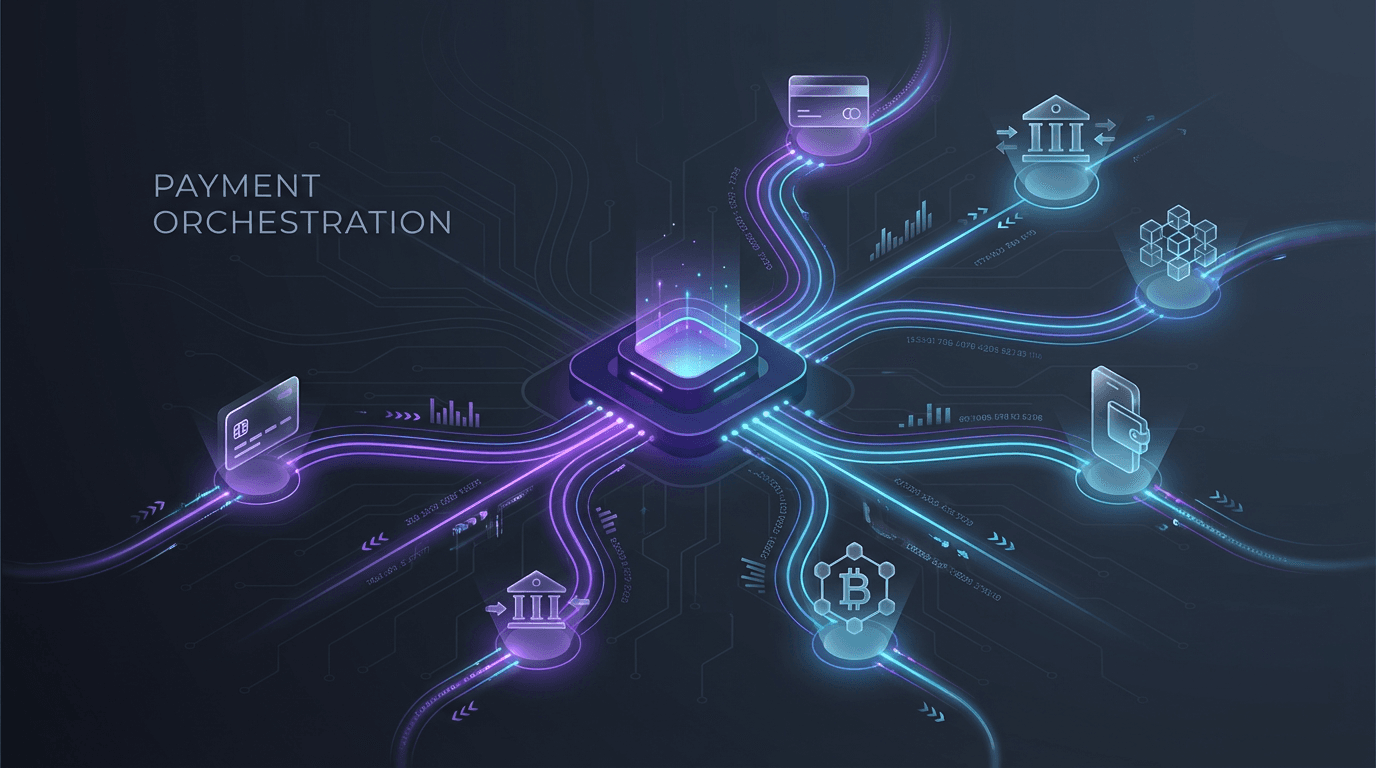
A $2.85 billion market growing to $6.1 billion by 2030. That's not a category built on hype — those are enterprises voting with their infrastructure budgets. If you're still running payments through a single processor, the question isn't "what is payment orchestration?" anymore. It's "how much revenue am I quietly losing without it?"
This article goes beyond the definition. We'll walk through real vertical use cases — from travel to subscriptions to marketplaces — with cited performance data, to show exactly where orchestration creates measurable business value.
The Core Problem: Payment Infrastructure Wasn't Built for Modern Commerce
Most ecommerce brands start with a single payment processor — Stripe, Adyen, Braintree — and for a while, everything is fine. You integrate the API, payments flow, life is good. Then the cracks show up. Slowly at first, then all at once.
According to Primer.io's research on merchant processing fee optimization, the moment you expand beyond one geography, add a second payment method, or scale past $1M in annual processing volume, a single-processor setup starts costing you money in four ways:
Cross-Border Fee Leakage
When a UK customer pays a US-domiciled Stripe account, the transaction incurs cross-border interchange fees — typically 1-2% above domestic rates. An orchestrator routes that same transaction through a UK-based acquirer, processing it as domestic. At scale, this saves 1-2% on every international transaction. (Source: Primer.io, "How merchants lower processing fees")
Authorization Rate Decay
Every processor has blind spots — card types, regions, or transaction patterns where their approval rates dip. A merchant locked to one processor has no recourse when approvals drop. An orchestrator detects declining authorization rates in real time and shifts traffic to better-performing processors. Industry average uplift: +3.5% authorization rate. (Source: CelerisPay, 2026)
Single Point of Failure
When your sole processor goes down — and every processor has outages — your revenue goes to zero. Orchestration provides automatic failover: if Processor A returns errors, traffic routes to Processor B within milliseconds. With 99.99% uptime across the orchestration layer, downtime becomes someone else's problem. (Source: Primer.io platform metrics)
Negotiation Weakness
When you're locked into one processor, they know it. Rate negotiations are one-sided because switching is expensive and risky. With an orchestrator, switching or adding processors is a configuration change, not a re-architecture. This shifts negotiation power back to the merchant. (Source: Primer.io, "How merchants negotiate better rates")
The Numbers: What Orchestration Actually Delivers
Let's ground this in specific, cited performance data:
| Metric | Without Orchestration | With Orchestration | Source |
|---|---|---|---|
| Authorization Rate Uplift | Baseline | +3.5% | CelerisPay, 2026 |
| Fraud Reduction | Baseline | 26% decrease | CelerisPay, 2026 |
| Failed Transaction Recovery | Lost | 30% recovered via fallbacks | CelerisPay, 2026 |
| Cross-Border Fee Savings | Full cross-border rates | 1-2% saved per tx | Primer.io Blog |
| Smart Routing Growth Rate | — | 34%+ annually | Global Growth Insights, 2026 |
| Market Size (2025) | — | $2.48-2.85B | GlobeNewsWire / GII Research |
For a merchant processing $10M annually, a 3.5% authorization uplift represents $350,000 in recovered revenue. Add 1-2% cross-border savings on international transactions and 30% recovery on previously failed payments, and the ROI of orchestration pays for itself within the first month.
Vertical Use Cases: Where Orchestration Creates the Most Value
Payment orchestration isn't equally valuable for every business. Let's break down the verticals where it delivers outsized returns — drawing from real case studies and industry data.
1. Travel & Experiences
Travel is arguably the vertical where payment orchestration creates the most immediate value. Here's why: travel transactions are inherently cross-border (a French customer booking a hotel in Thailand through a US-based OTA), high-value ($500+ per booking is common), and time-sensitive (customers won't retry a failed payment — they'll book on a competitor).
Hellotickets, a global travel experience platform operating in 20+ countries, adopted Primer's orchestration layer specifically to solve payment fragmentation across markets. The platform was on track to hit €100 million in sales in 2024 — up from €4 million three years prior. At that growth velocity, manually managing processors per region became untenable. Orchestration allowed Hellotickets to add local payment methods and acquirers per market without re-building their checkout for each one. (Source: Primer.io case study)
Ferryhopper, an online travel agency that raised $5M in 2022, faced a similar challenge after expanding beyond Greece. Their core issue: every new market required a new payment integration. With orchestration, Ferryhopper gained a unified payment infrastructure that scaled with their geographic expansion — adding processors as configuration, not code. (Source: Primer.io case study)
Travel Orchestration Playbook
Route European cards through Adyen (local acquiring), US cards through Stripe, LATAM through dLocal. Offer iDEAL in Netherlands, Bancontact in Belgium, BLIK in Poland — all through a single checkout. Automatic failover if any processor experiences latency. Result: domestic processing rates on international bookings, higher authorization rates, and zero revenue loss during processor outages.
2. Subscription & Recurring Commerce
Subscription businesses face a unique payment challenge: involuntary churn. Unlike voluntary churn (where the customer actively cancels), involuntary churn happens when a payment silently fails — an expired card, a bank decline, a network error. Industry data suggests involuntary churn accounts for 20-40% of total subscription churn, and most merchants don't even realize the scale of the problem until they measure it.
We've written extensively about subscription payment failures. An orchestration layer addresses this through three mechanisms:
Smart Retry Logic
Instead of retrying a failed rebill on the same processor at the same time, an orchestrator can retry on a different processor, at a different time of day, with a different authorization strategy. CelerisPay reports 30% of previously failed transactions are recovered through intelligent fallback routing.
Network Token Updates
When a customer's card is replaced (lost, expired, upgraded), network tokenization through the orchestration layer automatically updates the card-on-file. Without this, every card replacement triggers a failed rebill and the start of a dunning cycle.
Processor-Agnostic Tokens
A single-processor setup means your card tokens are locked to that processor. If Stripe goes down or you need to switch, those tokens don't transfer. An orchestration layer stores tokens independently, so you can route any transaction through any connected processor — eliminating the "golden handcuffs" of processor-specific tokenization.
For a subscription business with 50,000 active subscribers at $50/month, recovering just 5% of involuntary churn through smarter retry logic represents $125,000 in annual revenue that would have silently disappeared.
3. Digital Goods & Online Education
Digital goods have a unique payment profile: instant delivery, global customer base, high margins, and extreme sensitivity to authorization rates. A digital course sold to 100 countries can't rely on a single US-based processor — authorization rates for non-US cards through a US acquirer can drop below 70%.
Orchestration solves this by presenting local payment methods automatically. A customer in the Netherlands sees iDEAL. A customer in Germany sees Giropay. A customer in Brazil sees PIX. Each method routes through the optimal local processor — not because you built 20 different checkout experiences, but because the orchestration layer detected the customer's geography and adapted in real time.
For high-ticket digital products ($500-$5,000), the impact is dramatic. A single recovered transaction at a $2,000 price point pays for months of orchestration platform costs. And because digital goods have near-100% gross margins, every incremental authorization directly impacts the bottom line.
4. Marketplaces & Platforms
Marketplaces face a compounded version of the orchestration challenge: they need to accept payments from buyers, split funds to sellers, handle refunds and disputes, and manage payouts — often across multiple currencies and regulatory jurisdictions.
Companies like Printify (print-on-demand marketplace) use orchestration to manage the complexity of multi-party payments at scale. When a buyer purchases a t-shirt, the platform fee, production cost, and seller margin need to be split and routed to different parties — potentially through different processors and in different currencies. (Source: Primer.io customer roster)
Without orchestration, marketplace payment logic becomes a tangle of custom code, edge cases, and processor-specific workarounds. With orchestration, the routing rules are declarative: "take 15% platform fee, pay seller in EUR through local payout, hold dispute reserve for 30 days."
5. High-Risk & Regulated Verticals
For merchants in regulated or high-risk categories — telehealth, supplements, nutraceuticals, CBD — orchestration isn't a growth tool. It's a survival tool.
These merchants routinely face processor shutdowns, reserve holds, and sudden account terminations. Having a single processor means a single point of catastrophic failure. With orchestration, losing one processor is a routing change, not a business crisis. Traffic shifts automatically to backup processors while you onboard a replacement.
Celeris Pay specifically identifies crypto, dating, digital goods, forex, iGaming, and gambling as verticals where orchestration provides essential processor diversification. For these categories, the question isn't ROI — it's business continuity. (Source: CelerisPay, Payment Orchestration Explained)
What Makes an Orchestrator "Flexible"?
Here's the thing — not every "orchestrator" actually orchestrates. The market is full of glorified multi-processor connectors wearing a fancy label. Real flexibility looks like this:
Conditional Routing Without Code
Route Visa cards from France through Adyen, Mastercard from the US through Stripe, and everything else through NMI — without writing a single line of code. Rules should be composable: "IF card_country = DE AND amount > 100 AND processor_health(adyen) > 95%, THEN route to Adyen, ELSE route to Stripe."
Processor-Agnostic Tokenization
Card tokens should belong to you, not your processor. If you want to switch from Stripe to Adyen for a specific segment, your stored card data should route seamlessly without re-collecting payment information from customers.
Real-Time Performance Monitoring
Not just dashboards, but actionable intelligence. If Adyen's authorization rate for UK Mastercard drops 5% in the last hour, the orchestrator should surface that signal and automatically adjust routing — before you even notice.
Unified Reconciliation
When you process through 3-5 processors, reconciliation becomes a nightmare. A flexible orchestrator provides a single settlement report across all processors — with fee transparency that helps you identify overcharges and negotiate better rates. (Source: Primer.io, fee optimization research)
Payment Method Agnosticism
Cards, bank transfers, digital wallets (Apple Pay, Google Pay), buy-now-pay-later (Klarna, Afterpay), and emerging rails like fiat-to-crypto settlement — all managed through one integration. Adding a payment method should be a toggle, not a sprint.
The Build vs. Buy Decision
Every engineering team thinks about building this in-house at some point. "It's just routing logic — how hard can it be?" Turns out, very. This is one of the most expensive misconceptions in payment infrastructure.
GetYourGuide, a major travel experience platform, specifically chose Primer to avoid building payments infrastructure in-house. When a company of GetYourGuide's scale — with a world-class engineering team — decides that payment orchestration is better bought than built, it's a signal worth heeding. (Source: Primer.io)
The hidden costs of building in-house orchestration include:
Processor Integration Maintenance
Each processor API changes multiple times per year. Each change requires testing, deployment, and monitoring. With 5 processors, you're managing 5 parallel integration codebases — each with their own quirks, error codes, and undocumented behaviors.
Compliance & PCI Scope
Handling raw card data across multiple processors expands your PCI compliance scope dramatically. An orchestration platform maintains PCI-DSS Level 1 compliance and handles tokenization — keeping raw card data out of your infrastructure entirely.
Opportunity Cost
Every engineering sprint spent on payment routing logic is a sprint not spent on product features that drive revenue. The best payment infrastructure is the one you don't have to think about.
Where Tagada Fits: Orchestration as Part of the Operating System
Most payment orchestrators — Primer, Spreedly, Zooz (now PayU) — are standalone infrastructure layers. They do orchestration well, but they're another integration in your already complex stack. You still need a separate checkout, a separate CRM, a separate subscription manager, a separate email platform.
Tagada takes a different approach: orchestration is embedded into the commerce operating system. Your checkout, payment routing, subscription management, customer data, and email automation all share the same data layer. This means:
Context-Aware Routing
Routing decisions can incorporate customer LTV, subscription history, email engagement, and checkout behavior — not just card type and geography. A returning customer with a high LTV gets routed to the highest-approval-rate processor. A first-time buyer from a high-risk region gets additional fraud screening before routing.
Intelligent Dunning
When a subscription payment fails, the system doesn't just retry — it knows why it failed (insufficient funds vs. expired card vs. fraud flag) and adapts both the retry strategy and the customer communication accordingly. Context-aware dunning emails see 35-45% click rates vs. 15-20% for generic ones.
Checkout Optimization Feedback Loop
Payment performance data feeds directly back into checkout optimization. If a specific payment method has low conversion for a customer segment, the checkout adapts — reordering payment options, adjusting messaging, or offering alternatives. This closed loop between checkout and processing is impossible with a standalone orchestrator.
When You Don't Need Orchestration
We'd be doing you a disservice if we didn't say this: orchestration isn't for everyone. If most of these describe your business, a single processor is probably fine:
- Processing under $500K/year
- Selling to a single geographic market
- Using one payment method (cards only)
- Authorization rates above 95% and stable
- Low chargeback rates with no processor risk
But the moment you scale past any of these thresholds — more volume, more geographies, more payment methods, declining authorization rates, or processor risk — the economics of orchestration become impossible to ignore.
The Bottom Line
There's a reason this market is projected to more than double by 2030. The ROI isn't theoretical — it shows up in your bank account. A 3.5% authorization uplift, 30% recovery on failed payments, 1-2% saved on cross-border fees, and the peace of mind that one processor going down won't tank your revenue. Hellotickets, Ferryhopper, GetYourGuide — these aren't hypothetical examples. They're companies running orchestration in production, today.
The real question isn't whether you need orchestration. It's whether you need orchestration as a standalone layer — adding another integration to your stack — or as part of a unified commerce platform that connects payment intelligence to checkout optimization, subscription management, and customer communication.
We built Tagada around a simple bet: payment orchestration shouldn't be yet another tool in your stack. It should be woven into the commerce OS itself — where every transaction, every retry, every routing decision draws on the full picture of who your customer is and how they got here. That's where this market is heading. We're just getting there first.