
Payment Routing and Backup Processors for Online Pharmacies
How a backup processor protects an online pharmacy's orders and refills, why each route must approve your pharmacy, and Visa-safe cascade rules.

Article summary
TL;DR
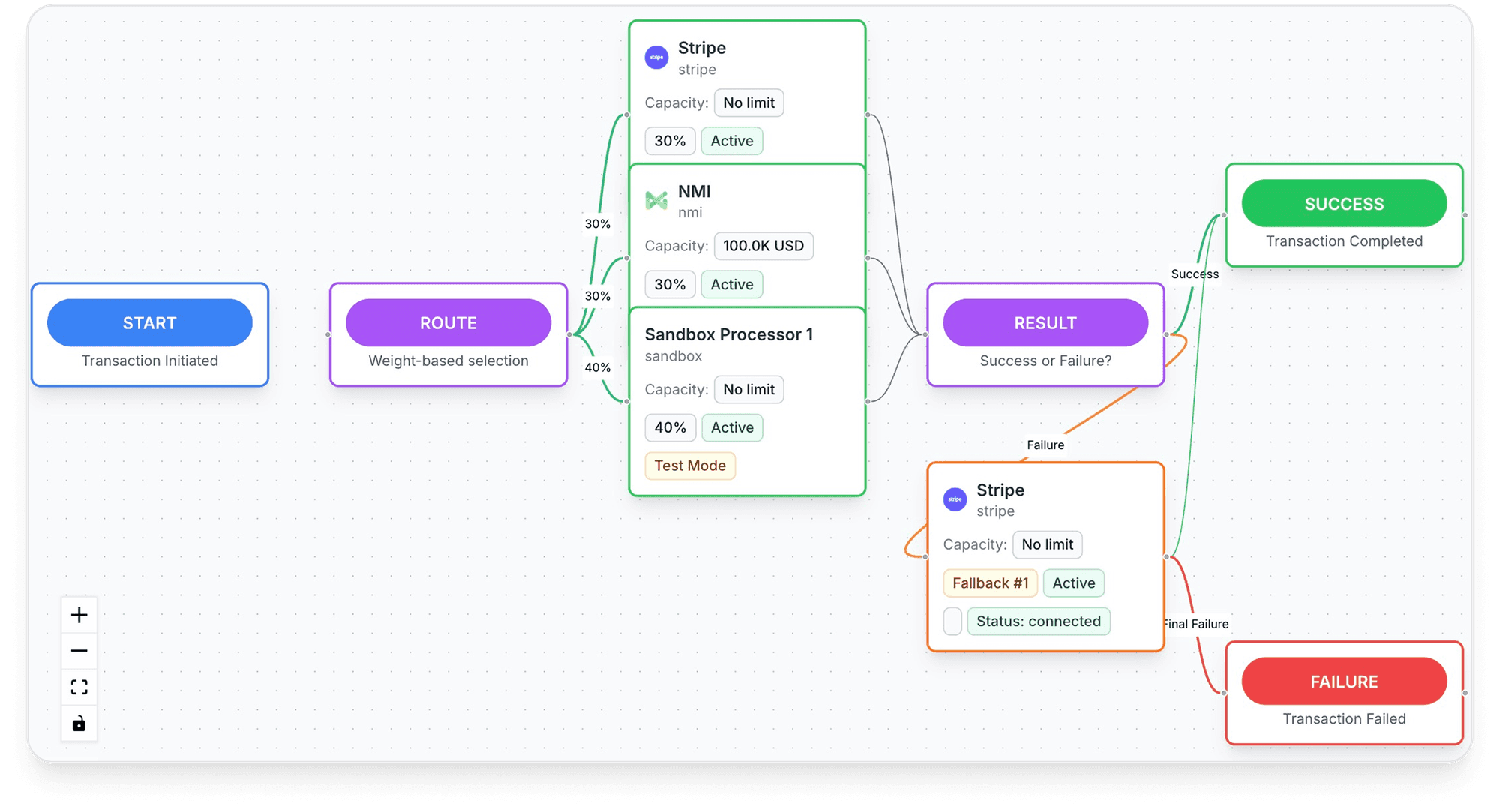
Payment routing sends each payment to the right processor; a backup processor takes over when the first one is down or times out. For an online pharmacy, every route must have approved and registered the pharmacy itself: a backup is a second approval, not a switch. Cascade outages and timeouts only, within card network retry rules.
- Mastercard requires the acquirer to register a non-face-to-face pharmacy (MCC 5122 or 5912) before it processes a single transaction (rules of August 4, 2026).
- Visa makes the acquirer register high-integrity-risk merchants, unless the pharmacy is accredited by NABP or another body Visa recognizes.
- Stripe approves pharmacies only in the US, Canada, the EU, Australia, the UK and Japan, and can revoke approval at any time.
- Shopify allows one credit card processor at a time in its checkout.
- Visa allows up to 20 attempts in 30 days for retryable declines and forbids retrying category 1 decline codes.
 ChatGPT
 Claude
 Perplexity
 Grok
On this page
This guide is part of our playbook on the best ecommerce platform for online pharmacies. The general guide, for any business: multiple merchant accounts. The processor side is covered in online pharmacy payment processing.
What payment routing does
| Routing type | How it works | Use for an online pharmacy |
|---|---|---|
| Cascade (failover) | A timeout or outage on A is retried on B | Recover orders lost while a processor is down or times out |
| Backup on outage | If A is down, payments go to B | Keep taking orders and refills during an outage |
| Rules-based | Choose the processor by country, currency or card type | Use each processor where it has approved you |
| Refill routing | Renewals run on a processor that can charge the saved card | Keep refill subscriptions running |
Fig. 1Two processors, both approved for your pharmacy
The backup takes over on an outage or timeout, never on a bank decline.
Every route must approve your pharmacy
A clothing store can add a backup processor in an afternoon. An online pharmacy cannot, because the card network rules sit with each acquirer.
| Requirement | Who it applies to |
|---|---|
| Register the pharmacy with Mastercard before acquiring its card-not-present pharmaceutical transactions | Each acquirer1Mastercard, Security Rules and Procedures, Merchant Edition, August 4, 2026, §9.4.3 and §9.2.1 |
| Verify the pharmacy's legality, for example with a legal opinion or third-party accreditation, at least every 12 months | Each acquirer1Mastercard, Security Rules and Procedures, Merchant Edition, August 4, 2026, §9.4.3 and §9.2.1 |
| Hold Visa approval for high-integrity-risk acquiring and register the merchant, unless the pharmacy is NABP-accredited or recognized by Visa | Each acquirer2Visa Core Rules and Visa Product and Service Rules, edition of October 24, 2026, §1.9.5.1, §1.7.2.1 and table 7-2 |
| Stripe: additional due diligence, pharmacies approved only in six regions | Stripe3Stripe Support, Prohibited and restricted businesses list FAQs, read November 2, 20264Stripe, Prohibited and restricted businesses, last updated September 22, 2026, read November 2, 2026 |
So a backup processor means a second application, a second review, and a second registration with the networks. Plan it before you need it, or launch on Tagada Rx, which includes payments and LegitScript. The approval itself is covered in how to get an online pharmacy merchant account approved.
Watch out
Mastercard can fine an acquirer up to $10,000 for processing an unregistered pharmacy, then more each month1Mastercard, Security Rules and Procedures, Merchant Edition, August 4, 2026, §9.4.3 and §9.2.1. A processor that "just adds you" as a backup without asking about your pharmacy is a risk, not a shortcut.
$10,000
Mastercard fine on the acquirer for an unregistered pharmacy, then more each month
12 months
Maximum time between legality checks by each acquirer (Mastercard)
20
Visa attempts allowed in 30 days
1.5%
Visa VAMP threshold for US merchants since April 1, 2026
Cascade rules that respect the card networks
| Do | Don't |
|---|---|
| Cascade to another processor when one is down or times out | Send an issuer decline to another processor: Visa forbids changing the acquirer to reattempt it, and category 1 codes must never be retried6Payway, Visa excessive reattempts rule and fees (rule effective April 2022), read October 26, 2026 (secondary source) |
| Keep total attempts within network limits | Exceed 20 attempts in 30 days2Visa Core Rules and Visa Product and Service Rules, edition of October 24, 2026, §1.9.5.1, §1.7.2.1 and table 7-2; Visa charges a fee per excess attempt6Payway, Visa excessive reattempts rule and fees (rule effective April 2022), read October 26, 2026 (secondary source) |
| Show one clear charge to the customer | Charge the same order twice on two processors |
| Use the same pharmacy name on all descriptors | Use descriptors the customer won't recognize |
| Log every route and decline code | Hide which processor took the payment |
Fig. 2When the backup helps, and when it doesn't
Issuer decline, category 1
- RefillSaved card
- routes toProcessor ADeclined by the issuerDeclined
Stop: never retried, not sent to another processor
Processor down
- RefillSaved card
- routes toProcessor ADown / timed outDeclined
- falls throughProcessor BApprovedApproved
Refill paid on the backup
The cascade answers an outage, never a no from the bank.
Tagada follows Visa and Mastercard rules and the laws that apply to payments.
Refills and saved cards
Refill subscriptions are where routing matters most, because renewals happen without the customer at the checkout.
- Saved cards are tokens held by a processor or a vault. Know where yours live before you add a backup.
- A refill can only run on a processor that can charge that card and has approved your pharmacy.
- Retries, card updates and routing work together: see failed payment recovery for online pharmacies.
- Changing processor without losing refill customers is covered on the payment side: switching payment processor for online pharmacies.
What routing is not
Routing is a resilience tool. It is not a way around a processor's decision or the networks' monitoring.
Not a way to keep selling after a processor refused you
Each processor must know you are a pharmacy and approve you as one.
Not a way to dilute disputes or fraud
Visa's VAMP threshold for US merchants is 1.5% since April 1, 20267Visa, Acquirer Monitoring Program (VAMP) fact sheet, 2025 v2. Splitting volume to stay under it fixes nothing and puts every account at risk.
Not a substitute for licenses and certification
The networks look at whether the pharmacy is legal1Mastercard, Security Rules and Procedures, Merchant Edition, August 4, 2026, §9.4.3 and §9.2.12Visa Core Rules and Visa Product and Service Rules, edition of October 24, 2026, §1.9.5.1, §1.7.2.1 and table 7-2, not at how many accounts it has.
Setup checklist
- Get a second processor that has reviewed and approved your pharmacy, and confirm it has registered you with Visa and Mastercard.
- Connect both to a checkout that can route between them; Shopify's own checkout allows one card processor at a time5Shopify Help Center, Configuring third-party payment providers, read October 26, 2026.
- Store cards so renewals can run on either route.
- Define the rules: cascade to another processor when one is down or times out, any rules by country or card type.
- Send a small share of live traffic to the backup every day, so it stays tested8Monstar Lab, 3 ways modern payment orchestration reduces risk, read October 26, 2026.
- Align descriptors and customer emails across processors.
Plan the backup before you need it.
Measure routing
| Metric | What it tells you |
|---|---|
| Approval rate by processor | Which processor performs best for which cards |
| Orders recovered by cascade | Revenue a single processor would have lost |
| Decline reasons by processor | Issuer problems vs. processor-side problems |
| Share of volume on backup | Whether the backup is really live |
| Refill success rate | Whether subscriptions survive declines |
How Tagada helps
Backup routes for a pharmacy every processor has approved
Tagada Rx takes payments off your plate: "Storefront, doctors, pharmacy and payments in one stack"11Tagada Rx, tagada.io/rx, read November 2, 2026, with "Payments and LegitScript included"11Tagada Rx, tagada.io/rx, read November 2, 2026. Payment follows the pharmacy: hold at checkout, capture on approval, rebill on ship day. It serves US patients and is open by application to a selected group of brands: see a telehealth stack with storefront, doctors, pharmacy and payments.
For brands that route their own payments:
- One vault, several processors: "Card data is vaulted once. Transactions flow to the best processor automatically"10Tagada docs, Multi-Stripe routing (Node SDK), read November 2, 2026
- Routing in TagadaPay's words: "Route to the processor most likely to approve it, retry on decline. No engineering required." and "Automatic cascade, weighted routing, sticky MID"12TagadaPay, tagadapay.io, read November 2, 2026; the cascade goes to another processor only when one is down or times out, never after a bank decline.
- Your processors or TagadaPay's: bring your own processor and keep "the acquiring relationship, the settlement and the risk", or use TagadaPay as a managed provider9Tagada docs, Payment processors, read November 2, 2026
- Portability: "Switch processors without re-onboarding customers."12TagadaPay, tagadapay.io, read November 2, 2026
- Fraud tools: "Native 3DS2, device intelligence, and rules engine"12TagadaPay, tagadapay.io, read November 2, 2026
TagadaPay applies "enhanced review for regulated verticals"12TagadaPay, tagadapay.io, read November 2, 2026.
Frequently asked questions
Can an online pharmacy use two payment processors?
What is a backup payment processor?
Can I add a second processor on Shopify?
Does routing help if my processor closes my pharmacy account?
Sources
Checked November 3, 2026- Mastercard, Security Rules and Procedures, Merchant Edition, August 4, 2026, §9.4.3 and §9.2.1
- Visa Core Rules and Visa Product and Service Rules, edition of October 24, 2026, §1.9.5.1, §1.7.2.1 and table 7-2
- Stripe Support, Prohibited and restricted businesses list FAQs, read November 2, 2026
- Stripe, Prohibited and restricted businesses, last updated September 22, 2026, read November 2, 2026
- Shopify Help Center, Configuring third-party payment providers, read October 26, 2026
- Payway, Visa excessive reattempts rule and fees (rule effective April 2022), read October 26, 2026 (secondary source)
- Visa, Acquirer Monitoring Program (VAMP) fact sheet, 2025 v2
- Monstar Lab, 3 ways modern payment orchestration reduces risk, read October 26, 2026
- Tagada docs, Payment processors, read November 2, 2026
- Tagada docs, Multi-Stripe routing (Node SDK), read November 2, 2026
- Tagada Rx, tagada.io/rx, read November 2, 2026
- TagadaPay, tagadapay.io, read November 2, 2026
Tagada Rx
Keep orders and refills running when one processor is down
Tagada Rx runs the stack behind your brand. Open by selection: every application is reviewed, and we reply to each one.
- 01Tell us about your brand
- 02We review every application
- 03Go live under your brand after review