
Convenience Fees: Who Can Charge One, and How
What a convenience fee is, Visa and Mastercard rules, why online-only stores can't charge one, state laws, and how it differs from a surcharge.

Article summary
TL;DR
A convenience fee is a flat charge for paying through an extra channel, such as online or by phone, when a business normally takes payments another way. Under Visa's rules it applies to every payment method in that channel, never to recurring payments, and a business that sells only online or by phone can't charge one.
- A convenience fee pays for a channel, not a card. If the fee disappears when the customer switches from credit to debit or bank transfer, it's a surcharge.
- Visa allows it in the US only for card-absent payments, as a flat amount, for every payment method in that channel, disclosed before payment with a chance to cancel.
- Under Visa's rules, a merchant that operates only online, by mail or by phone can't charge a convenience fee at all, and nobody can add one to a recurring or installment payment.
- Mastercard allows fees such as convenience fees when they apply to all like transactions, whatever the payment method.
- State law comes on top: surcharge bans catch card-only fees whatever their name, and California requires unavoidable fees to be in the advertised price.
 ChatGPT
 Claude
 Perplexity
 Grok
On this page
A convenience fee is the $2.50 a clinic, a school or a utility adds when you pay online instead of at the counter.
It's legal in most of the US, but only for some businesses: card network rules tie it to a payment channel, not to a card, and Visa shuts it to merchants that only sell online or by phone.
Here is who can charge one, what Visa and Mastercard require, which state laws apply, and what an online store can do instead.
Flat
A fixed amount under Visa's rules, the same whatever the payment amount
Card-absent
Only on online, mail or phone payments, never at the counter
Every method
Charged on all payment methods in that channel, debit and bank included
Never
On a Visa recurring or installment payment
What is a convenience fee?
Visa defines it as "a fee charged by a Merchant for a bona fide convenience to the Cardholder (for example: an alternative channel outside the Merchant's customary payment channel) that is not charged solely for the acceptance of the Card."1Visa Core Rules and Visa Product and Service Rules, October 24, 2026
In plain terms: you normally get paid one way, the customer chooses another way that costs you more to run, and you charge a flat fee for that choice.
Typical cases:
- A property manager that takes rent by check or bank transfer adds a fee for paying online.
- A clinic that collects at the front desk adds a fee for paying a bill through its patient portal.
- A school or a local government charges a fee for paying tuition, a permit or a fine online.
- A lender or a debt collector charges a fee for paying by phone. The CFPB calls this a "pay-to-pay fee" and says a debt collector can charge it only if the customer agreed to it when taking out the debt, or a law specifically allows it.3Consumer Financial Protection Bureau, What is a convenience fee or pay-to-pay fee? (last reviewed June 29, 2022)
What these cases share: the business has a usual way to get paid, and the fee applies to the extra one. That's what most online stores don't have.
Convenience fee vs surcharge vs service fee
The three names get mixed up on receipts, but card networks treat them as different things, each with its own test.1Visa Core Rules and Visa Product and Service Rules, October 24, 2026
| Convenience fee | Credit card surcharge | Service fee | |
|---|---|---|---|
| What triggers it | Paying through an extra channel | Paying by credit card | Paying in an eligible category |
| Who can charge it (Visa, US) | Merchants with a usual channel that isn't card-absent | Most merchants, where state law allows | Utilities, schools, courts, tax and government services only |
| Amount | Flat, whatever the payment amount | A percentage, capped at your cost and 3% on Visa | Reflects your card costs |
| Debit cards and bank payments | Same fee for every method in the channel | Never on debit or prepaid | Set by the category rules |
| Online-only store | Not allowed | ConditionalNetwork rules and state law | Not allowed |
| Recurring payments | Not allowed | Not banned by Visa's rules | Under conditions |
Verdict
The quick test: remove the card. If the fee stays when the customer pays by bank transfer in the same channel, it can be a convenience fee. If it disappears, it's a surcharge, and surcharge rules and state bans apply.
The full surcharge rules, caps and state bans are in our guide to the credit card surcharge. The service fee is limited in the US to utilities (MCC 4900), schools, courts, fines, tax payments and government services.1Visa Core Rules and Visa Product and Service Rules, October 24, 2026
Visa's convenience fee rules
Visa's rules for the US and Asia-Pacific (outside Australia since October 1, 2026) list the conditions in one table. A merchant that charges a convenience fee must make sure the fee is:1Visa Core Rules and Visa Product and Service Rules, October 24, 2026
- For a real alternative channel. Charged for a bona fide convenience outside your customary payment channels, and not charged only because the customer uses a card.
- Card-absent only. Added only to a transaction completed online, by mail or by phone.
- Not for online-only merchants. Not charged if you operate exclusively in a card-absent environment.
- Charged by you. Only by the merchant that provides the goods or services, not by a third party.
- The same for every method. Applied to all forms of payment you accept in that channel.
- Disclosed first. Shown as a charge for the convenience of the channel, before the transaction is completed, with a chance to cancel.
- Flat. A flat or fixed amount, whatever the value of the payment due.
- Inside the transaction. Included in the total amount, not collected separately.
- Alone. Not added on top of a surcharge.
- One-off. Not charged on a recurring or an installment transaction.
Visa Product and Service Rules, October 24, 2026, section 5.5.2.1, table 5-4, pages 401-402.
On the receipt, Visa requires the convenience fee to be shown separately and clearly, and no fee may be identified as a charge imposed by Visa.1Visa Core Rules and Visa Product and Service Rules, October 24, 2026
Not charged if the Merchant operates exclusively in a Card-Absent Environment
Why an online store can't charge one
For a store that sells only on its website, online is the customary channel. There is no other channel to compare it with, so a fee on every online payment is just a fee for paying, and Visa's table rules it out.
Adding a phone line doesn't change it: phone orders are card-absent too, so a business that sells online and by phone still operates exclusively in a card-absent environment.
The fee becomes possible when you have a real non-card-absent channel: a shop, a counter, a front desk, payment by check or by cash at delivery. Then online or phone payment is the extra channel, and the fee can apply to it.
Outside the US
Visa's convenience fee allowance is written for the US and Asia-Pacific. Since October 1, 2026, Australia is separate: only business payment solution providers under MCC 7399 may charge one, and only on Visa commercial credit cards.1Visa Core Rules and Visa Product and Service Rules, October 24, 2026
Elsewhere, Visa's general rule applies: a merchant must not add any amount over the advertised or normal price unless local law expressly requires that merchants be allowed to surcharge.1Visa Core Rules and Visa Product and Service Rules, October 24, 2026
In the EU, member states must ban charges for paying with consumer debit and credit cards and with SEPA transfers and direct debits (PSD2, article 62(4)).6Directive (EU) 2015/2366 (PSD2), Article 62
In the UK, a payee must not charge any fee for paying with a consumer card when both payment providers are in the UK (regulations 6A and 6B).7The Consumer Rights (Payment Surcharges) Regulations 2012, regulations 6A and 6B These bans look at the charge for paying by card, not at its name.
Mastercard's rule
Mastercard's global rule bans surcharges and then carves out fees that don't depend on the payment method:2Mastercard Rules, June 2, 2026
A Merchant is permitted to charge a fee (such as a bona fide commission, postage, expedited service or convenience fees, and the like) if the fee is imposed on all like transactions regardless of the form of payment used, or as the Corporation has expressly permitted in writing.
The same rule defines a surcharge as "any fee charged in connection with a Transaction that is not charged if another payment method is used." So Mastercard's test is the same as the quick test above: the fee must stay when the customer pays another way.
In the US, Mastercard rewrites rule 5.12.2 for credit card transactions to set its surcharge conditions, and in Canada it forbids a surcharge on a credit card transaction that already carries a convenience or service fee.2Mastercard Rules, June 2, 2026
If you also accept American Express or Discover, their rules apply to their cards. Ask your acquirer for the current text before you switch the fee on for every brand.
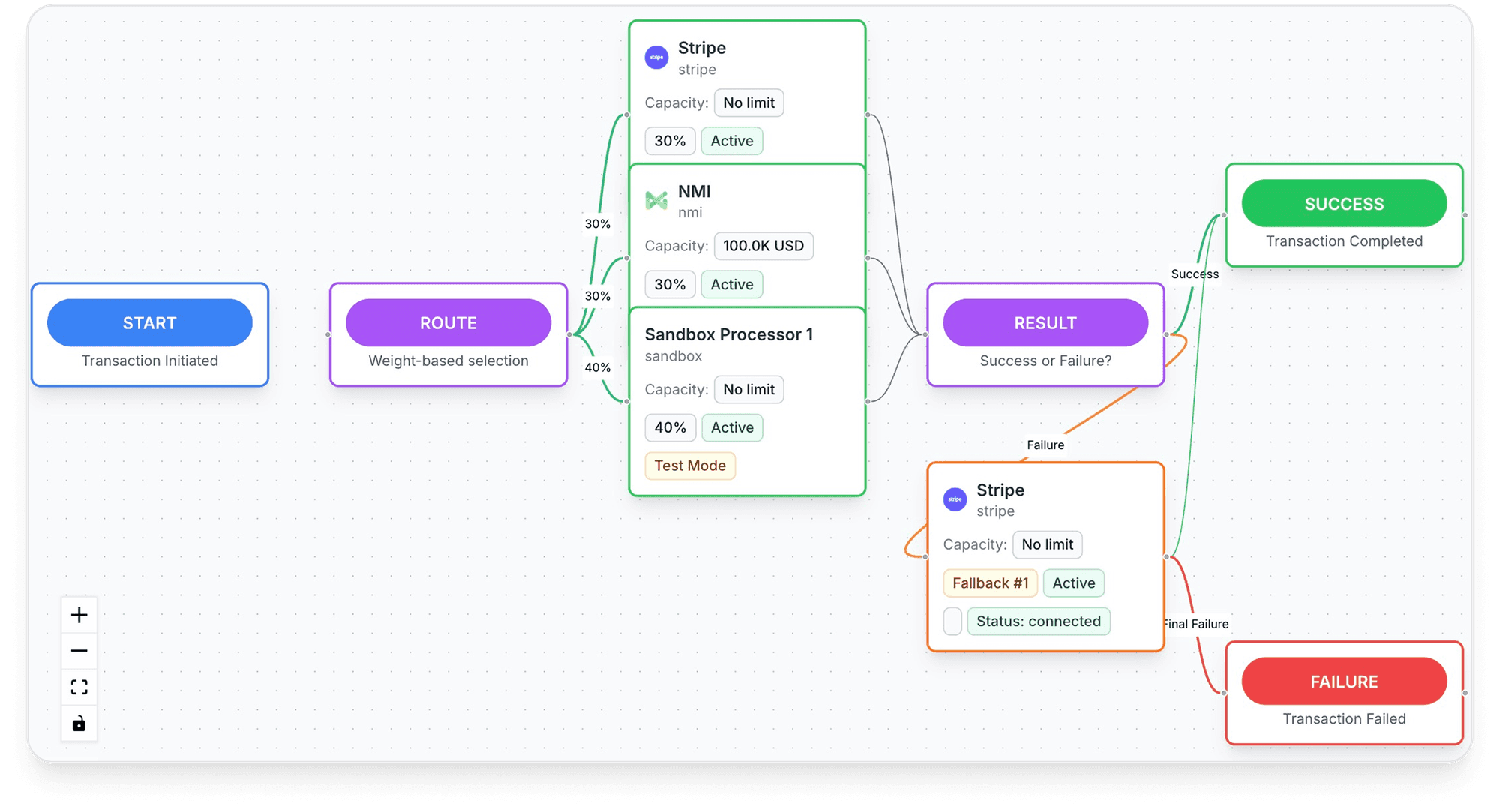
Inside Tagada
See every payment's route, processor by processor
Set the order your processors are tried in, per store, per country or per product.
State laws on convenience fees
Card network rules are a floor. State and federal law decide whether the fee can be charged at all, and how it's shown.
| Law | What it covers | What it means for a convenience fee |
|---|---|---|
| Surcharge bans (Connecticut, Massachusetts, Maine) | Fees for paying by card instead of cash or check | A fee charged only on card payments is a surcharge, whatever its label. Connecticut warns that illegal surcharges often appear as a "transaction fee", "processing fee" or "non-cash adjustment"5Connecticut Department of Consumer Protection, Credit card surcharge, read November 2, 2026 |
| California SB 478, since July 1, 2024 | Advertised prices for most goods and services sold to California consumers | A card fee isn't mandatory if the customer can avoid it by paying another way. If you only accept cards, the fee is mandatory and must be in the advertised price4California Department of Justice, Hidden fees (SB 478), read November 2, 2026 |
| Fair Debt Collection Practices Act (CFPB reading) | Debt collectors | A pay-to-pay fee is legal only if the customer agreed to it when taking on the debt, or a law specifically allows it3Consumer Financial Protection Bureau, What is a convenience fee or pay-to-pay fee? (last reviewed June 29, 2022) |
| EU and UK payment surcharge rules | Consumer card payments | NoCharge for paying by consumer card, whatever it's called6Directive (EU) 2015/2366 (PSD2), Article 627The Consumer Rights (Payment Surcharges) Regulations 2012, regulations 6A and 6B |
The California line matters for online sellers. A fee every online customer must pay is a mandatory fee: under SB 478 it belongs in the price you advertise, not in a line added at checkout.4California Department of Justice, Hidden fees (SB 478), read November 2, 2026
The state-by-state surcharge rules, including New York's, are in the table of our credit card surcharge guide. Laws change and some states regulate fees charged by government bodies or lenders separately: check your state before charging.
How to show a convenience fee at checkout
When the fee is allowed, the disclosure carries the compliance. Visa requires it before the transaction is completed, labeled as a charge for the channel, with a way to cancel.1Visa Core Rules and Visa Product and Service Rules, October 24, 2026
Fig. 1A compliant convenience fee line
- Invoice
- $180.00
- Online payment convenience fee
- $2.50 flat
- Applies to
- Card, debit card and bank account payments in the portal
- Notice
- This fee is for the convenience of paying online. Pay at the front desk to avoid it.
- Total
- $182.50
- Option
- Cancel without paying
Illustrative record.
same fee for card and bank, cancel before paying
Then keep it consistent: the same amount on every card brand and every method in the channel, a separate line on the receipt, and no wording that suggests Visa or your bank charges it.1Visa Core Rules and Visa Product and Service Rules, October 24, 2026
What happens if you get it wrong
- A 3% convenience fee on every online orderIt's a percentage, card-absent only, from an online-only merchant: three breaches of Visa's tableRemove it, or turn it into a compliant credit card surcharge where allowed
- The fee applies only when the customer pays by cardIt's a surcharge under network rules and state bansApply surcharge rules, or charge the same fee on every method
- A convenience fee plus a credit card surchargeVisa lets the customer's bank recover the surcharge through a compliance caseCharge one or the other, never both
- A fee on each subscription renewalVisa forbids convenience fees on recurring and installment paymentsBuild the cost into the plan price
- The fee appears after the customer paysNo disclosure before completion, no chance to cancelShow it before the pay button, with a cancel option
The compliance case is written in Visa's rules: in the US and Canada, a customer's bank can file for compliance when a convenience fee, service fee or similar charge was applied to a transaction that included a credit card surcharge, and it recovers the surcharge amount.1Visa Core Rules and Visa Product and Service Rules, October 24, 2026
Beyond that, a fee outside the rules is a breach of your merchant agreement, which your acquirer can act on. Disputes it triggers count in your chargeback rate.
What an online store can do instead
If you sell only online, the convenience fee is off the table on Visa. The options that remain:
Build costs into prices
Card fees become part of the price, like rent or shipping. Nothing to disclose, nothing to refund separately, and California's rule on mandatory fees is met by design.
Discount a cheaper method
In the US, Visa lets you offer a discount, a rebate or another benefit for using another payment method, and tell customers what each method costs you. Mastercard allows discounts for cash.
Surcharge credit cards
A percentage on credit cards only, capped at your cost and 3% on Visa, with 30 days' notice to your acquirer, where your state allows it. Never on debit.
Lower the cost itself
Read your statement, move to interchange-plus pricing if you're on a flat rate, and route each payment to the processor that costs less for that card.
Sources for the discount options: Visa Core Rules section 1.5.4.11 and Mastercard rule 5.12.2.1Visa Core Rules and Visa Product and Service Rules, October 24, 20262Mastercard Rules, June 2, 2026 The surcharge conditions are detailed in our credit card surcharge guide. To see what your card costs actually are, start with how to read a merchant statement and the payment processing fees guide; for routing, see dynamic payment routing.
How Tagada helps
Lower card costs without a fee at checkout
Tagada follows Visa and Mastercard rules and the laws that apply to payments. TagadaPay scores every transaction against your live MID network in real time and routes it to the processor most likely to approve it, with retry on decline. Already on Stripe, NMI or Airwallex? TagadaPay orchestrates those too, from one checkout. Pricing is on the pricing page.
Frequently asked questions
Is it legal to charge a convenience fee?
Can an online business charge a convenience fee?
What is the difference between a convenience fee and a surcharge?
How much can a convenience fee be?
Can you charge a convenience fee on debit cards?
Can you charge a convenience fee on subscription payments?
Sources
Checked November 2, 2026- Visa Core Rules and Visa Product and Service Rules, October 24, 2026
- Mastercard Rules, June 2, 2026
- Consumer Financial Protection Bureau, What is a convenience fee or pay-to-pay fee? (last reviewed June 29, 2022)
- California Department of Justice, Hidden fees (SB 478), read November 2, 2026
- Connecticut Department of Consumer Protection, Credit card surcharge, read November 2, 2026
- Directive (EU) 2015/2366 (PSD2), Article 62
- The Consumer Rights (Payment Surcharges) Regulations 2012, regulations 6A and 6B
TagadaPay
Lower your card costs instead of passing them on
Tell us what you sell and how you sell it. Each application is underwritten, and approval is not guaranteed.
- 01Tell us what you sell and how
- 02Underwriting reviews your business
- 03Process through TagadaPay alongside your other processors