
High-Risk Processing Fees
High-risk processing fees explained: what the card networks set, what your processor sets, published ranges, network fees, reserves and your effective rate.

Article summary
TL;DR
A high-risk merchant pays the same card network costs as everyone else, plus a higher processor markup, a rolling reserve and some network fees that only apply to high-risk categories. Published processor rates for high-risk files start around 3% to 4% per sale, unsourced. Compare offers on your effective rate: every fee divided by your sales.
- On Visa's April 2026 US table, a $100 online sale costs $1.99 of interchange on a basic credit card and $2.70 on a top-tier rewards card.
- Interchange is the same for every merchant. The processor's markup, monthly fees and reserve are what you negotiate.
- Published high-risk reserves: "typically 5 to 10% of your processing volume".
- Mastercard's registration for high-risk merchants is $500 a year in its 2025 rules; PaymentCloud reports $1,000 since May 1, 2026.
- Stripe charges $15 per dispute in the US, plus $15 to contest it, refunded if you win.
 ChatGPT
 Claude
 Perplexity
 Grok
On this page
High-risk pricing looks opaque because three parties take a share and only one of them sends you the bill. This guide splits the fee into its parts, shows which ones you can move, and how to compare two offers.
What you pay, and who sets it
| Part of the fee | Who sets it | Can you negotiate it? |
|---|---|---|
| Interchange | Visa and Mastercard tables, paid to the customer's bank | NoSame table for every merchant1Visa, Visa USA Interchange Reimbursement Fees, April 18, 2026 |
| Scheme fees | Visa and Mastercard | No |
| High-risk network fees | Visa and Mastercard programs | NoBut you can avoid triggering them |
| Processor markup | Your processor | Yes |
| Monthly and per-item fees | Your processor | Yes |
| Rolling reserve | Your processor | YesWith history |
| Dispute fees | Your processor | Sometimes |
The first three are pass-through costs. Everything below is the processor's price for carrying your risk. More on each line: interchange fees, scheme fees, what a transaction fee includes.
What interchange costs online
Interchange is usually the largest line, and it's higher online than in store because remote payments carry more fraud risk.
| Card, $100 online sale | Visa US interchange |
|---|---|
| Basic consumer credit card | $1.991Visa, Visa USA Interchange Reimbursement Fees, April 18, 2026 |
| Top-tier rewards credit card | $2.701Visa, Visa USA Interchange Reimbursement Fees, April 18, 2026 |
Fig. 1Where a high-risk fee goes
Interchange
Paid to the customer's bank. Same Visa and Mastercard table for every merchant.
Scheme and network fees
Paid to Visa and Mastercard, plus high-risk programs you can avoid triggering.
Processor share
Markup, monthly fees, dispute fees and reserve. This is what you negotiate.
Only the third share is on the table.
Pricing models
| Model | How it works | What to watch |
|---|---|---|
| Interchange plus | Interchange and scheme fees at cost, plus a fixed markup | The most readable: the markup is the processor's price. See pass-through pricing |
| Blended or flat | One rate for every card | Simple, but you pay the same on a cheap debit card as on a rewards card. See blended rate |
| Tiered | Cards sorted into qualified, mid-qualified and non-qualified buckets | The processor decides which bucket a card falls into |
For a high-risk file, ask for interchange plus when you can. It makes two offers comparable line by line.
What processors publish
Few high-risk processors publish prices. These are the figures we found, read in October 2026. They're the processors' own, not Tagada's.
| Term | Published figure | Published by |
|---|---|---|
| Processing rate | "As low as a blended 2.95%" | Corepay4Corepay, nutraceutical merchant account page, read October 2026 |
| Processing rate | 3.49% to 3.95% per transaction, about $0.25 per sale | PaymentCloud, unsourced2PaymentCloud, High-risk merchant account fees, read October 27, 2026 (figures without a stated source) |
| Monthly account fee | $10 to $50 | PaymentCloud, unsourced2PaymentCloud, High-risk merchant account fees, read October 27, 2026 (figures without a stated source) |
| Rolling reserve | "Typically 5 to 10% of your processing volume" | Soar Payments3Soar Payments, published nutraceutical merchant account terms, read October 2026 |
| Reserve review | "Every 60 to 90 days" | Soar Payments3Soar Payments, published nutraceutical merchant account terms, read October 2026 |
"As low as" is a floor, not a quote. Treat every range as a starting point for negotiation.
Network fees that only hit high-risk merchants
| Fee | Amount |
|---|---|
| Mastercard high-risk merchant registration | $500 a year in the February 2025 rules; $1,000 since May 1, 2026, as reported (Mastercard, PaymentCloud)5Mastercard Security Rules and Procedures, Merchant Edition, February 11, 2025, section 9.2.16PaymentCloud, Mastercard raises high-risk registration fee, read October 27, 2026 (secondary source) |
| Mastercard specialty merchant transaction fee | $0.02 per transaction from June 3, 2026, as reported (PaymentCloud)6PaymentCloud, Mastercard raises high-risk registration fee, read October 27, 2026 (secondary source) |
| Mastercard specialty merchant volume fee | 0.10% of volume from June 3, 2026, as reported (PaymentCloud)6PaymentCloud, Mastercard raises high-risk registration fee, read October 27, 2026 (secondary source) |
| Visa VAMP, "Excessive" tier | $8 per fraud report or dispute, as reported (Chargeback Gurus)7Chargeback Gurus, Visa VAMP fees, May 27, 2025 (secondary source) |
| Visa excess reattempts | $0.10 per excess retry domestic, plus $0.05 cross-border, as reported (Payway)8Payway, Visa excessive reattempts rule and fees, read October 26, 2026 (secondary source) |
Tagada follows Visa and Mastercard rules and the laws that apply to payments.
The last two are avoidable: keep disputes far below the thresholds, see chargeback monitoring programs, and retry declines within the network limits, see payment acceptance rate.
Dispute and platform fees
| Fee | Amount |
|---|---|
| Stripe dispute fee, US | $15 per dispute, plus $15 to contest, refunded if you win (Stripe)9Stripe Support, June 2025 pricing updates for disputes, read October 14, 2026 |
| Shopify fee for a third-party processor | 2% on Basic, 1% on Grow, 0.6% on Advanced, 0.2% on Plus (Shopify)11Shopify pricing, third-party payment provider fees, read October 26, 2026 |
High-risk processors often charge more per dispute, and one dispute weighs more on a large order: see high-ticket payment processing. Ask for the number, and for the fee per alert if you use chargeback alerts.
The reserve is a cost too
A reserve isn't a fee: the money comes back. But it's cash you can't use for stock or ads while it's held. Stripe sizes reserves on your industry, payment activity, dispute and refund rates, and financial stability10Stripe Support, Reserves FAQ, read October 14, 2026.
Example
$50,000 of monthly sales with a 10% reserve held 90 days keeps about $15,000 aside at any time. That's inventory you can't buy.
How reserves work and how to get them released: rolling reserves.
Your effective rate, worked out
The effective rate is every fee you paid in a month divided by your card sales. It's the only number that compares two offers fairly.
| Line, one month | Amount |
|---|---|
| Card sales | $50,000 from 1,000 orders |
| Percentage fee, 3.5% | $1,750 |
| Per-sale fee, $0.25 × 1,000 | $250 |
| Monthly fees | $50 |
| Disputes, 5 × $25 | $125 |
| Total fees | $2,175 |
| Effective rate | 4.35% |
Illustrative assumptions, not a quote. Reserve held on top: about $15,000 at a 10% reserve over 90 days.
Your own statement gives the real figure: how to read a merchant statement.
How to read a high-risk quote
- [ ] Model: interchange plus, blended or tiered, in writing.
- [ ] Markup: percentage and fixed fee per sale, and the same for international cards and wallets.
- [ ] Monthly fees: account, gateway, PCI, minimum, statement.
- [ ] Disputes: fee per chargeback, per alert, per retrieval request.
- [ ] Reserve: percentage, period, review date.
- [ ] Network fees: which ones are passed through, at cost or with a margin.
- [ ] Exit: early termination fee, and how long the balance is held after you leave.
Fig. 2A high-risk quote, read line by line
- 1. Model
- Interchange plus, in writing
- 2. Markup
- Domestic cards only, international not stated
- 3. Monthly fees
- Account, gateway and PCI listed
- 4. Disputes
- Fee per chargeback and per alert
- 5. Reserve
- Percentage given, no review date
- 6. Network fees
- Passed through at cost
- 7. Exit
- Balance held period stated
Illustrative record, not real data.
Two missing lines are enough to make an offer look cheaper than it is.
How to lower your fees legitimately
- Lower disputes. It's the main driver of high-risk pricing and of network fees.
- Send full data. Address verification, 3D Secure where it helps, and clear descriptors cut fraud and disputes.
- Retry declines within the rules. Excess retries cost a fee per attempt8Payway, Visa excessive reattempts rule and fees, read October 26, 2026 (secondary source).
- Ask for interchange plus so you see the markup and can negotiate it.
- Ask for a reserve review after a few clean months, with your statements.
- Compare effective rates, not headline rates.
The networks' costs don't move. Your risk does, and the processor's price follows it.
By industry
| Industry | What changes | Guide |
|---|---|---|
| Supplements | Subscriptions and trials raise reserves; Mastercard registration may apply | Supplement processing fees and reserves |
| Skincare | Subscriptions and claims drive the pricing | Skincare processing fees and reserves |
How Tagada helps
Fees you can read, across several processors
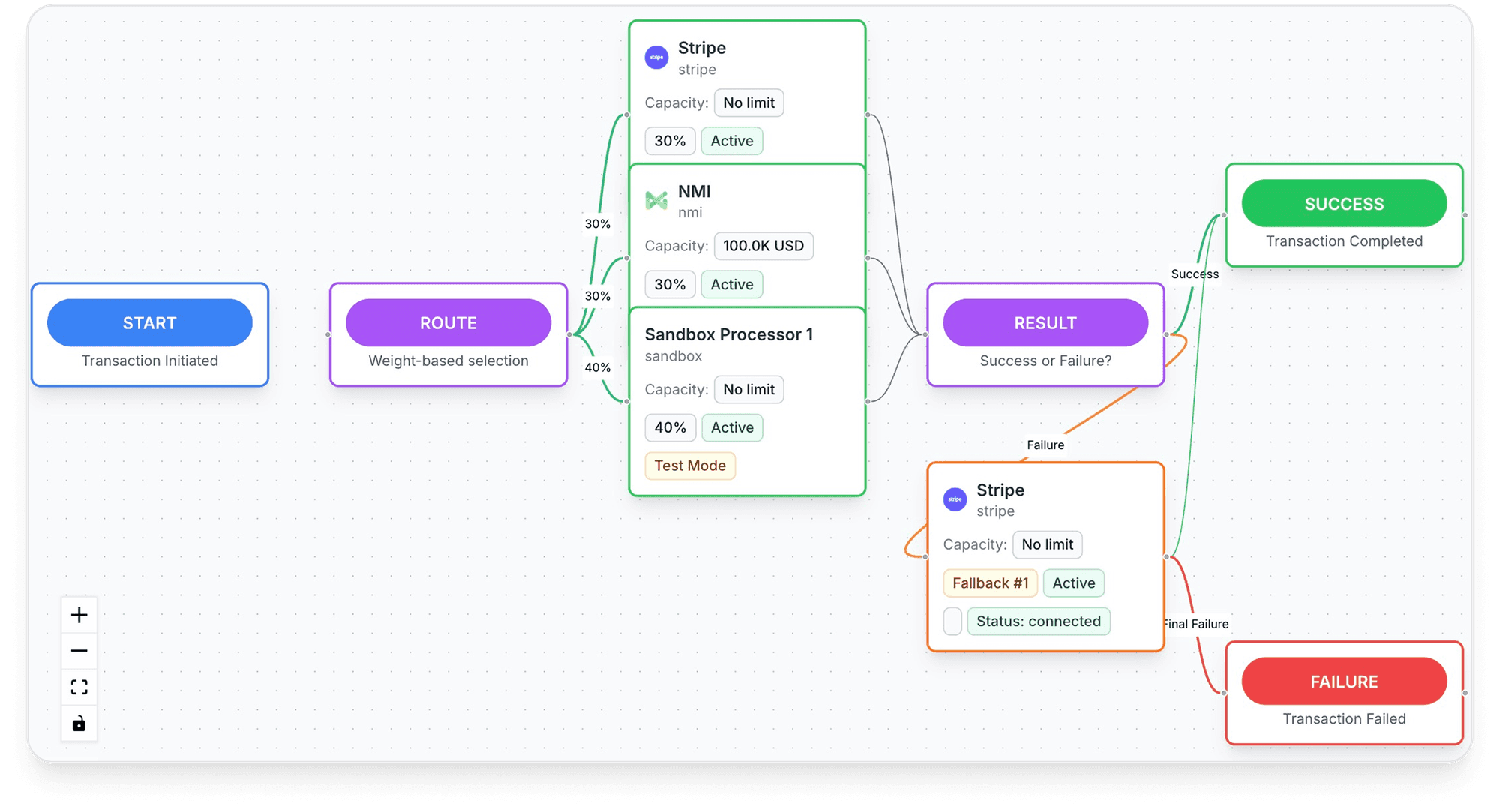
- Routing across Stripe, Adyen and TagadaPay with one logic, so one account's terms don't decide all your volume.
- Cascade on decline to another processor.
- Native 3DS2, device intelligence and a rules engine to keep fraud disputes down.
- Subscriptions with retries and automatic recovery.
Plans and rates are on the pricing page.
Frequently asked questions
How much does a high-risk merchant account cost?
Why are high-risk processing fees higher?
Is interchange plus better for high-risk merchants?
Can I negotiate high-risk fees?
What is a good effective rate for a high-risk merchant?
Sources
Checked October 27, 2026- Visa, Visa USA Interchange Reimbursement Fees, April 18, 2026
- PaymentCloud, High-risk merchant account fees, read October 27, 2026 (figures without a stated source)
- Soar Payments, published nutraceutical merchant account terms, read October 2026
- Corepay, nutraceutical merchant account page, read October 2026
- Mastercard Security Rules and Procedures, Merchant Edition, February 11, 2025, section 9.2.1
- PaymentCloud, Mastercard raises high-risk registration fee, read October 27, 2026 (secondary source)
- Chargeback Gurus, Visa VAMP fees, May 27, 2025 (secondary source)
- Payway, Visa excessive reattempts rule and fees, read October 26, 2026 (secondary source)
- Stripe Support, June 2025 pricing updates for disputes, read October 14, 2026
- Stripe Support, Reserves FAQ, read October 14, 2026
- Shopify pricing, third-party payment provider fees, read October 26, 2026
TagadaPay
See where every cent of your fee goes
Tell us what you sell and how you sell it. Each application is underwritten, and approval is not guaranteed.
- 01Tell us what you sell and how
- 02Underwriting reviews your business
- 03Process through TagadaPay alongside your other processors