
Supplement Processing Fees and Reserves
What supplement brands pay to process cards: published rates and reserves, how a rolling reserve ties up cash, network fees, what to ask first.



Article summary
TL;DR
Supplement brands pay a processing rate above standard retail pricing, often keep a rolling reserve of 5% to 10% of sales, and carry network costs such as subscription registration and dispute fees. Few processors publish their numbers. Ask for five terms in writing before signing: rate, reserve percentage, reserve period, payout delay, and what happens to your balance when you leave.
- Soar Payments publishes rolling reserves of "typically 5 to 10% of your processing volume".
- Corepay advertises rates "as low as a blended 2.95%"; "as low as" is a floor, not a quote.
- Mastercard's registration for negative option billing merchants costs $500 a year in its February 2025 rules; PaymentCloud reports $1,000 since May 1, 2026.
- Visa charges a fee for each retry beyond its limits: $0.10 domestic plus $0.05 cross-border, as reported by Payway.
- On Shopify, a third-party processor adds 0.2% to 2% per order.
 ChatGPT
 Claude
 Perplexity
 Grok
On this page
This guide is part of our hub on nutraceutical payment processing. The general guides, for any business: high-risk processing fees and rolling reserves.
What you pay
| Cost | What it is | Who sets it |
|---|---|---|
| Processing rate | A percentage plus a fixed fee per transaction | Your processor |
| Rolling reserve | A share of each sale held for a period, then released | Your processor |
| Dispute fees | Per chargeback, and per alert if you use alerts | Processor and alert providers |
| Network programs | Fees when you exceed Visa or Mastercard thresholds | Visa, Mastercard8Chargeback Gurus, Visa VAMP fees, May 27, 2025 (secondary source) |
| Registration | Annual fee for negative option billing merchants | Mastercard6Mastercard Security Rules and Procedures, Merchant Edition, February 11, 2025, section 9.2.1 |
| Retry fees | Visa fees on excess reattempts | Visa9Payway, Visa excessive reattempts rule and fees, read October 26, 2026 (secondary source) |
| Platform fees | Shopify's fee when you don't use Shopify Payments | Shopify10Shopify pricing, third-party payment provider fees, read October 26, 2026 |
What processors publish
These are the processors' own figures, not Tagada's, read in October 2026.
| Term | Published figure | Published by |
|---|---|---|
| Rolling reserve | "Typically 5 to 10% of your processing volume" | Soar Payments1Soar Payments, published nutraceutical merchant account terms, read October 2026 |
| Reserve review | "Every 60 to 90 days" | Soar Payments1Soar Payments, published nutraceutical merchant account terms, read October 2026 |
| Rate | "As low as a blended 2.95%" | Corepay2Corepay, nutraceutical merchant account page, read October 2026 |
| Monthly minimum | None of the six processors we read publishes one | Our reading |
5 to 10%
Rolling reserve Soar Payments publishes as typical
60 to 90 days
How often Soar Payments reviews the reserve
2.95%
Corepay's "as low as" blended rate, a floor, not a quote
Online guides quote wider ranges for rates and reserves, usually without a source. Treat any range as a starting point for negotiation, not a price.
How a rolling reserve works
A rolling reserve keeps a share of each day's sales and releases it after a set period.
Example
You sell $100,000 a month with a 10% reserve held 90 days. Each month $10,000 is held. After three months, about $30,000 sits in reserve at any time, and month 1's $10,000 comes back in month 4.
| Monthly sales | Reserve | Period | Cash held at steady state |
|---|---|---|---|
| $50,000 | 5% | 90 days | About $7,500 |
| $100,000 | 10% | 90 days | About $30,000 |
| $100,000 | 10% | 180 days | About $60,000 |
Simple arithmetic on the reserve terms; real releases follow your contract's schedule.
Fig. 1The reserve from the example, coming back month by month
Held at steady state
$30,000
- $10,000Held until month 4Paid back month 4
- $10,000Held until month 5Paid back month 5
- $10,000Held until month 6Paid back month 6
Each month's 10% returns three months later.
Plan this cash before launching a big promotion: reserves grow with sales. How payouts and reserves interact: payout timing for supplement brands.
Reserves at Stripe and PayPal
| Provider | How reserves work | Source |
|---|---|---|
| Stripe | Two types, fixed and rolling; "a temporary hold on a portion of a business's funds for a predetermined period of time"; "in some rare cases" indefinite | Stripe3Stripe Support, Reserves: frequently asked questions, read October 26, 2026 |
| PayPal | Rolling, minimum and jumpstart reserves; example: "10% and held for a 90-day rolling period"; minimum reserves "reviewed within every 180 days" | PayPal4PayPal, The why and what of account reserves, November 17, 20255PayPal User Agreement, updated September 14, 2026 |
PayPal warns "you might never be able to fully remove a reserve from your account"4PayPal, The why and what of account reserves, November 17, 2025.
Network and platform costs
| Cost | Amount | Source |
|---|---|---|
| Mastercard negative option registration | $500 a year (February 2025 rules); $1,000 since May 1, 2026 as reported | Mastercard6Mastercard Security Rules and Procedures, Merchant Edition, February 11, 2025, section 9.2.1, PaymentCloud7PaymentCloud, on Mastercard's registration fee from May 1, 2026 (secondary source) |
| Visa VAMP, "Excessive" level | $8 per fraud report or dispute, as reported | Chargeback Gurus8Chargeback Gurus, Visa VAMP fees, May 27, 2025 (secondary source) |
| Visa excess reattempts | $0.10 per excess attempt domestic, plus $0.05 cross-border | Payway9Payway, Visa excessive reattempts rule and fees, read October 26, 2026 (secondary source) |
| Shopify third-party processor | 2% Basic, 1% Grow, 0.6% Advanced, 0.2% Plus | Shopify10Shopify pricing, third-party payment provider fees, read October 26, 2026 |
Fig. 2Shopify's fee on orders paid through a third-party processor
Tagada follows Visa and Mastercard rules and the laws that apply to payments.
Avoiding the dispute costs: chargebacks for supplement brands.
What to ask before you sign
- [ ] Rate: percentage and fixed fee, for cards, wallets and international cards.
- [ ] Reserve: percentage, period, and when it's reviewed.
- [ ] Payouts: delay after capture, and frequency.
- [ ] Disputes: fee per chargeback, and per alert.
- [ ] Limits: monthly volume cap and approved products.
- [ ] Leaving: notice period, and how long the balance and reserve are held after.
- [ ] Changes: how reserve changes are communicated, and with what notice.
How Tagada helps
Don't let one account's terms set all your costs
- TagadaPay lists "Supplements / nutra" among its industries; each file is underwritten, with enhanced review on regulated verticals
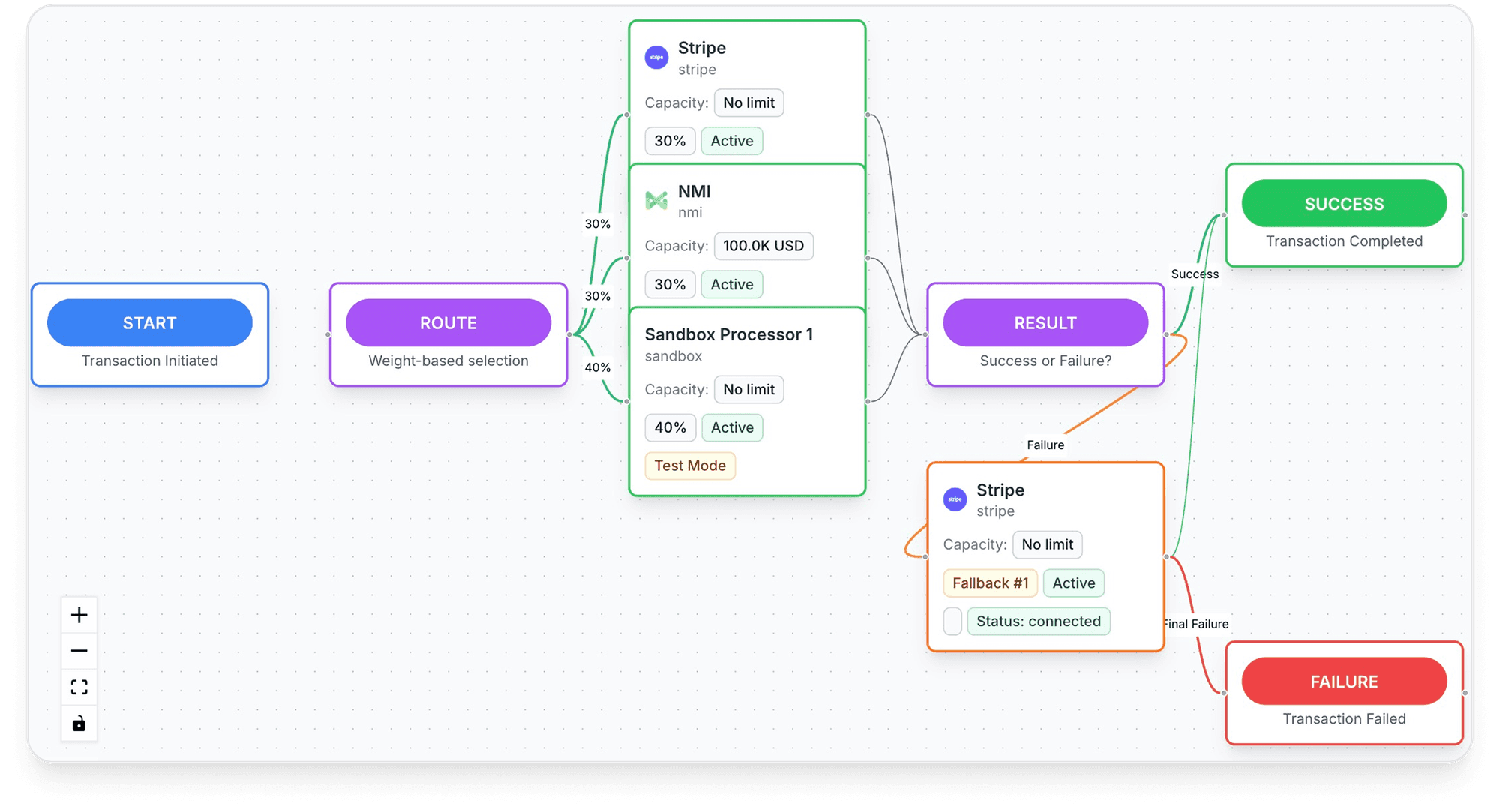
- Routing across Stripe, Adyen and TagadaPay, cascade on decline, so one account's terms don't decide all your volume
- Subscriptions with retries and automatic recovery
- Native 3DS2, device intelligence and a rules engine to keep fraud disputes down
Plans and rates are on the pricing page.
Frequently asked questions
How much does a nutraceutical merchant account cost?
What is a normal rolling reserve for a supplement brand?
Can I negotiate the reserve?
Why do supplement brands pay more for card processing?
Sources
Checked October 26, 2026- Soar Payments, published nutraceutical merchant account terms, read October 2026
- Corepay, nutraceutical merchant account page, read October 2026
- Stripe Support, Reserves: frequently asked questions, read October 26, 2026
- PayPal, The why and what of account reserves, November 17, 2025
- PayPal User Agreement, updated September 14, 2026
- Mastercard Security Rules and Procedures, Merchant Edition, February 11, 2025, section 9.2.1
- PaymentCloud, on Mastercard's registration fee from May 1, 2026 (secondary source)
- Chargeback Gurus, Visa VAMP fees, May 27, 2025 (secondary source)
- Payway, Visa excessive reattempts rule and fees, read October 26, 2026 (secondary source)
- Shopify pricing, third-party payment provider fees, read October 26, 2026
TagadaPay
Know what you pay and what they hold
Tell us what you sell and how you sell it. Each application is underwritten, and approval is not guaranteed.
- 01Tell us what you sell and how
- 02Underwriting reviews your business
- 03Process through TagadaPay alongside your other processors