
A customer places an order, sees a pending transaction, and contacts support because the available balance has changed even though the order hasn't shipped. Your operations team checks the payment dashboard and sees an approved authorization, not a settled charge. Meanwhile, fulfillment is delayed, the original authorization window is approaching, and nobody is certain whether to capture, void, or reauthorize.
That gap between payment approval and completed fulfillment is where merchants lose conversions, create duplicate holds, and trigger avoidable disputes. A credit card pre authorization hold isn't difficult to understand in isolation. The operational challenge is managing its expiry, amount, capture status, and customer visibility across ecommerce, high-risk products, subscriptions, and multiple payment service providers.
What Is a Credit Card Pre Authorization Hold
A customer can place an order and see a pending hold before any money reaches the merchant. The issuer has reserved part of the customer's available credit or funds, but the merchant hasn't captured the payment. If the merchant later completes the transaction, the authorization can become a posted charge. If the order is cancelled or the authorization expires without capture, the reserved amount is released according to the issuer's process.
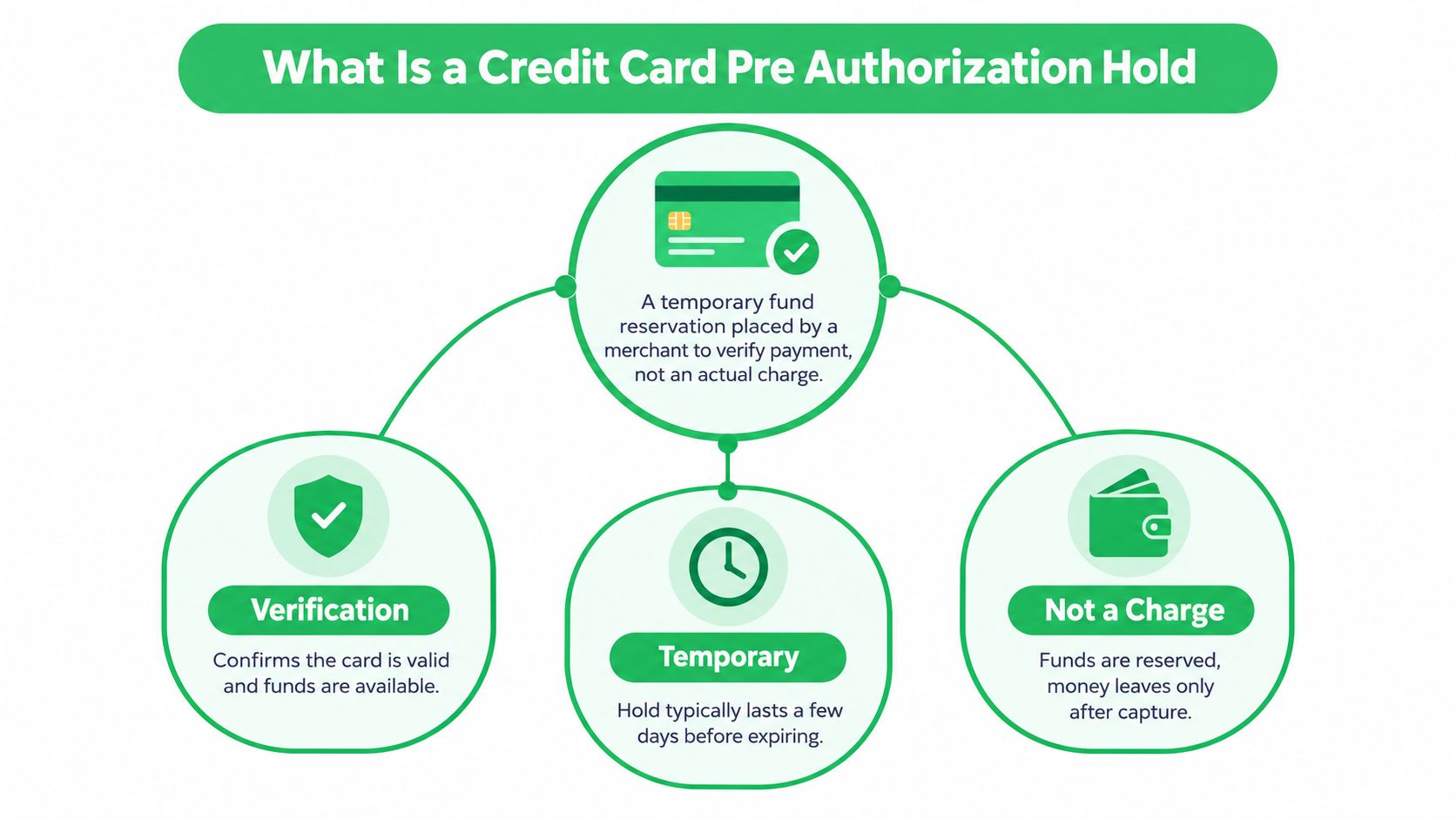
Consider a customer booking a hotel room or starting a vehicle rental. The final amount may depend on additional nights, fuel, incidentals, or other variable charges. The merchant needs evidence that the card is valid and that funds are available before providing the service, but the final amount isn't known at the first payment event. Retail, travel, lodging, vehicle rentals, and entertainment use the same basic mechanism for this reason, as described in Visa payment authorization guidance.
A gas station can also place a hold that exceeds the eventual fuel purchase. Consumer guidance gives the example of a $75 hold for a final purchase that is much smaller, because the merchant needs to verify available funds before the exact total is known. The hold reduces the customer's available balance immediately, but the money hasn't moved to the merchant at that stage, as explained by Consumer Action's authorization hold guidance.
Practical rule: Treat a pending authorization as reserved spending power, not revenue. Revenue becomes collectable only after a valid capture succeeds.
The distinction matters for ecommerce teams. An authorization can protect against fulfilling an order for a customer whose available funds disappear before shipment, but it also consumes part of that customer's spending capacity. A larger-than-necessary hold can create friction, especially when a customer is using a debit card or has limited available credit. The right objective isn't to hold as much as possible. It's to reserve a defensible amount, communicate it clearly, and capture or release it before the authorization becomes operationally dangerous.
How Authorization Holds Work Step by Step
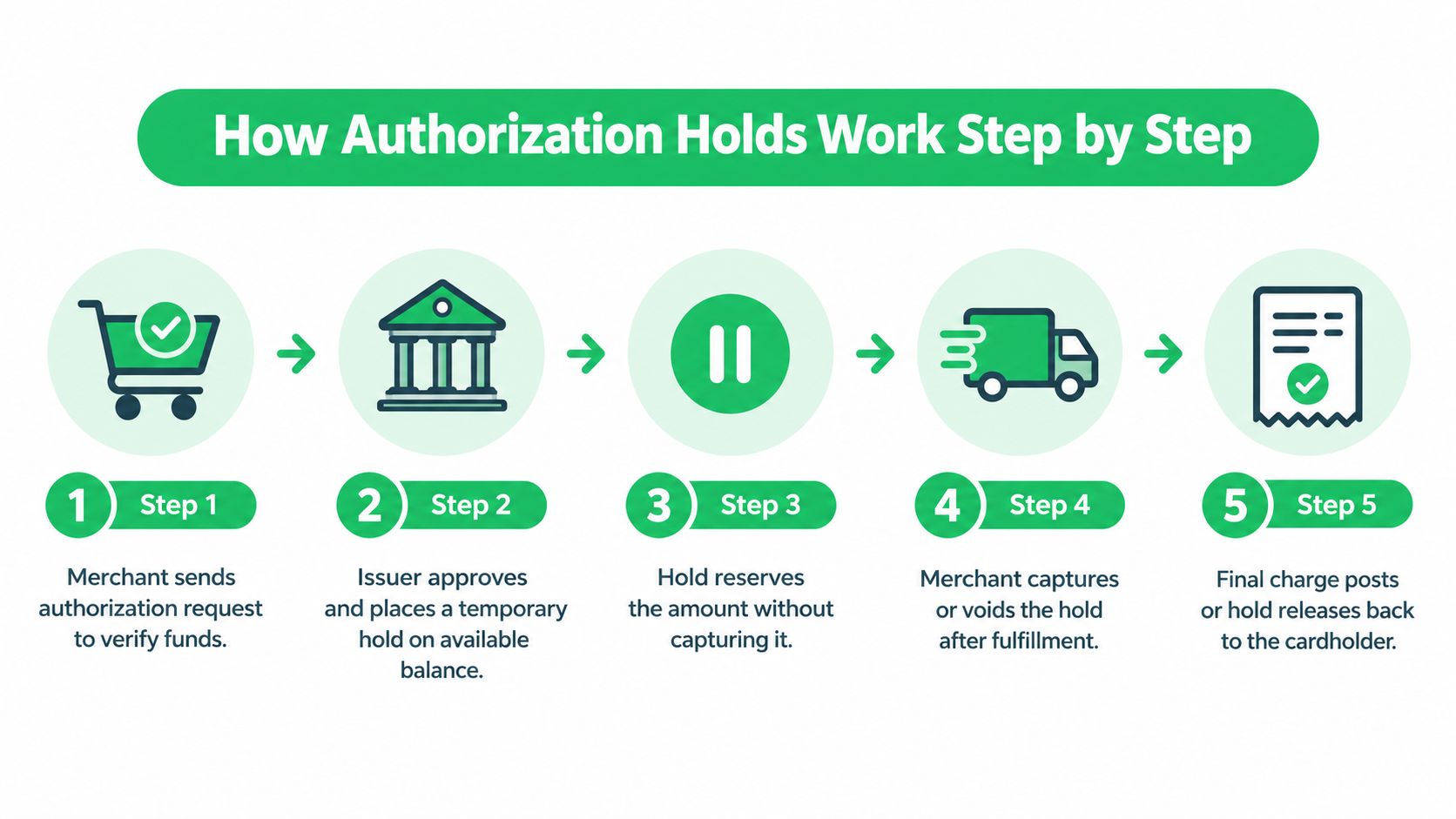
The lifecycle starts when the merchant sends an authorization request through a processor or acquiring bank. The request includes the transaction details, card information, merchant context, and amount the merchant wants reserved.
The issuer then evaluates the request and, if approved, places a temporary hold on the cardholder's available balance. The merchant receives an approval response and an authorization identifier. That approval means the issuer accepted the request at that moment. It doesn't guarantee that a later capture will succeed after the authorization window has expired or the account circumstances have changed.
The five operational stages
Authorization request: The merchant submits the payment for approval before fulfillment or final settlement.
Issuer decision: The issuer approves or declines the request and controls the reservation on the customer's available balance.
Pending period: The approved amount remains reserved. The merchant can prepare fulfillment, verify risk signals, or wait for the final amount, but no funds have been captured.
Capture or reversal: The merchant captures the approved amount when the payment is ready to settle, or sends a void or reversal when the transaction won't proceed.
Posting or release: A successful capture becomes a posted transaction. A valid release allows the reserved balance to become available again, although the customer may not see that change immediately.
The merchant dashboard may show statuses such as authorized, pending, captured, voided, or expired. The customer may see a pending transaction, a disappearing hold, and later a final charge. Those views don't always update at the same time, which is why a merchant-side reversal doesn't automatically mean the customer sees instant balance restoration.
The timing depends on transaction type and network rules. Visa guidance summarized by payment industry coverage says many card-present authorizations expire after 5 calendar days, cardholder-initiated card-not-present authorizations after 10 calendar days, and lodging or vehicle-rental estimates can remain valid for up to 30 calendar days. Incremental authorizations don't extend those limits, so merchants must plan capture around the original validity window, as outlined in Visa authorization lifecycle coverage.
<iframe width="100%" style="aspect-ratio: 16 / 9;" src="https://www.youtube.com/embed/BiGihUA6Mes" frameborder="0" allow="autoplay; encrypted-media" allowfullscreen></iframe>
How Long Holds Last and When They Expire
There are two clocks, and merchants often confuse them.
The first is authorization validity. This is the period in which the merchant can generally capture against the original approval. The second is issuer release timing. This is how long the pending hold remains visible or unavailable to the cardholder after capture, void, reversal, or expiry.
Those clocks don't always end together. A payment may no longer be valid for capture while the customer still sees a pending hold. Conversely, a merchant may send a reversal promptly and still receive support requests because the issuer hasn't updated the available balance.
Why the same hold behaves differently
Network, transaction type, card product, market, and issuer policy all affect the result. General industry guidance describes credit and debit holds as potentially lasting from about 7 days on debit cards to up to 30 days on some credit products, while other payment guidance describes shorter typical windows for online and in-person transactions. The outer limit isn't a promise that every customer will wait that long, and a short merchant authorization window isn't a promise that the pending line will disappear immediately.
Lodging and vehicle rental transactions have more room for estimates because the final amount can change during service. Ecommerce merchants don't automatically receive that flexibility just because an order has a long fulfillment cycle. A backorder, made-to-order product, or delayed digital review process can outlast the authorization's usable capture period.
Customer support standard: Tell customers when the hold was placed, what it represents, what the final charge will depend on, and what to do if the pending amount remains visible.
An issuer isn't required to process an authorization reversal instantly. Scheme rules require acquirers to support reversals, but the issuer controls when the release is reflected for the cardholder. That means a merchant can correctly cancel a payment while the customer still sees the reservation, as explained in Visa Acceptance reversal guidance.
Build internal alerts around time remaining before capture, not only around the presence of a pending status. A hold that still appears on a dashboard may already be close to expiry. Your team needs a separate process for fulfillment delays, failed captures, and reauthorization decisions.
Capture vs Void Decisions and Their Impact
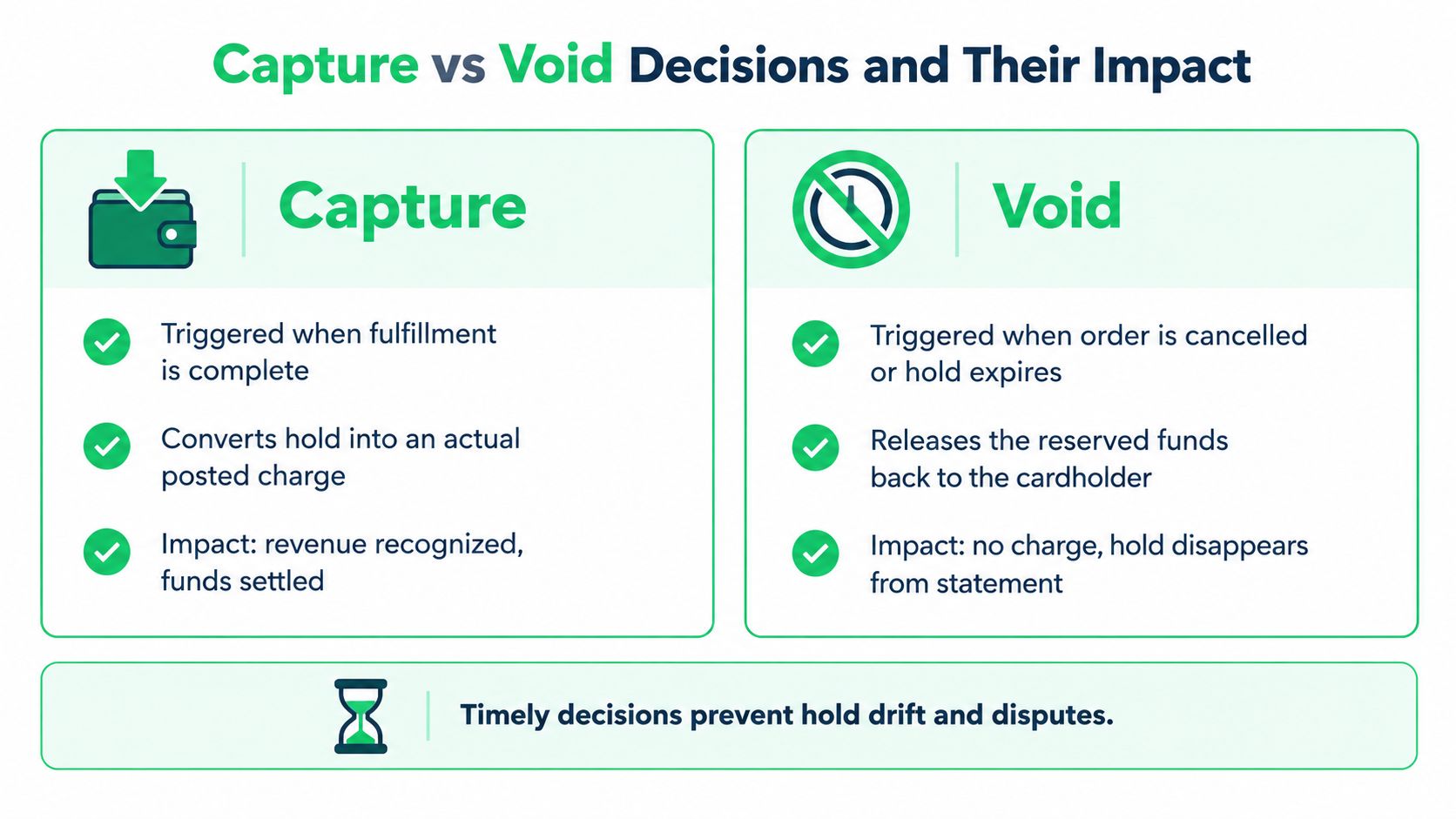
Capture and void are not interchangeable buttons. They represent different outcomes and should be tied to the actual state of the order.
| Decision | Use it when | Financial result |
|---|---|---|
| Capture | The order is ready, the final amount is known, and the authorization is still valid | The reserved payment becomes a posted charge |
| Void | The order is cancelled, fraud concerns stop fulfillment, or the merchant won't collect | The reservation is released without settling the payment |
| Reauthorize | The original authorization has expired or no longer covers the final amount | A new approval attempt is required before capture |
Capture is appropriate when the merchant has completed the condition that justified the hold. For a physical product, that may mean the order has passed its final fulfillment check. For a service, it may mean the customer has completed the service and the variable amount is known. The capture amount must also align with the authorization and the applicable processor rules.
Void is the cleaner outcome when no revenue should be collected. Don't leave a cancelled order in an authorized state and assume the platform will resolve it. Send the release instruction, record the response, and monitor the customer-facing status because issuer updates can lag behind the merchant action.
A final amount that differs from the original hold requires deliberate handling. A smaller capture may leave an authorization remainder to release. A larger amount may require an additional authorization or a new payment attempt, depending on the processor and network. If the original approval expires first, a late capture can fail even when the customer still sees a pending hold.
For teams documenting the difference between settlement actions, the capture glossary entry provides useful terminology. The operational principle is simple: capture only when you intend to settle, void when you won't, and never use a stale authorization as a substitute for a fresh approval.
Holds in Subscription and Recurring Billing Models
Subscriptions expose the weakness of treating an authorization as if it were a standing payment agreement. An authorization reserves funds for a specific payment event. It doesn't create an indefinite right to capture future billing cycles.
A trial conversion can create one payment event, while the first paid renewal creates another. If a merchant authorizes at signup and waits too long to capture after the trial or fulfillment period, the original hold may no longer be usable. Subscription teams need a clear distinction between payment method verification, the current billing authorization, and future recurring payment consent.
The risk is especially visible in long fulfillment cycles and subscriptions. Guidance for placing a hold notes that standard authorization windows can be short, around 5 days for Visa card-not-present transactions and 7 days for Mastercard and American Express, creating exposure when fulfillment or billing occurs later, as described in Stripe's payment hold documentation.
A reliable recurring billing workflow
At signup: Validate the payment method and explain any pending authorization in plain language.
Before the billing event: Confirm that the stored payment method remains usable and that the account is eligible for the next charge.
At renewal: Run the appropriate authorization and capture flow for that billing event. Don't assume an earlier hold can be reused.
After a decline: Separate soft declines, expired authorizations, and hard payment failures. Each needs a different retry or customer communication path.
After a failed attempt: Keep the subscription state accurate. A customer shouldn't appear active internally while access, payment, and dunning records disagree.
Teams that manage membership revenue also benefit from connecting payment events to broader retention measures. This billing models and KPIs guide offers useful context for linking recurring payment performance with operational reporting. For payment-specific implementation patterns, see the subscription payment processing guide.
The strongest recurring flows don't wait for a silent failure to reveal that an authorization expired. They track the next billing event, prepare a valid attempt, notify the customer when action is needed, and preserve the subscription state until the payment outcome is known.
Chargeback and Fraud Risks Associated with Holds
A hold can reduce payment risk, but poor hold communication can create a different support and dispute problem. Customers may see a pending amount they don't recognize, a hold that differs from the final charge, or more than one pending entry while the processor updates the transaction. If the merchant descriptor is unfamiliar, the customer may contact the issuer before contacting the merchant.
The risk grows when a merchant's authorization amount isn't explained at checkout. A customer needs to know whether the amount is an estimated total, a security reservation, or the exact amount that will be captured. The checkout should also identify the merchant clearly and state what happens if the order is cancelled or delayed.
Controls that protect both sides
Use a recognizable descriptor. The name on the pending transaction should connect to the storefront or service the customer remembers. A technically correct but unfamiliar descriptor pushes legitimate customers toward fraud claims.
Explain variable amounts before approval. Hotels, rentals, marketplaces, and high-risk merchants should state why the reserved amount may differ from the final amount. Don't make support agents explain a predictable outcome one ticket at a time.
Separate duplicate-looking entries from duplicate captures. A pending hold and a later posted charge can look like two charges while the issuer is processing the release. Your operations team should check the authorization identifier, capture status, and settlement record before issuing a refund or retrying payment.
Resolve stale authorizations. Merchant and network rules can require authorizations to be settled or reversed within 31 business days at most, while many holds must be resolved within 7 business days or less. The issuer still determines when the customer sees the released balance, according to authorization hold timing guidance from Chargebacks911.
For merchants facing high fraud risk, hold management should sit beside screening, descriptor controls, fulfillment evidence, and dispute response. A hold is not a fraud guarantee. It only confirms a payment condition at a particular point in time.
Use the chargeback prevention guide to connect payment-state accuracy with broader dispute controls. The practical goal is to prevent customers from having to explain a confusing pending transaction to their bank.
Operational Best Practices for Merchant Hold Management
The most effective hold programs combine payment rules with workflow discipline. A processor can approve an authorization, but your order system still needs to know when fulfillment is delayed, when an amount changes, and when another processor should handle the next attempt.
Set the amount deliberately
Start with the customer's likely financial experience, not only the merchant's risk preference. A variable final amount may justify a reserve, but an inflated hold can consume spending power and create conversion friction. Document the logic by product, market, and fulfillment model so customer support can explain it consistently.
Automate the decision clock
Create events for authorization created, fulfillment delayed, amount changed, capture attempted, capture failed, void requested, and authorization expired. An operations queue that only shows "pending" is too shallow for high-volume ecommerce. The system should surface orders that need action before the original approval window closes.
Keep capture close to fulfillment
Capture when the merchant has a clear obligation to deliver and the final amount is known. Don't authorize at checkout and leave the payment untouched while inventory, fraud, or shipping teams work in separate systems. If the order can't ship within the planned window, route it into a reauthorization or customer-contact workflow.
Normalize processor behavior
Multi-PSP routing adds resilience only when payment states are normalized. Your orchestration layer should map different processor responses into shared statuses for authorization, capture, reversal, expiry, and failure. It should also prevent a retry on one processor from creating an unnoticed second hold on another.
A practical setup can route through processors such as Stripe, Adyen, and NMI, apply smart retries to eligible failures, and retain a single order-level payment record. The same layer can support native subscription management, dunning, local payment methods, and chargeback-aware risk handling. Tagada provides this type of ecommerce orchestration, including multi-processor routing, subscription management, smart retries, and payment-event workflows.
Measure operational outcomes
Track more than approval rate. Review expired authorizations, failed captures, duplicate holds, void latency, reauthorization success, customer contacts about pending charges, and disputes linked to unclear descriptors. These measures show where the payment flow breaks after the initial approval.
Operations principle: An authorization isn't complete payment work. It's a timed task with an owner, a next action, and a failure path.
Key Takeaways and Next Steps for Merchants
A pre-authorization hold is a bridge between checkout intent and fulfilled payment. It gives the merchant a way to verify available funds before settling, but the bridge has a limited operating window and can affect the customer's available balance while it remains open.
The merchants that manage this well make three distinctions consistently:
A hold isn't revenue: The issuer has reserved funds, but the merchant hasn't collected them until capture succeeds.
An expired hold isn't a successful payment: The customer may still see a pending entry even when the original authorization can no longer support capture.
A reversal isn't always an instant release: The merchant can send the correct instruction while the issuer takes additional time to update the cardholder's balance.
Start with an audit of current hold amounts by product and customer segment. Check whether the reserved amount reflects the actual risk and whether checkout messaging explains the pending transaction before the customer sees it.
Next, review every fulfillment path that can outlast the original authorization. Backorders, made-to-order goods, manual review, high-risk approval queues, trial conversions, and subscription renewals all need an explicit reauthorization or cancellation path. Don't let a payment remain in an ambiguous pending state because the order system lacks a deadline.
Finally, evaluate how your PSP setup handles multiple processors. Confirm that your team can identify the original authorization, route a new attempt without creating unnecessary duplicate holds, issue a normalized void or reversal, and preserve one payment history across the customer and order records.
A merchant may start with a customer who sees a pending hold and ends with a settled payment, a clean release, or a well-managed reauthorization. That outcome depends less on the initial approval than on what the payment operation does next.
Tagada gives ecommerce, subscription, and high-volume merchants a single orchestration layer for checkout, multi-PSP payment routing, smart retries, recurring billing, and payment-event workflows. Visit Tagada to connect authorization, capture, expiry, and recovery processes into a more reliable revenue flow.