
How to Start a Subscription Box Business That Keeps Billing
Start a subscription box: pick the model, source and price it, set the cutoff, charge and ship calendar, meet Visa's recurring rules, keep subscribers.

Article summary
TL;DR
To start a subscription box business, choose one box model (curated, personalized, replenishment or access), validate it with a waitlist or presale, build a prototype, and price the box on its full cost per shipment. Then set a billing calendar with a cutoff, a charge date and a ship date, and follow Visa's recurring rules from the first sign-up.
- Four box models: curated, personalized, replenishment and access. Each fails in a different way, so pick the risk you can manage.
- Price the box on the full cost per shipment: products, packaging, shipping, fulfillment, payment fees and the acquisition cost spread over expected boxes.
- Run a fixed calendar: a cutoff for changes, a charge date, a ship date. Visa wants shipped goods charged on or after the ship date, outside a few categories.
- Visa requires the terms at consent, separately from your general terms, online cancellation for online sign-ups, and a notice 7 days before a trial or intro price ends.
- Skip, swap and pause keep subscribers who would cancel. Card updates and retries keep those whose payment fails.
 ChatGPT
 Claude
 Perplexity
 Grok
On this page
A subscription box sells the same promise every month: a box that's worth opening. The business side is less romantic. Each box has a cutoff, a charge and a shipment, and each renewal is a card payment made without the customer at checkout.
This guide covers the box itself, the numbers, the billing calendar and the card network rules. For subscriptions in general (replenishment plans, memberships, retention metrics), see subscription-based ecommerce.
What is a subscription box business?
A subscription box business ships a box on a schedule, usually monthly, and charges the customer's saved payment method at each cycle until they cancel. Boxes fall into four models. The model decides what the customer pays for, and how the box fails.
| Box model | What the customer pays for | Example of a box | Where it breaks |
|---|---|---|---|
| Curated | A surprise selection on a theme | Snacks from a different country each month | Items the subscriber didn't want; repeats |
| Personalized | A selection built from their profile or quiz | Clothing picked by a stylist | Fit errors, returns, cost of picking per box |
| Replenishment | The same consumables, on time | Razors, coffee, pet food | Competition on price; stock piles up if the cadence is wrong |
| Access | Member perks in or around the box | Member pricing, early drops, exclusives | Perks that cost more than the fee |
Personalized boxes often carry returns. Stitch Fix, for example, describes its Fix as a box of items picked by a stylist, with a styling fee credited toward what the client keeps.4Stitch Fix, Inc., Form 10-K for the fiscal year ended August 1, 2026 (SEC, filed September 24, 2026)
The same filing shows the model's main risk: Stitch Fix warns that its client count will keep falling if new clients don't keep "receiving Fixes after their first few tries."4Stitch Fix, Inc., Form 10-K for the fiscal year ended August 1, 2026 (SEC, filed September 24, 2026)
Step 1: Pick a niche and validate it
Narrow until the box describes one person: not "a snack box" but "Japanese snacks for people who have been to Japan". A narrow box is easier to source, easier to market and harder to copy.
Then test before you buy stock:
- Look at existing boxes in your niche: price, contents, shipping terms, and what their reviews complain about.
- Put up a waitlist page with the box, a price and a launch date.
- Run a presale for the first box. A payment is the only proof that counts.
- Build one prototype box with real products. It gives you photos, the real weight and size for shipping quotes, and something to show 10 or 20 target customers.
Step 2: Source the products
Most boxes mix sources so that one late supplier doesn't stop a shipment.
Wholesale and distributors
Steady supply at wholesale prices. Fits replenishment boxes. Risk: the same items are available elsewhere.
Brands looking for exposure
Emerging brands may supply samples or full sizes to reach your subscribers. Get the terms in writing, including volumes and dates.
Makers, marketplaces, trade shows
Independent makers and wholesale marketplaces give you items shoppers haven't seen, often with low minimums.
Your own products
The best margin and the strongest brand, once you know what subscribers keep and reorder.
Ask for samples before committing, negotiate lower minimum order quantities for the first boxes, and lock recurring prices once your subscriber count is stable. If your box contains food, cosmetics or supplements, the product rules and the payment rules both get stricter: see the supplements and skincare guides.
Step 3: Price the box on its full cost per shipment
The classic mistake is pricing on the products alone. A box has a cost per shipment, and the subscriber has to stay long enough to pay back what they cost to acquire.
| Cost line | What to include | Often forgotten |
|---|---|---|
| Products | Cost of every item, including free samples you'll have to buy later | Price increases after the launch deal |
| Packaging | Box, filler, inserts, printing | Minimum print runs for custom boxes |
| Shipping | Label for the real weight and size | Crossing a carrier weight or size tier |
| Fulfillment | Your time, or the 3PL's pick, pack and storage fees | Kitting fees per box at a 3PL |
| Payment fees | Processing on each renewal, retries, disputes | Dispute fees and refunds |
| Acquisition | Ad spend per new subscriber, spread over the boxes they'll take | Discounts on the first box |
| Losses | Damaged or lost parcels, replacements | Reships for wrong addresses |
Then check the margin on the third or sixth box, not the first: the first box carries the discount and the acquisition cost, the later ones carry the profit. The metrics to track that, by cohort, are in subscription-based ecommerce and what is CLTV.
Plans: monthly, prepaid and gifts
- Monthly is the default: one charge per box.
- Prepaid terms (3, 6 or 12 boxes paid upfront) bring cash and lower churn, but they're a payment for goods delivered later. Visa allows a full advance payment only in a few categories, such as travel and entertainment or custom goods.1Visa Core Rules and Visa Product and Service Rules, October 24, 2026 Ask your acquirer how it treats prepaid plans before you sell them, and write the refund rule for cancellations.
- Gift subscriptions usually end without renewal. Say clearly whether they renew, and on whose card.
Step 4: Set the billing calendar
A box business runs on three dates per cycle. Write them down before launch and show them to subscribers.
Fig. 1One box cycle
- CutoffLast day to skip, swap, update card or address
- Pick and packBox count fixed from active subscribers
- ChargeRenewals billed, declines retried
- ShipTracking sent to each subscriber
- DeliverySupport window for damaged or missing boxes
every change must land before the cutoff
The order of "charge" and "ship" isn't only an operations choice. Visa's rules say that for goods that are shipped, the transaction date must be on or after the date the goods ship, except for advance payments.1Visa Core Rules and Visa Product and Service Rules, October 24, 2026
The simple setups that follow it: charge on the ship date, or authorize a few days before and capture when the box ships. A charge taken weeks before shipping is the case to clear with your acquirer.
A Visa recurring transaction is also defined as one processed "at fixed, regular intervals (not to exceed one year between Transactions)".1Visa Core Rules and Visa Product and Service Rules, October 24, 2026 Keep the billing day fixed, and say it at sign-up.
Inside Tagada
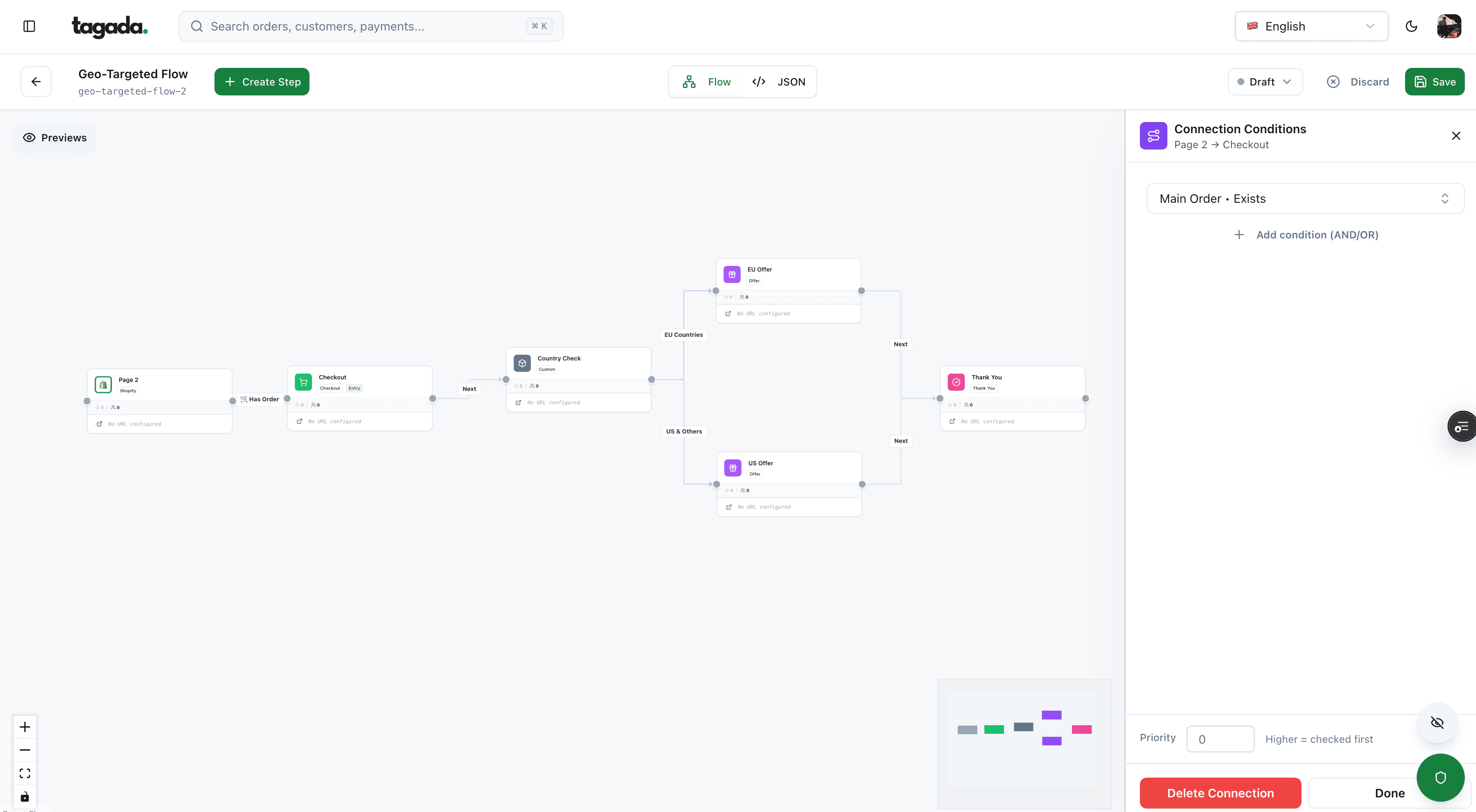
Build the funnel once, route every customer to the right offer
Checkout, upsells and subscriptions on one flow, with conditions per country, order or customer.
Step 5: Meet the card network rules for recurring billing
Visa's rules for recurring payments apply to every box sold by card. Before you take the first sign-up:1Visa Core Rules and Visa Product and Service Rules, October 24, 2026
- Show the terms at consent, separately from your general terms: the amount, the currency, the timing and frequency of charges, how the card will be used, and the length of any trial or intro offer.
- Include the fixed dates or intervals of the charges.
- Offer a simple cancellation, and an online one if the subscriber signed up online.
- Notify at least 7 days before a trial, intro offer or promotional period ends, with the amount and date of the next charges and a link or simple way to cancel online or by text.
- In Europe, confirm the agreement within 2 business days, and remind subscribers when more than 6 months have passed since the last charge or the terms change.
Visa Product and Service Rules, October 24, 2026, tables 5-19 and 5-20, pages 467-470.
US law adds its own layer. ROSCA requires, for any negative option sold online, clear disclosure of the material terms before you take billing information, the customer's express informed consent, and a simple mechanism to stop recurring charges.3Restore Online Shoppers' Confidence Act, 15 U.S.C. § 8403
State automatic renewal laws, California's first, add reminders and cancellation rules. The full picture, including where the FTC stands in 2026, is in negative option billing.
Your MCC can change with your marketing
Visa's merchant data manual puts subscriptions of delivered goods sold through direct marketing, such as cosmetics, food or nutraceuticals, under MCC 5968, a code Visa lists as high-risk for card-absent sales when it's used for negative option offers. A store that simply offers a subscribe option, without direct marketing, keeps the code of its main business.2Visa, Merchant Data Standards Manual, April 2026 Trial-heavy box offers are where that line gets crossed.
Step 6: Package, ship and fulfill
- Design for the carrier first. Your box's weight and size decide the shipping tier. Check the next tier up before adding an item.
- Start with stock boxes and branded stickers or tissue, then move to custom printing when volume covers the minimum print run.
- Use inserts: what's in the box and why, how to skip or swap, and a referral code.
- Pack in-house at first. You learn what breaks and what takes time. Move to a 3PL when packing day costs more than the 3PL's fees.
- Send tracking with every box. A box without tracking turns a late delivery into a "not received" dispute you can't answer.
Step 7: Launch in small cohorts
Open to your waitlist first, then widen. The first box tells you what subscribers think of the product. The second charge tells you whether they stay.
Before the first renewal, check three things: the cutoff and charge dates in your billing tool, the retry settings for declines, and the reply your support team gives to "where is my box" and "how do I cancel".
Step 8: Keep subscribers: churn you can prevent
Subscribers leave for two reasons: they choose to, or their payment fails. Give each one its own fix.
- Cancellations right after box oneThe first box didn't match the promiseFix box one first; ask why in the cancel flow
- Cancellations with 'too much product'The cadence is wrong for this subscriberOffer skip, pause or a longer interval before cancel
- Renewals declinedExpired card, insufficient funds or a cautious issuerCard updater, retries within network limits, card-update link
- Visa 13.2 disputes (cancelled recurring)A charge after a cancellation, or a cancellation that didn't workOnline cancellation that stops the next charge, with a confirmation email
- Visa 13.1 disputes (not received)Late, lost or untracked boxesTracking on every box, clear ship dates, quick reships
Save offers, cancellation flows and win-back are covered in subscription retention. Failed renewals have their own guides: why subscription payments fail and dunning and failed payment recovery. How recurring card payments work, from stored credentials to card updates, is in subscription payment processing.
Where Tagada fits
How Tagada helps
Subscriptions, checkout and payments in one system
Tagada runs subscriptions with trials, billing cycles, automatic retries and recovery, from the same checkout that sells the first box with order bumps and one-click upsells. TagadaPay routes each renewal to the processor most likely to approve it and retries on decline. Your PCI-tokenized cards, customer profiles and subscription data stay portable: switch processors without re-onboarding customers. Pricing is on the pricing page. Tagada follows Visa and Mastercard rules and the laws that apply to payments.
The box is what subscribers talk about. The calendar, the terms and the renewals are what keep the business running after the first month.
Frequently asked questions
How much does it cost to start a subscription box business?
Are subscription boxes profitable?
How do subscription boxes get their products?
Can I charge subscribers before the box ships?
What payment processor works for a subscription box?
Do I need an LLC to start a subscription box?
Sources
Checked November 2, 2026Tagada
Bill, retry and ship boxes from one system
Funnels, one-click upsells, subscription billing and payment routing, on one customer record.
- 01Create your free account
- 02Connect your store or build a checkout
- 03Launch funnels, upsells and subscriptions