
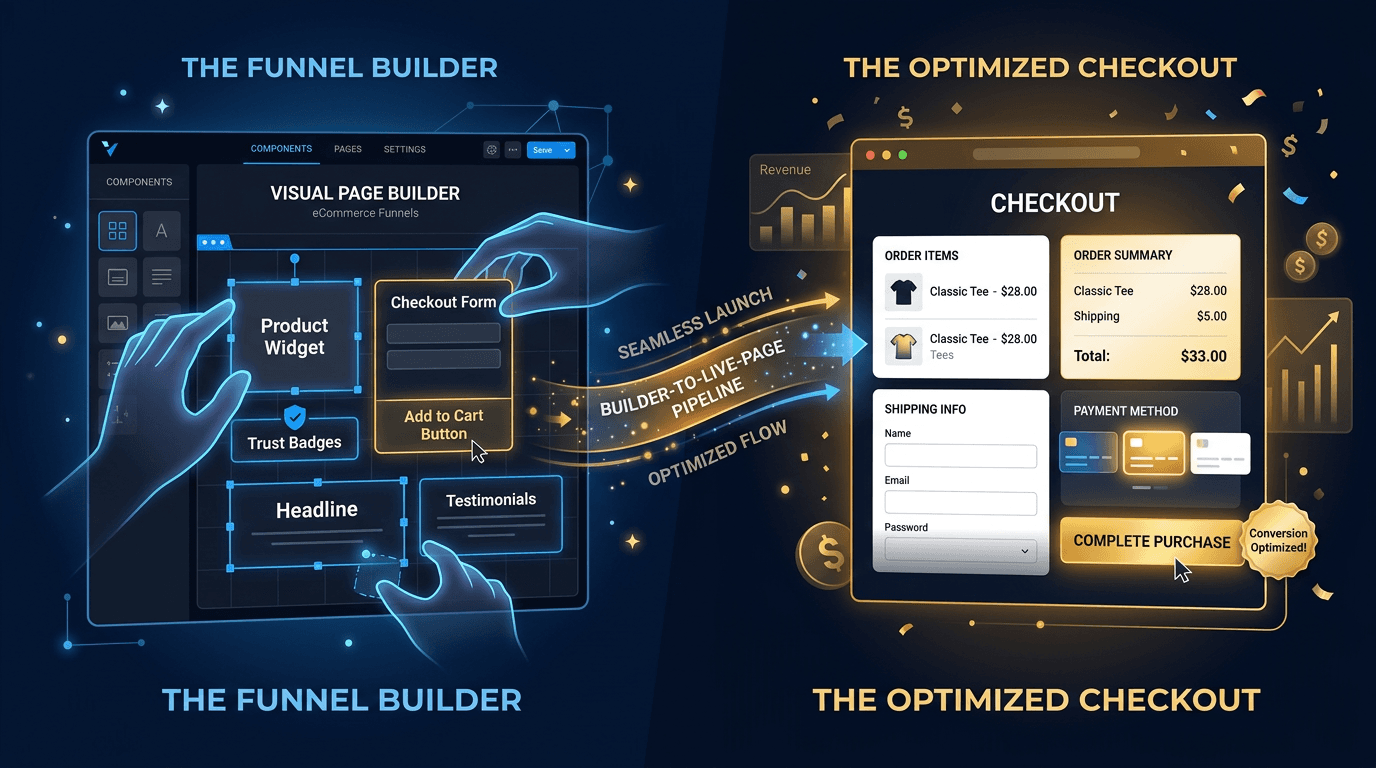
There's a gap in the market that nobody talks about. On one side, you've got website builders — Framer, Webflow, Builder.io — that produce gorgeous, pixel-perfect pages. On the other side, funnel builders — Funnelish, ClickFunnels, CheckoutChamp — that know how to sell but look like they were designed in PowerPoint. Neither side crosses the line into the other's territory. We built TagadaStudio to sit exactly in that gap.
This isn't a "we're the best at everything" pitch. It's an honest look at why both categories exist, what each gets right, what each gets wrong, and why ecommerce funnels specifically need something that neither category provides.
The Website Builder Side: Beautiful, But Can't Sell
Let's start with the tools designers love. Framer, Webflow, and Builder.io are genuinely impressive. Framer gives you Figma-level design control with native animations that make pages feel alive. Webflow offers full CSS/HTML visual editing with an advanced CMS. Builder.io lets developer teams add visual editing to any React, Vue, or Svelte codebase.
For marketing sites, portfolios, and brand pages, these tools are hard to beat. But try to build a high-converting ecommerce funnel with them, and you hit walls fast:
No Native Checkout
Framer's ecommerce is Stripe-only with basic product support — no order summaries, no cart logic, no multi-step checkout. Webflow has better ecommerce (up to 1,000 products on Plus) but its checkout is rigid and can't handle custom funnel flows. Neither platform understands what a "funnel step" is.
No Upsell / Cross-Sell Logic
Post-purchase upsells, order bumps, dynamic cross-sells based on cart contents — these are table stakes for ecommerce funnels. Website builders don't have them. You'd need to hack together custom code or bolt on third-party tools, fragmenting your data.
No Payment Intelligence
These builders have zero awareness of payment routing, processor health, authorization rates, or payment orchestration. They're presentation layers with no connection to the transaction. Your checkout page can't adapt based on the customer's payment method, geography, or LTV.
Proprietary Hosting Lock-In
Framer doesn't export code — your pages live on Framer's servers forever. Webflow offers code export on higher plans but it's complex. Builder.io is better here (framework-agnostic), but you still need to wire up every commerce feature yourself.
The bottom line: website builders produce beautiful pages that don't know how to sell. They're designed for content, not commerce.
The Funnel Builder Side: Can Sell, But Looks Like 2018
Now flip the coin. Funnelish, ClickFunnels, and CheckoutChamp's built-in page builders exist for one purpose: conversion. They know what an order bump is. They understand funnel step sequences. They can wire up a post-purchase upsell in minutes.
But their builders are... functional. That's the most generous word. Here's the reality:
Funnelish ($49-$199/mo)
Fast-loading pages and genuine one-click upsells — credit where it's due. But the page builder itself offers limited customization compared to even basic WordPress page builders. Multiple reviews cite design constraints as the main limitation. And you're locked to Shopify or WooCommerce — no standalone funnels. (Source: Ecommerce Platforms)
ClickFunnels ($97-$297/mo)
The OG funnel builder. It pioneered the category and still works for digital products and coaching funnels. But the builder feels dated — template-heavy, limited responsive control, and the design output screams "funnel page" to anyone who's seen more than three of them. It's also not ecommerce-native — it was built for info products, not physical goods.
CheckoutChamp ($300/mo + 1%)
Powerful subscription management and 270+ gateway integrations, but the page builder is notoriously difficult to use for custom designs. Most CheckoutChamp merchants hire developers or agencies for anything beyond basic templates. It wasn't designed as a builder — it was designed as a CRM that happens to have one.
The pattern is consistent: funnel builders treat the page as an afterthought. The intelligence is in the backend — payment routing, subscription logic, upsell sequences. The frontend is just... a form you dress up with templates.
That made sense in 2019. It doesn't in 2026. Customers today can tell when they're on a templated funnel page. Trust drops. Conversion drops. The very thing funnel builders optimize for — conversion — is undermined by the design limitations of their own builders.
The Comparison: Side by Side
| Capability | Website Builders | Funnel Builders | TagadaStudio |
|---|---|---|---|
| Design Freedom | Excellent | Basic / Templated | Excellent |
| Native Checkout | No / Basic | Yes | Yes (multi-step) |
| Upsells & Order Bumps | No | Yes | Yes (native) |
| Payment Orchestration | No | Basic / None | Full (smart routing) |
| Page Speed Control | Platform-dependent | Fast (limited control) | 4 runtime modes |
| AI Assistance | Some (Framer AI) | No | Built-in + MCP |
| Code Export | Limited / None | No | Full (HTML, standalone) |
| Platform Lock-in | High (Framer, Webflow) | High (Shopify required) | None (deploy anywhere) |
What TagadaStudio Actually Is
TagadaStudio is a visual page builder where every component understands commerce context. You drag and drop like Framer. You get real responsive control, custom typography, flexible layouts, and advanced animations. But unlike Framer, the component library includes checkout forms, order summaries, offer sections, pricing tables, and payment method selectors — all wired directly into Tagada's payment orchestration layer.
Pages are organized as funnel templates with typed page steps: landing, checkout, offer, thank-you, and custom. Each step can declare features (like "this page has a checkout") that the runtime uses to wire up payment processing, cart state, and customer data automatically.
The result: you build pages that look like they came from a design agency, but they function like they came from a conversion optimization team. No compromise on either side.
The Speed Question: Four Runtime Modes
Page speed directly impacts conversion — every 100ms of load time costs roughly 1% in conversion rate. Funnel builders like Funnelish get this right: their pages load fast. Website builders are hit or miss (Framer is generally fast; Webflow depends on your build).
TagadaStudio takes a different approach: instead of one output format, you choose from four runtime modes based on what your page needs:
Runtime Mode (Recommended)
Loads the Tagada SDK from CDN. Full interactivity — checkout forms, dynamic upsells, real-time cart updates, payment method switching. This is the default for pages that need to sell. The SDK is lightweight and cached globally.
Islands Mode (Fastest First Paint)
Static HTML with selective hydration. The page renders instantly as pure HTML — then interactive "islands" (checkout form, cart widget) hydrate independently. Perfect for landing pages where the hero and copy need to load instantly, but the checkout form lower on the page can hydrate a moment later.
Treeshake Mode (Smallest Bundle)
Uses esbuild-wasm to tree-shake the output down to the absolute minimum JavaScript. If your page only uses 3 of 30 available components, only those 3 ship. Ideal for simple offer pages or thank-you pages where bundle size matters more than feature richness.
Standalone Mode (Zero Dependencies)
Everything inlined — no CDN calls, no external dependencies. The page works completely offline. Useful for edge deployments, email-embedded pages, or environments where you can't guarantee CDN availability.
No other builder — website or funnel — gives you this level of control over how your pages render. You're not locked into someone else's performance tradeoffs. You pick the strategy that fits each page.
AI That Actually Understands Your Page
Every builder is slapping "AI" on their feature list right now. Most of it is glorified template generation — "make me a landing page about shoes" and you get a generic layout. TagadaStudio's AI is different because it has context.
The built-in AI assistant (choose between GPT-4o-mini at 5 credits/turn for fast iterations, or Claude Sonnet at 20 credits/turn for complex changes) can see your entire page tree — every component, every style token, every page in your funnel. It doesn't generate from scratch; it modifies your existing work with full awareness of the structure.
But the real power move is MCP integration. TagadaStudio exposes a Model Context Protocol bridge — a WebSocket connection that any external AI agent can use to read and modify your editor state in real time. This means:
Use Your Own AI, Free
Connect Cursor, Claude Desktop, or any MCP-compatible tool to TagadaStudio. Your AI agent can query the page tree, list tokens, view component properties, and execute changes — all through the MCP bridge. No credits consumed. No vendor lock-in on the AI side either.
Or Use Our Trained Model
Our built-in AI is specifically trained for conversion-optimized checkout and funnel pages. It understands which layout patterns convert, where trust signals should go, how to structure an offer section for maximum impact. General-purpose AI won't know that putting the price anchor above the CTA increases conversion by 12% — ours does.
Build Custom Agents
The MCP bridge isn't just for chat. You can build automated agents that A/B test layouts, generate page variants, or apply brand guidelines across your entire funnel — programmatically, through the same WebSocket API.
The Component Library: Design Meets Commerce
TagadaStudio's component library is organized into five categories, reflecting the dual design-and-commerce nature of the builder:
| Category | What's Included | Why It Matters |
|---|---|---|
| Layout | Containers, stacks, grids, sections | Framer-level layout control for responsive design |
| Content | Headings, text, images, video, media | Rich content primitives with real typography |
| Form | Inputs, selects, checkboxes, multi-step forms | Data collection wired to customer records |
| Commerce | Checkout form, order summary, offer sections, pricing, product selectors | The differentiator — components that understand transactions |
| Section | Heroes, testimonials, FAQs, feature grids, CTAs | Pre-built conversion-tested patterns, fully customizable |
The commerce components are what set this apart. An "Offer" component in TagadaStudio isn't a text block with a buy button — it's a structured element with slots for hero imagery, value proposition stack, pricing display, action buttons, and extras. Each slot is independently designable, but the component itself understands the offer context: what product is being sold, at what price, with what urgency or scarcity signals.
Publishing: From Editor to Live in One Click
TagadaStudio publishes as Tagada plugins — deployable assets that include the compiled page, a manifest declaring page types and features, and the source data for round-trip editing. The flow is straightforward:
- Build your pages in the visual editor — design, add commerce components, configure funnel steps
- Hit Publish — the system validates your manifest, builds in your chosen runtime mode, generates preview screenshots
- Assets deploy to your store — live staging URL available immediately, alias reuse for instant updates
- Pages are live — connected to Tagada's checkout, payment routing, and customer data layer from the first visit
When embedded in the Tagada CRM, the flow is even tighter — save triggers build + deploy + manifest update automatically. Your funnel pages are part of the same system as your payment processing, subscription management, and email automation. No integration required because there's nothing to integrate.
Who This Is For (and Who It's Not For)
TagadaStudio is purpose-built for a specific use case: ecommerce funnels where design quality and conversion mechanics both matter. If that's you, it's the only tool that doesn't force a tradeoff.
Great Fit
DTC brands running paid traffic through multi-step funnels. Supplement and telehealth brands that need trust-building landing pages with integrated checkout. High-ticket product sellers who can't afford to look "funnel-y." Teams migrating from Funnelish or CheckoutChamp who want better design without losing conversion features.
Not the Right Fit
If you're building a blog, portfolio, or brand website with no commerce — use Framer or Webflow, they're better for that. If you need a full e-commerce store with product catalog, inventory management, and shipping — that's Shopify's territory. TagadaStudio is for the conversion-critical pages: the landing page, the checkout, the upsell, the thank-you.
Try It
TagadaStudio is live at studio.tagada.io. Open the editor, drag some components, switch between runtime modes, and see for yourself what happens when a page builder actually understands what it's building for.
The gap between "beautiful" and "converts" doesn't have to exist. We built TagadaStudio to prove it.