
A surcharge is a fee added at checkout when a customer pays by credit card, and U.S. rules generally require it to stay within the merchant's actual acceptance cost, with Visa's network cap set at 3%. Card acceptance cost U.S. merchants reached $187.2 billion in 2024, which explains why more businesses are examining cost-recovery options.
You've filled an online cart, entered your delivery details, and reached the payment screen. Then a new line appears beside the order total: card processing surcharge. The amount may be small, but the customer now has to decide whether to accept a higher price, switch payment methods, or leave.
That moment captures the true meaning of what are surcharges. This isn't only a finance question. It's a decision about checkout design, customer trust, card-network rules, payment routing, and the economics of every successful or failed transaction.
<h2>A Surcharge Starts at the Checkout Counter</h2>
A surcharge is an additional fee a merchant adds to a transaction when the customer uses a particular payment method, most commonly a credit card. The fee sits on top of the price of the product or service and is normally intended to recover the merchant's cost of accepting that card.
The merchant pays several parties before card revenue reaches the business account. The surcharge passes some of that cost to the customer whose payment method created it. From the customer's perspective, the fee feels like a charge for choosing credit rather than cash, debit, or another available method.
That distinction matters. A general price increase affects every shopper, while a surcharge changes the price at checkout based on how the shopper pays. The Payment Card Industry Merchant Surcharging overview describes the growing visibility of this practice in the U.S., including 34% of small businesses assessing surcharges by late 2024, compared with less than 5% in 2021 and less than 2% in 2016.
<h3>Who charges whom</h3>
The merchant charges the surcharge. The card network does not add that line to the shopper's receipt, and the processor usually doesn't decide the customer-facing amount on the merchant's behalf. The business configures the checkout, displays the fee, collects it, and remains responsible for following applicable rules.
For example, an ecommerce store might show:
| Order component | Amount |
|---|---|
| Product price | $120 |
| Credit-card surcharge | 3% |
| Total before any other charges | $123.60 |
That example illustrates the mechanics, but the merchant can't just choose any percentage. In the U.S., the amount must be tied to the actual cost of acceptance and must be disclosed before payment. A customer shouldn't discover the fee only after clicking the final purchase button.
The customer's side is equally important. LendingTree found that 69% of cardholders said they had been charged extra for using a credit card, while a survey cited by AARP reported that 79% had encountered such fees. Those figures, reported in the same overview of the U.S. card surcharge trend, show why shoppers recognize the line item but may still react negatively when it appears late.
<h2>Why a Surcharge Exists in Card Payments</h2>
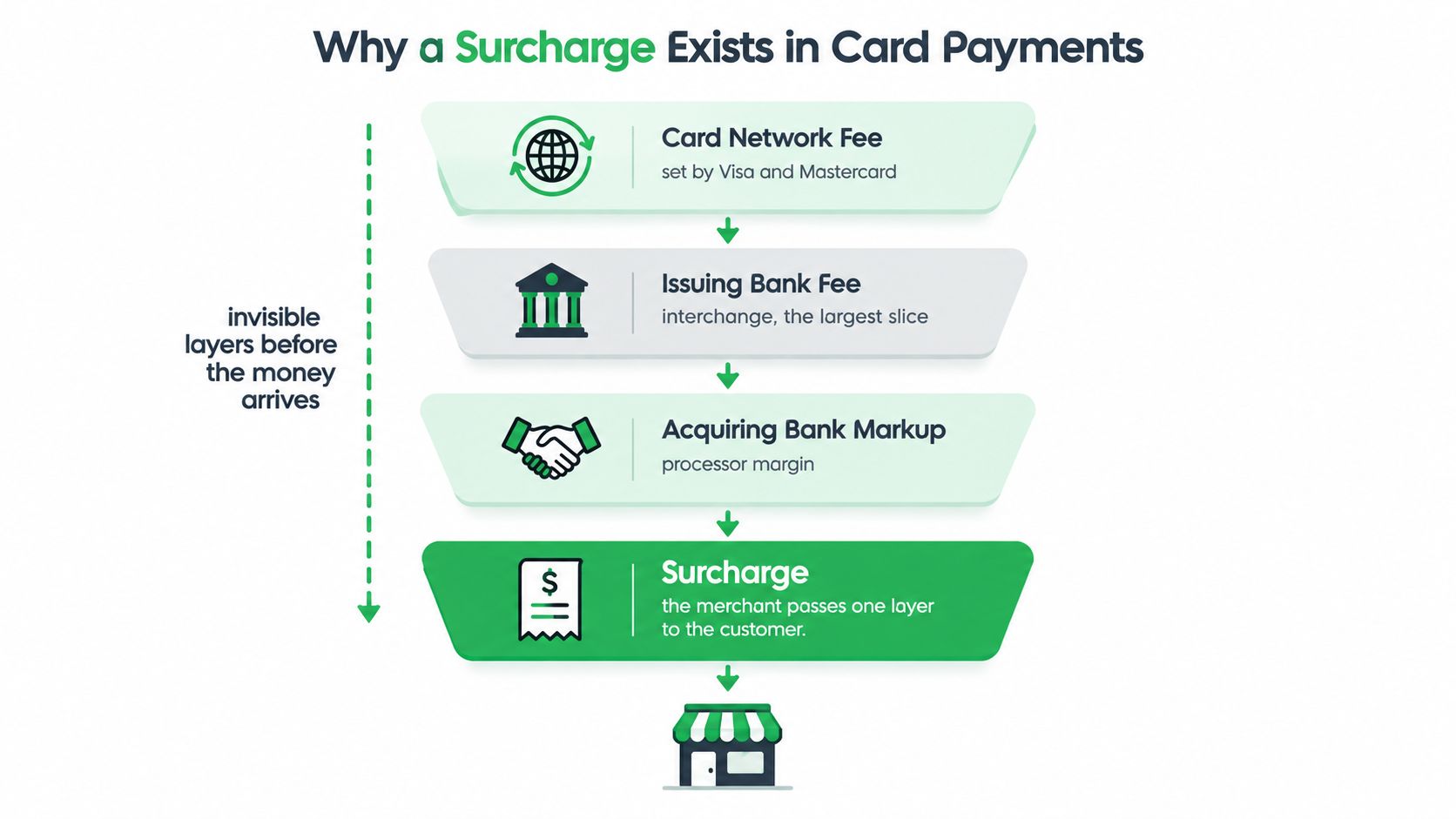
A card payment works a little like a receipt with several invisible deductions. The customer pays the listed price, but the merchant receives less after the acceptance costs are taken out. A surcharge makes one of those deductions visible to the buyer who selected the credit card.
The merchant discount rate is the combined cost charged to accept a payment. It usually contains three layers:
- Interchange, set by the customer's issuing bank.
- Network fees, set by schemes such as Visa or Mastercard.
- Processor or acquirer markup, which pays for acquiring, processing, risk controls, and related services.
Interchange is not the whole cost. The merchant discount rate explanation from Investopedia distinguishes interchange from the broader amount the merchant pays to its acquirer, which can also include processor markup and network-related costs.
<h3>Why card type changes the economics</h3>
Credit cards don't all cost the same to accept. Rewards, commercial, international, and other card products can carry different acceptance costs. Debit cards follow a different pricing and rules framework, and merchants generally can't surcharge them under card-network rules.
That means a merchant needs card-type detection before applying a fee. A checkout that blindly adds a surcharge to every card can create a compliance problem, especially when a debit or prepaid card is presented through a flow that looks similar to credit.
The surcharge is therefore a cost-recovery mechanism, not automatically a profit tool. Visa's merchant guidance requires advance notice to the acquirer, disclosure at the point of entry and point of sale, a separate receipt line, and a cap at the lesser of the applicable merchant discount rate or 3%. Those requirements are detailed in Visa's merchant surcharging FAQ.
For a broader explanation of how interchange affects merchant economics, the best SA card payment guide 2026 can help small businesses compare the pieces of card acceptance. Merchants evaluating their own cost base should also review interchange fees for credit cards rather than treating the processor's blended rate as a single unexplained number.
<h2>Surcharge vs Convenience Fee vs Service Fee</h2>
Customers often call every checkout add-on a surcharge. That shortcut creates confusion because the fee's name can reflect why it exists, when it applies, and which rules govern it.
A surcharge is tied to the payment method. A convenience fee is tied to the payment channel. A service fee is tied to a particular service or transaction arrangement. The same percentage or dollar amount can therefore have a different legal and operational meaning depending on how the merchant applies it.
| Fee Type | Definition | Typical Use | Amount | Example | U.S. Status |
|---|---|---|---|---|---|
| Surcharge | A fee added because the customer uses a credit card | Retail, ecommerce, professional services | Often percentage-based | A 3% line added when a clothing customer pays by credit card | Subject to network, state, and disclosure rules |
| Convenience fee | A fee for using a non-standard payment channel | Utility bills, government payments, phone or online payments | Often fixed or percentage-based | A $2.50 fee for paying a utility bill online by credit card | Depends on the payment program and applicable rules |
| Service fee | A charge connected to providing or administering a service | Tax payments, education, ticketing, and managed services | Fixed or percentage-based | A 2.85% fee attached to a tax payment service | Depends on the service, contract, and governing rules |
<h3>How to label the fee correctly</h3>
Ask one question first: Would the customer pay this fee if they used another payment method?
If the answer is no, and the fee exists because the customer used a credit card, it functions as a surcharge. Mastercard's merchant definition treats a fee tied to a transaction that isn't charged when another payment method is used as a surcharge. U.S. government card guidance similarly describes a surcharge as a retailer's added fee when a customer uses a credit card. These distinctions appear in the GSA SmartPay guidance on surcharges.
A convenience fee has a different trigger. A utility company may allow customers to pay at a local office without a fee but charge for the convenience of paying by phone or online. The fee relates to the channel, not just the use of a particular card.
A service fee can cover administration, fulfillment, or another defined service. Calling a credit-card surcharge a “service fee” doesn't change its underlying function if the fee disappears when the customer pays by debit or bank transfer.
Practical test: Name the fee according to the event that triggers it, then make that trigger visible before the customer pays.
<h2>The Rules That Decide When You Can Surcharge</h2>
Surcharging sits inside several rulebooks at once. The card network may allow a program, but state law can restrict it. A processor agreement may impose additional requirements, and the merchant's checkout still has to provide clear notice.
In the U.S., Visa requires merchants to notify their acquirer at least 30 days before beginning a surcharge program. The fee can apply only to credit cards, must not exceed the lesser of the merchant's applicable discount rate or 3%, and must appear as a separate charge. Visa also requires disclosure at the point of entry, at the point of sale, and on every receipt, as described in its merchant surcharge requirements.
Debit and prepaid cards are a critical carve-out. A merchant can't apply a credit-card surcharge just because a debit card is processed through a checkout experience that resembles credit. Stripe's 2026 summary of surcharge rules identifies debit and prepaid cards as excluded and lists 10 U.S. states with surcharging restrictions: California, Colorado, Connecticut, Florida, Kansas, Maine, Massachusetts, New York, Oklahoma, and Texas.
<h3>Rules vary by location</h3>
The United States doesn't have one simple nationwide permission slip. A merchant serving customers in multiple states needs a jurisdiction-aware setup rather than one global fee toggle.
| Jurisdiction | Allowed? | Cap | Notice Required |
|---|---|---|---|
| U.S. markets under Visa rules | Generally possible for credit cards | Lesser of actual applicable cost or 3% | Acquirer notice at least 30 days before launch, plus checkout and receipt disclosure |
| Restrictive U.S. states | Restricted or prohibited depending on state | Follow the applicable state rule | Review state requirements before enabling the fee |
| EU consumer card payments | Surcharges are broadly restricted or prohibited in many consumer-card situations | Follow local and regional law | Don't assume a U.S.-style program transfers |
| Debit and prepaid cards | Not eligible under the cited network guidance | No surcharge | Detect the payment type before applying a fee |
The European position is important for international ecommerce. A surcharge program that works for a U.S. customer may not be appropriate for a consumer card payment in the EU or another market with stronger restrictions. Merchants should map the customer's jurisdiction, card type, and transaction flow before displaying the fee.
Your payment service provider also matters. A merchant comparing processors should understand what a PSP is, because the PSP may manage acquiring relationships, card detection, routing, compliance settings, and transaction records. None of those tools removes the merchant's responsibility, but they can prevent a checkout from applying the wrong rule.
<h2>How Surcharges Change Conversion and Cart Value</h2>
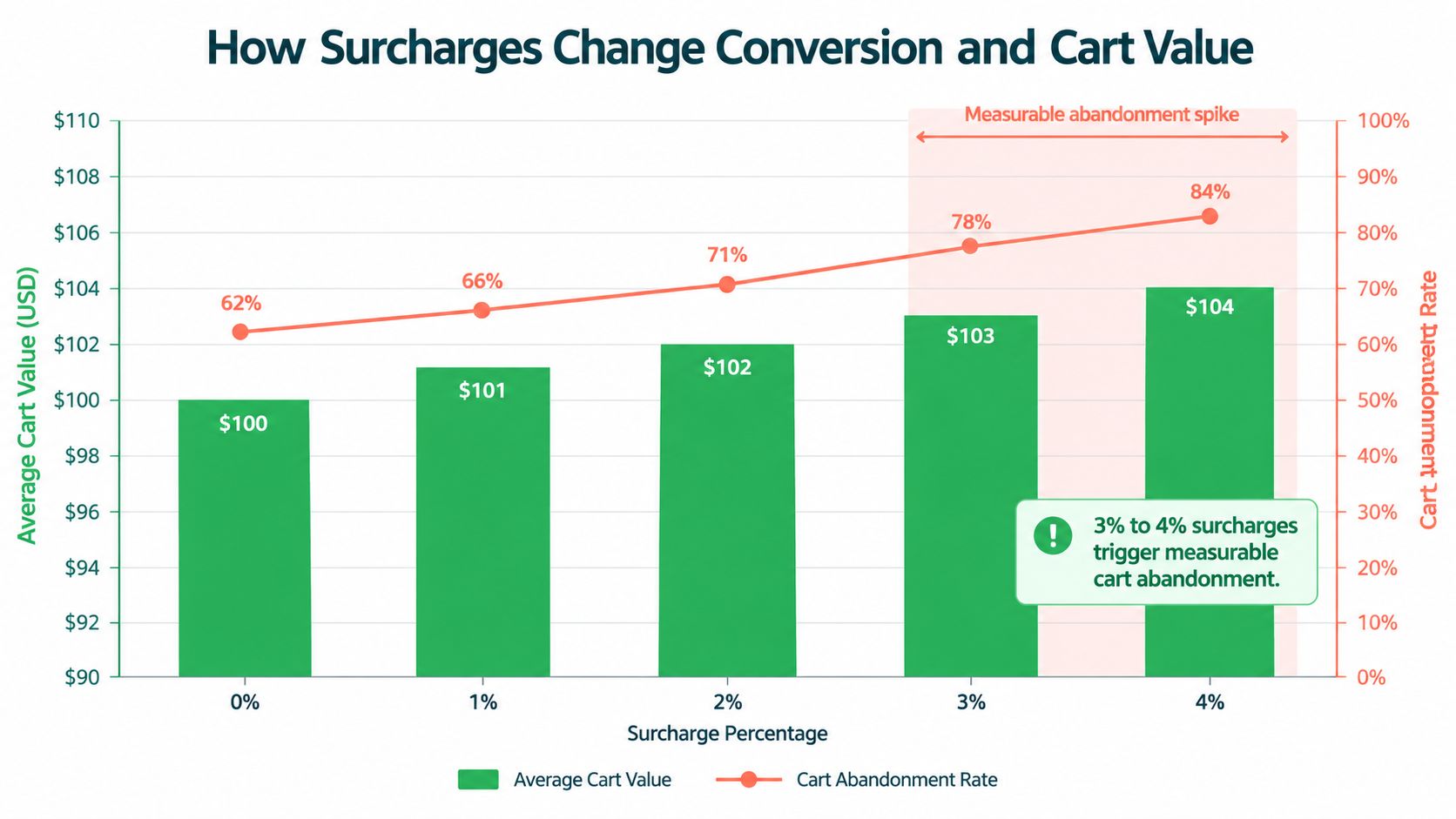
A surcharge changes the customer's decision at the last stage of the purchase. The merchant may recover more from a completed credit-card order, but some customers may switch payment methods, reduce the order, or abandon the checkout.
Consumer reaction can be substantial. One survey cited in Longbridge's surcharge analysis found that 73% of cardholders said they would use credit cards less frequently if surcharges applied, with the figure reaching 84% among women in that survey. The same source reports that 64% of U.S. respondents encountered surcharges in 2026, including customers who encountered them always, usually, or sometimes.
The effect isn't limited to conversion. A visible fee can shift payment volume toward debit, bank transfer, or another lower-cost rail where available. It can also change the order size if shoppers consolidate purchases to make the added charge feel more worthwhile. Those are different outcomes, so merchants should measure payment-method mix and completed orders separately.
<h3>Three numbers to watch</h3>
A merchant testing a surcharge should monitor:
- Completed checkout rate: Compare customers who see the fee with a comparable checkout experience that doesn't.
- Payment-method migration: Track whether customers choose debit, ACH, wallets, or another route instead of credit.
- Net contribution per order: Measure the recovered processing cost against lost orders, support contacts, refunds, and payment-method changes.
The surcharge itself isn't the only variable. Disclosure timing influences how fair the fee feels. A customer who sees it near the product or cart price can evaluate the total before investing time in payment. A customer who sees it only after entering billing information may treat the same amount as an unexpected penalty.
Multi-PSP routing gives merchants another option. Instead of placing the full burden on the customer, the business can route transactions to an acquirer or processor with a more suitable acceptance cost, use local payment methods where appropriate, and retry eligible failures through a different path. That approach doesn't eliminate compliance work, but it can reduce the number of orders that need a surcharge to remain commercially viable.
<iframe width="100%" style="aspect-ratio: 16 / 9;" src="https://www.youtube.com/embed/xML1Mv3qjqY" frameborder="0" allow="autoplay; encrypted-media" allowfullscreen></iframe>
<h2>Best Practices for Displaying and Routing Surcharges</h2>
A compliant surcharge begins before the payment button. The customer should understand the fee while reviewing the price, not after submitting card details. The checkout should also preserve the same amount through authorization, capture, receipt generation, refunds, and reporting.
<h3>Build disclosure into the flow</h3>
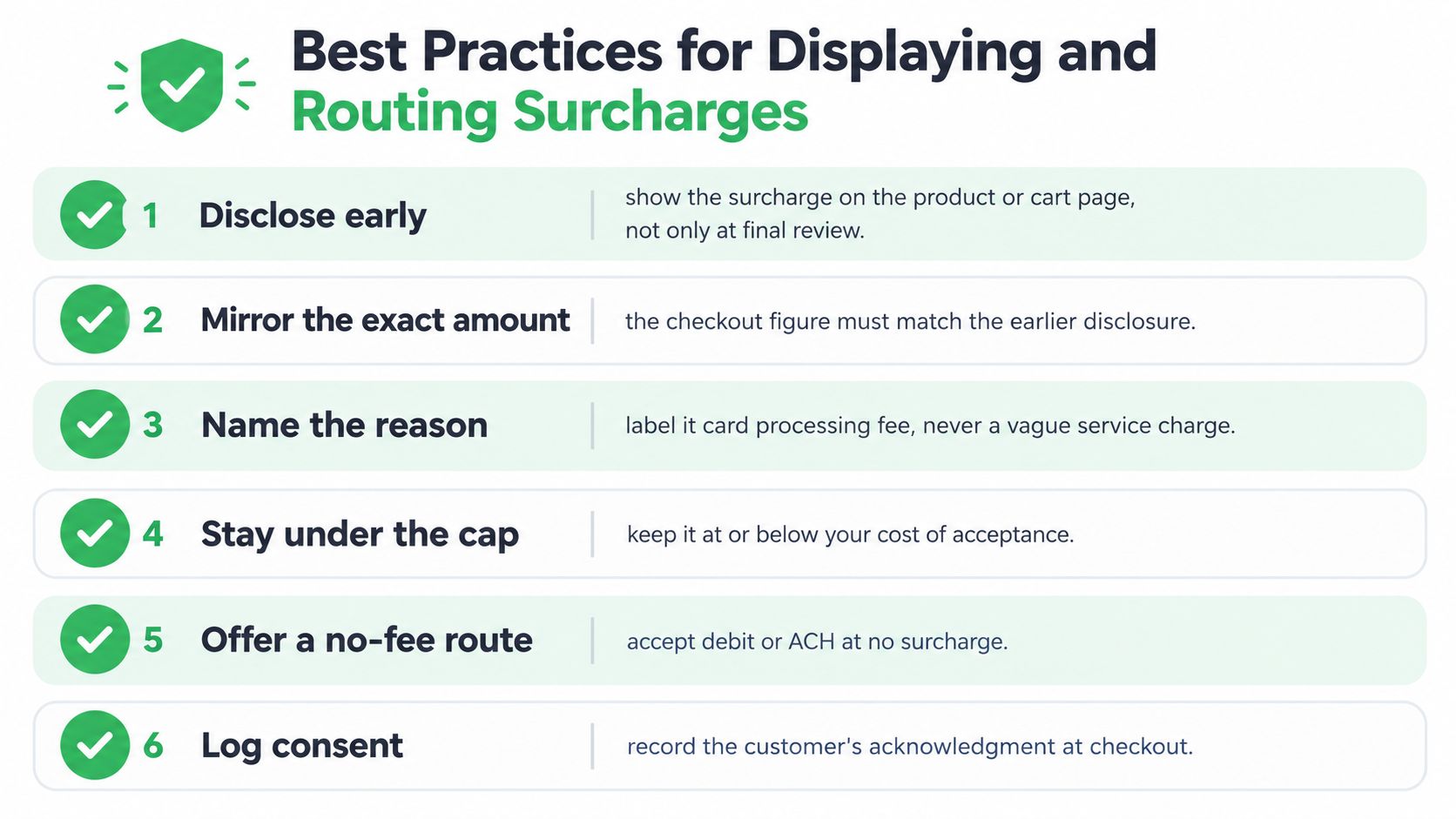
Use a clear, separate line such as credit-card surcharge or card processing surcharge. Don't bury the fee in terms and conditions, merge it into the product price, or use a vague label that prevents the buyer from understanding the trigger.
A reliable flow should:
- Disclose early: Show the possibility and amount near the product, cart, or payment choice.
- Show the exact amount: Make the checkout total match the receipt and order record.
- Identify the payment method: Apply the fee only after the system confirms that the card is eligible.
- Offer another route: Present debit, bank transfer, or another available method without the credit-card surcharge.
- Record acknowledgment: Store the customer's acceptance with the transaction details.
- Reconcile consistently: Make sure refunds and reporting treat the surcharge as a separate line.
The checkout page design guidance from Tagada is relevant to this operational detail because page layout affects whether customers see, understand, and accept the total before payment.
<h3>Use routing before raising the customer price</h3>
Payment orchestration can evaluate transaction attributes and select an appropriate processor. For a merchant using Stripe, Adyen, NMI, or another acquirer, routing logic may consider card type, geography, currency, risk signals, historical approval behavior, and processor availability.
A practical sequence looks like this:
- Identify whether the payment is credit, debit, prepaid, wallet-based, or another eligible type.
- Check whether the customer's location permits the proposed fee.
- Calculate the surcharge from the merchant's documented acceptance cost.
- Display the fee before payment authorization.
- Route the transaction through the processor configured for that card and market.
- Apply a controlled retry only when the first decline is eligible for another attempt.
High-risk merchants need additional discipline because their processing arrangements may include rolling reserves, enhanced PCI and regulatory scrutiny, and network monitoring. Fibonatix's high-risk processing overview describes monitoring thresholds including Visa's VAMP reference of 1.5% fraud-plus-dispute ratio with at least 1,500 monthly events, and Mastercard's ECM reference beginning at 100 chargebacks and a 1.5% ratio.
Subscriptions add another complication. A customer may accept a surcharge during the initial checkout but react differently when a rebill arrives later. One recurring-payment guide reports first-time card-present approval around 96% to 98%, compared with approximately 85% to 90% when the same card is rebilled three months later, while another support source says about 95% of declines come from the customer's bank. Those figures appear in VonPay's recurring payment processing guide. Dunning, account-updater support, and carefully timed payment retries can matter more than just adding a fee.
<h2>When a Surcharge Is the Right Move and When to Skip It</h2>
The right question isn't “Can I add a fee?” It's “Will a compliant fee recover more value than it costs in lost trust, payment volume, and operational complexity?”
A surcharge may fit a thin-margin ecommerce store where credit acceptance materially affects order profitability. It can also be defensible for a high-risk merchant whose processor costs are high, or for an invoice-based B2B operation where buyers already expect itemized payment costs. Subscription and rebill businesses need more caution because a fee that seems acceptable at signup can create resentment at every renewal.
<h3>Use a four-question decision test</h3>
- Does the jurisdiction allow it? Check the customer's location, the transaction market, card type, and current network rules. Don't treat a U.S. configuration as suitable for EU consumer payments.
- Can the checkout disclose it reliably? The fee must appear before payment, remain separate on the receipt, and avoid debit or prepaid application.
- Will the conversion trade-off be acceptable? Use a controlled test and measure completed orders, payment-method changes, support complaints, and refunds. If the fee causes a conversion hit that exceeds the margin it recovers, redesign the program.
- Is routing cheaper than surcharging? Compare the merchant's actual acceptance cost with alternative processors, local methods, debit, ACH, wallets, and retry paths.
Skip or defer the surcharge when the average order is small, the customer base is debit-heavy, or the business operates in a restricted jurisdiction. A fee that looks modest on a large invoice can feel disproportionate on a low-ticket purchase. Premium brands should also consider whether a visible payment fee conflicts with the price experience they're trying to create.
| Merchant profile | Decision | Reason |
|---|---|---|
| Thin-margin ecommerce | Consider launching | Recovery may protect order contribution if disclosure is clear |
| High-risk vertical | Consider with controls | Higher acceptance costs make cost recovery relevant, but risk monitoring remains essential |
| B2B invoice payments | Consider selectively | Buyers may accept an itemized processing line when terms are explicit |
| Subscription-first brand | Test or defer | Repeated fees can affect renewal sentiment and failed-payment recovery |
| Low-ticket retailer | Usually skip | A surcharge can feel disproportionate to the order |
| Debit-heavy business | Usually skip | Much of the payment mix may not qualify, reducing the program's usefulness |
| Restricted state or market | Do not launch until reviewed | Network permission doesn't override local restrictions |
Surcharging is appropriate when it is legal, measurable, accurately calculated, and presented early enough for the customer to make an informed choice. If any of those conditions fails, better routing or a different pricing model is usually safer.
Tagada offers checkout orchestration, multi-processor payment routing, smart retries, subscription management, dunning, and chargeback-aware payment operations for ecommerce and high-risk merchants. To evaluate whether your surcharge strategy should use clearer disclosure, alternative payment routes, or processor-level routing, visit Tagada and review how the platform can fit your payment flow.