
Checkout A/B Testing for Fitness Brands
What to A/B test first on a fitness checkout, how many visitors you need, which metric decides, and the test variants that break the rules.

Article summary
TL;DR
Test what changes the purchase before you test design: the accessory order bump, how delivery is shown, express payment, and the default tier for sports nutrition. At a 2.25% conversion rate, detecting a 20% lift takes about 18,700 visitors per version. Run at least two weeks and pick the winner on contribution per visitor after freight and returns.
- Polar Analytics reports median conversion rates of 2.25% for "Sports & Outdoor" and 2.74% for "Health & Wellness" Shopify brands (August 2026).
- At those rates, a 20% lift needs about 18,700 and 15,300 visitors per version (95% confidence, 80% power, our calculation).
- 40% of US shoppers who abandoned a checkout cited extra costs such as shipping, taxes and fees (Baymard, September 2025).
- An agency reports +26.2% revenue per visitor for a sports nutrition brand that showed express checkout in the cart (undated case study).
- Some "winning" variants break rules: pre-checked boxes, hidden subscription terms, fake "was" prices.
 ChatGPT
 Claude
 Perplexity
 Grok
On this page
This guide is part of our playbook on the best ecommerce platform for fitness brands. For the checkout itself, see checkout optimization for fitness brands.
What to test first
Order your tests by how much revenue they can move. Equipment and sports nutrition don't share the same first test.
| Priority | Test | Version A vs. B | Decide on | For |
|---|---|---|---|---|
| 1 | Accessory order bump | NoBump vs. one related accessory | Contribution per visitor, bump take rate | Equipment |
| 2 | Delivery display | Freight cost at checkout vs. built into the price | Checkout completion, contribution | Heavy equipment |
| 3 | Express payment | Apple Pay and Google Pay at checkout only vs. also in the cart3Blend Commerce, Sports nutrition brand, express checkout on Smart Cart, case study, undated, read November 2, 2026 | Mobile revenue per visitor | Both |
| 4 | Default nutrition tier | 1 tub highlighted vs. 2 tubs highlighted | Contribution per visitor | Sports nutrition |
| 5 | Subscription presentation | One-time first vs. subscription first, terms equally clear | Subscribers, 90-day revenue | Sports nutrition |
| 6 | One-click upsell | Second piece of equipment vs. nutrition subscription | Upsell take rate, contribution | Both |
| 7 | Kit vs. single item | Product alone vs. product with a kit option | AOV, partial returns | Equipment |
Fig. 1Seven tests, from most revenue to least
- Accessory order bump: no bump vs. one related accessory. Equipment.
- Delivery display: freight cost at checkout vs. built into the price. Heavy equipment.
- Express payment: Apple Pay and Google Pay at checkout only vs. also in the cart. Both.
- Default nutrition tier: 1 tub highlighted vs. 2 tubs highlighted. Sports nutrition.
- Subscription presentation: one-time first vs. subscription first, terms equally clear. Sports nutrition.
- One-click upsell: second piece of equipment vs. nutrition subscription. Both.
- Kit vs. single item: product alone vs. product with a kit option. Equipment.
Each test changes one thing. The last word says who it is for.
Equipment and sports nutrition start in different places.
Why delivery deserves a test: 40% of abandoners cite extra costs and 20% delivery that is too slow, in Baymard's US survey2Baymard Institute, Cart abandonment rate statistics and reasons for abandonment, updated September 22, 2025. Heavy items make both worse.
Fig. 2Why delivery is test number two
40%
abandoned over extra costs such as shipping, taxes and fees
20%
abandoned because delivery was too slow
How much traffic you need
A test needs enough visitors in each version to tell a real difference from noise. The table uses the standard two-proportion formula at 95% confidence and 80% power.
| Current conversion rate | Lift you want to detect | Visitors per version | Days at 1,000 visitors a day (two versions) |
|---|---|---|---|
| 2.25% (Sports & Outdoor median) | +10% | about 71,500 | about 143 |
| 2.25% | +20% | about 18,700 | about 37 |
| 2.25% | +30% | about 8,700 | about 17 |
| 2.74% (Health & Wellness median) | +20% | about 15,300 | about 31 |
| 2.74% | +30% | about 7,100 | about 14 |
Baselines are Polar Analytics medians1Polar Analytics, Ecommerce benchmarks, "Sports & Outdoor" and "Health & Wellness", last update August 25, 2026, read November 2, 2026. Computed figures; your own rate changes them.
What this means for a small fitness brand:
Test big changes.
A bump or a new default offer can move results by 20% or more; a button color rarely does.
Test on your highest-traffic product
Usually the hero item or the main protein.
Run at least two full weeks
Even if you reach the numbers sooner, so weekdays and paydays even out.
Measure the right thing
A version can win on conversion and lose money. Track five numbers for every test.
| Metric | Why |
|---|---|
| Conversion rate | Did more visitors buy? |
| AOV | Did they buy more? |
| Contribution per visitor | Did you earn more after product, freight, payment fees and discounts? |
| Returns and disputes | For equipment, did the extra sales come back? |
| Reorder or renewal rate | For nutrition, did buyers return? |
Example (illustrative): version B adds a $35 accessory bump to a $400 bench. The bench earns $120 of contribution per order, the bump $17.50. Conversion stays at 2.2% and 18% of buyers take the bump, so contribution per visitor rises from $2.64 to about $2.71. Check returns on the bump item 30 days later before you call it.
Fig. 3Same conversion, more money
Version A
- Bench pageConverts 2.2%
- buysOrder$400 bench alone
$2.64 contribution per visitor
Version B
- Bench pageConverts 2.2%
- buysOrder18% add the $35 accessory bumpApproved
About $2.71 contribution per visitor
Then check the bump's returns 30 days later.
Equipment results need a delay: a disputed delivery or a "not as described" claim can come weeks after the order, and the refund is limited to what is returned8Visa Core Rules and Visa Product and Service Rules, edition of October 24, 2026, dispute condition 13.3. Wait for that window before calling a test that changed what buyers expect.
How to run a clean test
- Write the hypothesis: "An accessory bump will raise contribution per visitor on the bench."
- Change one thing. Several changes at once make the result unreadable.
- Split traffic randomly, 50/50, on the same pages and channels.
- Fix the sample size and duration before starting, and don't stop when one version leads early.
- Avoid big promotion periods unless that is what you test.
- Check tracking: purchases counted once, server-side. See server-side tracking for fitness brands.
- Log every test, its result and the decision.
Tests that touch the rules
Some variants are not worth testing, because the "winning" version breaks a rule.
| Variant to avoid | Rule |
|---|---|
| A pre-checked accessory or protection bump | The FTC lists "tricking a shopper into buying unwanted items by using a pre-checked box" as a dark pattern7FTC, Bringing Dark Patterns to Light, staff report, September 14, 2022 |
| Subscription terms in small print or below the button | ROSCA: clear terms before billing, express consent5Restore Online Shoppers' Confidence Act, 15 U.S.C. § 8403 |
| A chain of upsells with countdowns | Stripe's list includes businesses that "use high-pressure upselling"4Stripe, Prohibited and restricted businesses, read November 2, 2026 |
| A "was" price you never charged | The former price must be "the actual, bona fide price"616 CFR 233.1, Former price comparisons |
- A pre-checked accessory or protection bumpThe FTC lists a pre-checked box that adds unwanted items as a dark pattern.The same bump, unchecked: no bump vs. one related accessory.
- Subscription terms in small print or below the buttonROSCA asks for clear terms before billing and express consent.Subscription first vs. one-time first, terms equally clear.
- A chain of upsells with countdownsStripe lists businesses that use high-pressure upselling.Test the upsell itself: second piece of equipment vs. nutrition subscription.
- A was price you never chargedThe former price must be the actual, bona fide price.Compare only against a price you actually charged.
Watch out
A pre-checked bump often "wins" on AOV. It then loses on refunds and disputes, which the test window rarely sees.
How Tagada helps
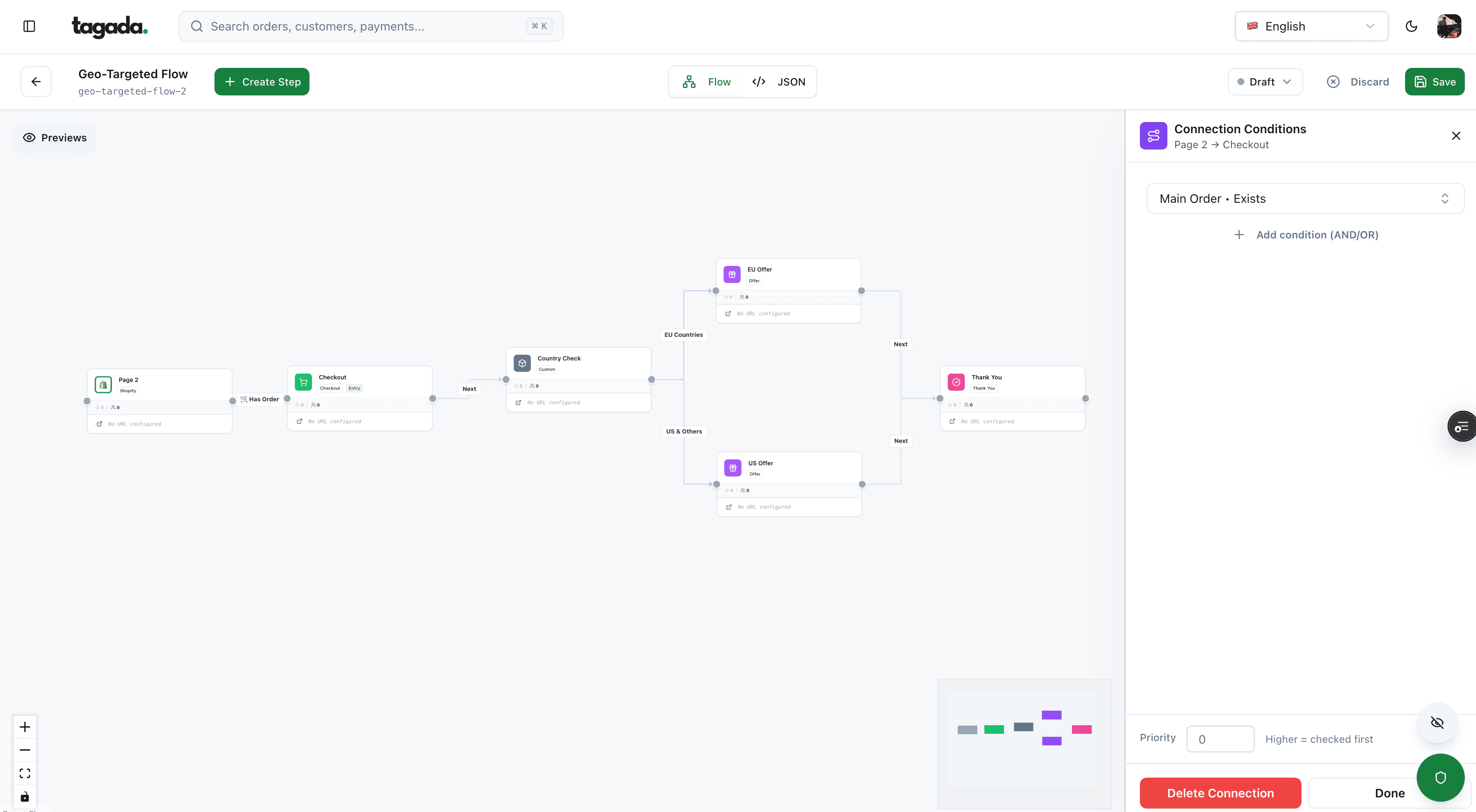
Run bump, delivery and express payment tests from one checkout
- A/B tests on offers, pages and checkout
- Order bumps, triggered for all orders or by the product in the cart, and one-click upsells
- Subscriptions with trials, billing cycles and retries, to test nutrition offers
- Apple Pay and Google Pay to test express payment
- Server-side tracking to Meta, Google and TikTok, so each version's purchases count once
It runs standalone, on Shopify, on WooCommerce or headless. Plans are on the pricing page. To take payments with TagadaPay, apply today: "Most merchants are live under 24 hours," according to TagadaPay.
Frequently asked questions
What should a fitness brand A/B test first?
How long should a checkout A/B test run?
Can a small fitness store run A/B tests?
Should I judge an A/B test on conversion rate?
Does showing express checkout in the cart help?
Sources
Checked November 2, 2026- Polar Analytics, Ecommerce benchmarks, "Sports & Outdoor" and "Health & Wellness", last update August 25, 2026, read November 2, 2026
- Baymard Institute, Cart abandonment rate statistics and reasons for abandonment, updated September 22, 2025
- Blend Commerce, Sports nutrition brand, express checkout on Smart Cart, case study, undated, read November 2, 2026
- Stripe, Prohibited and restricted businesses, read November 2, 2026
- Restore Online Shoppers' Confidence Act, 15 U.S.C. § 8403
- 16 CFR 233.1, Former price comparisons
- FTC, Bringing Dark Patterns to Light, staff report, September 14, 2022
- Visa Core Rules and Visa Product and Service Rules, edition of October 24, 2026, dispute condition 13.3
Tagada
Test the bump and the delivery, not the button color
Funnels, one-click upsells, subscription billing and payment routing, on one customer record.
- 01Create your free account
- 02Connect your store or build a checkout
- 03Launch funnels, upsells and subscriptions