
Landing Pages for Supplement Brands
How to build a supplement landing page: which type for which traffic, the sections in order, the proof buyers look for and the claim rules.

Article summary
TL;DR
A supplement landing page sells one product to one kind of visitor, usually from an ad. It opens with the outcome in the buyer's words, then gives proof (reviews, testing, ingredients), the supply options and a short path to checkout. Every claim on it needs evidence, and structure/function claims need the FDA statement next to them.
- Use a landing page for paid traffic, a product page for browsing traffic, and a pre-sell page only for cold audiences.
- Structure/function claims need the FDA statement; disease claims turn the product into a drug.
- If testimonials show results most buyers won't get, the FTC expects you to disclose "the generally expected performance".
- Meta checks where your ad leads: products on the page must match the ad.
- Mobile is where most supplement traffic converts least: 1.7% median for health and wellness stores.
 ChatGPT
 Claude
 Perplexity
 Grok
On this page
This guide is part of our playbook on the best ecommerce platform for supplement brands. The full funnel around the page is in the supplement sales funnel.
Landing page vs. product page
| Landing page | Product page | |
|---|---|---|
| Traffic | Ads, email campaigns | Search, browsing, returning visitors |
| Goal | One action: choose a supply and check out | Inform and let the visitor explore |
| Navigation | None or minimal | Full menu |
| Content | One product, one outcome, one offer | Details, variants, related products |
| Measured by | Conversion rate of the campaign | Add-to-cart rate |
3 landing page types for supplements
| Type | When to use it | What it contains |
|---|---|---|
| Offer page | Warm traffic, retargeting, email | Product, proof, 1/3/6-month tiers, checkout button |
| Goal page | Search or ads around one need (sleep, energy, joints) | The goal, how the product fits, the offer |
| Pre-sell page | Cold paid social | The problem and the story, then a link to the offer page |
Offer page
Warm traffic, retargeting, email. Product, proof, 1/3/6-month tiers, checkout button.
Goal page
Search or ads around one need. The goal, how the product fits, the offer.
Pre-sell page
Cold paid social. The problem and the story, then a link to the offer page.
A pre-sell page must read as your ad, not as independent news: the FTC treats formats that hide their commercial nature as deceptive7FTC, Enforcement Policy Statement on Deceptively Formatted Advertisements, December 22, 2015.
The sections, in order
Visitors scan from the top and decide in seconds. Build the page in the order of their questions.
| # | Section | Its job | Rule |
|---|---|---|---|
| 1 | Headline | The outcome, in the buyer's words | NoDisease claims |
| 2 | Product and offer | What it is, the supply options, price per month | Show the total, shipping included or not |
| 3 | Proof | Reviews, number of customers, ratings | Typical results, or disclose expected results216 CFR 255.2(b), Consumer endorsements |
| 4 | Testing and quality | Third-party testing, cGMP manufacturing | Link the certificate |
| 5 | Ingredients | Supplement Facts panel, why each key ingredient | Readable on mobile |
| 6 | How to use it | Dose, timing, when to expect results | Realistic timelines |
| 7 | Guarantee and returns | Remove the risk | Clear conditions |
| 8 | FAQ | Shipping, subscription terms, cancellation | Answer before the checkout |
| 9 | Offer again | Catch scrollers | Same tiers, same prices |
Fig. 1The page on a phone, in the order of the buyer's questions
- 1. Headline
- The outcome, in the buyer's words
- 2. Product and offer
- Supply options, price per month
- 3. Proof
- Reviews, number of customers, ratings
- 4. Testing and quality
- Third-party testing, cGMP
- 5. Ingredients
- Supplement Facts panel
- 6. How to use it
- Dose, timing, realistic timelines
- 7. Guarantee and returns
- Clear conditions
- 8. FAQ
- Shipping, subscription terms, cancellation
- 9. Offer again
- Same tiers, same prices
Illustrative layout.
Offer near the top, offer again at the end.
Showing costs early matters: 12% of US shoppers who abandon a checkout could not see the total cost up front, and 40% cite extra costs6Baymard Institute, Cart abandonment rate statistics and reasons for abandonment, updated September 22, 2025.
Fig. 2Costs that surprise US shoppers at checkout
Claims, testimonials and the FDA statement
These rules apply to every line of the page, including reviews you display.
| Element | Rule | Source |
|---|---|---|
| Structure/function claim ("supports restful sleep") | AllowedWith the FDA statement | 21 CFR 101.93121 CFR 101.93, Certain types of statements for dietary supplements |
| Disease claim ("treats insomnia") | Makes the product a drug | 21 CFR 101.93(f)121 CFR 101.93, Certain types of statements for dietary supplements |
| Proof for health claims | "Competent and reliable scientific evidence" | FTC guidance3FTC, Health Products Compliance Guidance, December 2022 |
| Testimonials with exceptional results | Disclose the generally expected performance, and back it up | 16 CFR 255.2(b)216 CFR 255.2(b), Consumer endorsements |
| Page vs. ad | Products on the page must match the ad | Meta ad review4Meta, Ads review policy guidelines, read October 26, 2026 |
The FDA statement121 CFR 101.93, Certain types of statements for dietary supplements:
This statement has not been evaluated by the Food and Drug Administration. This product is not intended to diagnose, treat, cure, or prevent any disease.
Watch out
The FTC says the FDA statement "won't cure an otherwise deceptive ad"3FTC, Health Products Compliance Guidance, December 2022. A strong claim with the disclaimer underneath is still a strong claim.
Mobile first
Most ad traffic for supplements arrives on phones, where health and wellness stores convert at a 1.7% median against 3.0% on desktop5Eevy AI, Shopify conversion rate benchmarks 2026, health and wellness, March 29, 2026.
Fig. 3Median conversion rate, health and wellness stores
- Offer and price visible within the first two screens.
- Supplement Facts as text or a sharp image that can be zoomed.
- Sticky checkout button at the bottom of the screen.
- Apple Pay and Google Pay at checkout, so buyers skip typing their card.
- Fast load: compress images and limit third-party scripts.
What to test
Test one thing at a time, in this order of impact:
- Headline and opening image
- The default offer (which tier is highlighted)
- Where the proof sits (above or below the offer)
- Price presentation (total vs. per month)
- Page length
One test at a time, highest impact first.
Run the tests with checkout A/B testing for supplement brands. If the page gets traffic but no orders, use why your supplement brand gets traffic but no sales.
How Tagada helps
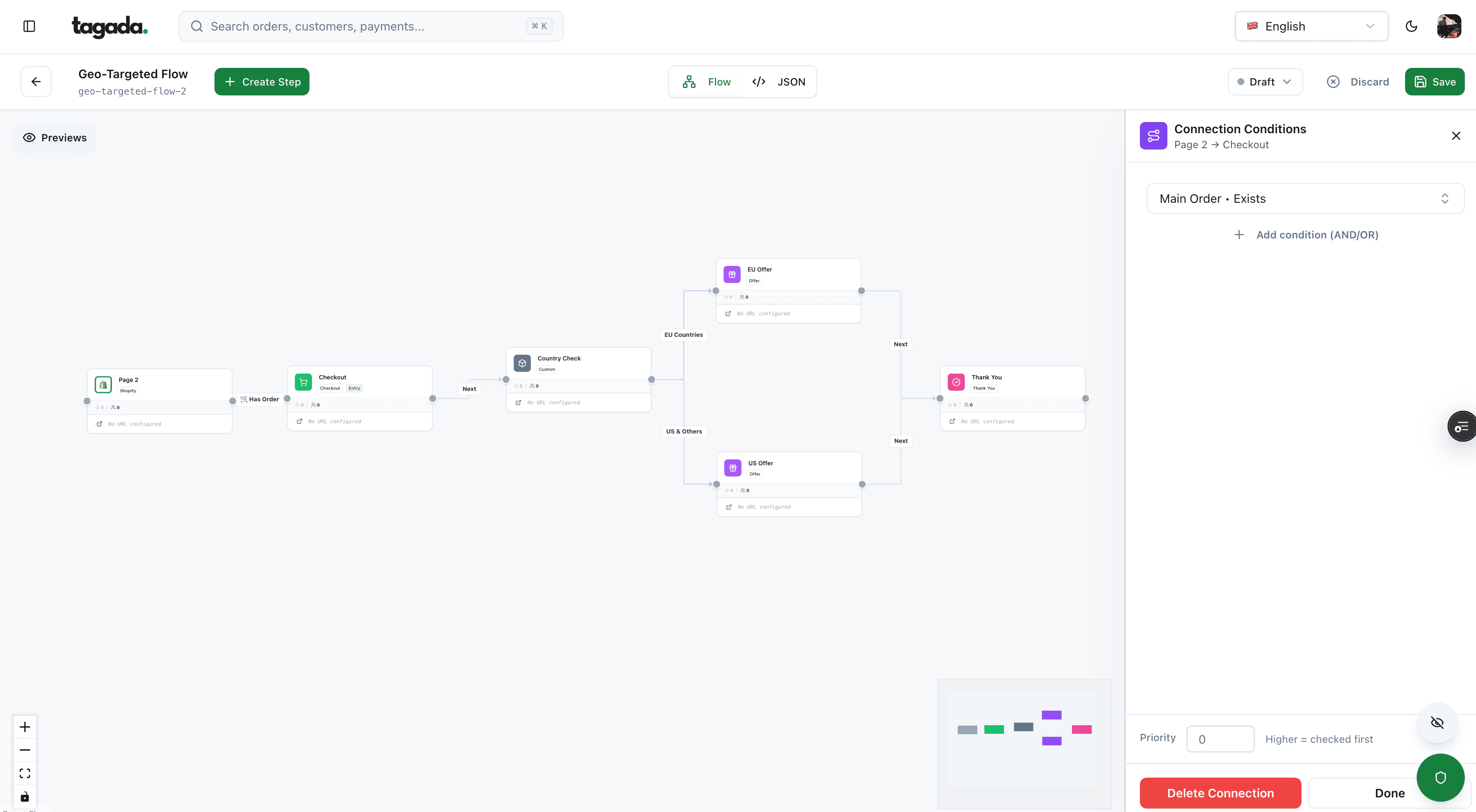
Where the landing page hands off: checkout, upsells, tracking
Tagada takes over where the landing page sends the buyer:
- Checkout: one page, Apple Pay and Google Pay
- Order value: order bumps and one-click upsells
- Testing: A/B tests on offers and checkout
- Tracking: server-side events to Meta, Google and TikTok, so you know which page sells
It runs standalone, on Shopify, on WooCommerce or headless. Plans are on the pricing page.
Frequently asked questions
What should a supplement landing page include?
Should supplement ads go to a landing page or a product page?
Can I use customer testimonials on a supplement landing page?
How long should a supplement landing page be?
Sources
Checked October 26, 2026- 21 CFR 101.93, Certain types of statements for dietary supplements
- 16 CFR 255.2(b), Consumer endorsements
- FTC, Health Products Compliance Guidance, December 2022
- Meta, Ads review policy guidelines, read October 26, 2026
- Eevy AI, Shopify conversion rate benchmarks 2026, health and wellness, March 29, 2026
- Baymard Institute, Cart abandonment rate statistics and reasons for abandonment, updated September 22, 2025
- FTC, Enforcement Policy Statement on Deceptively Formatted Advertisements, December 22, 2015
Tagada
Turn ad clicks into orders, with claims that hold up
Funnels, one-click upsells, subscription billing and payment routing, on one customer record.
- 01Create your free account
- 02Connect your store or build a checkout
- 03Launch funnels, upsells and subscriptions