
Checkout A/B Testing for Supplement Brands
What to A/B test first on a supplement checkout and offer, how much traffic you need, which metric decides, and tests that touch the rules.

Article summary
TL;DR
Start with tests that change what people buy, not the button color: the default supply tier, the order bump, the upsell and express payment. Run each test until both versions have enough visitors (often 10,000 to 20,000 each at a 2 to 3% conversion rate) and at least two weeks, and pick the winner on contribution per visitor, not conversion alone.
- Offer tests (tiers, bundles, subscription default) usually move revenue more than design tests.
- At a 2.3% conversion rate, detecting a 20% lift takes about 18,000 visitors per version (95% confidence, 80% power).
- Run tests for at least two to three weeks so paydays and weekdays even out.
- Judge on contribution per visitor; for bundles and subscriptions, wait for the reorder window.
- Some tests touch rules: no hidden subscription terms, no "high-pressure upselling", no fake "was" prices.
 ChatGPT
 Claude
 Perplexity
 Grok
On this page
This guide is part of our playbook on the best ecommerce platform for supplement brands. For the checkout itself, see checkout optimization for supplement brands.
What to test first
Order your tests by how much revenue they can move.
| Priority | Test | Version A vs. B | Decide on |
|---|---|---|---|
| 1 | Default supply tier | 1 month highlighted vs. 3 months highlighted | Contribution per visitor |
| 2 | Order bump | NoBump vs. a small related add-on | AOV, bump take rate |
| 3 | One-click upsell | Bigger supply vs. second product | Upsell take rate, contribution |
| 4 | Subscription presentation | One-time first vs. subscription first, terms equally clear | Subscribers, 90-day revenue |
| 5 | Express payment | Card form only vs. Apple Pay and Google Pay on top | Mobile checkout completion |
| 6 | Shipping | Flat fee vs. free above a threshold | AOV, conversion |
| 7 | Checkout length | Multi-step vs. one page | Checkout completion |
Fig. 1Seven tests, from most revenue to least
- Default supply tier: 1 month vs. 3 months highlighted.
- Order bump: none vs. a small related add-on.
- One-click upsell: bigger supply vs. second product.
- Subscription presentation: one-time first vs. subscription first, terms equally clear.
- Express payment: Apple Pay and Google Pay on top of the card form.
- Shipping: flat fee vs. free above a threshold.
- Checkout length: multi-step vs. one page.
Each test changes one thing. Decide on contribution per visitor unless the table says otherwise.
Start at the top: offers before design.
Why checkout tests matter: 40% of US shoppers who abandon a checkout cite extra costs, and 17% a checkout that is too long or complicated2Baymard Institute, Cart abandonment rate statistics and reasons for abandonment, updated September 22, 2025.
How much traffic you need
A test needs enough visitors in each version to tell a real difference from noise. The table uses the standard two-proportion formula at 95% confidence and 80% power.
| Current conversion rate | Lift you want to detect | Visitors per version | Days at 1,000 visitors a day (two versions) |
|---|---|---|---|
| 2.3% | +10% | about 70,000 | about 140 |
| 2.3% | +20% | about 18,300 | about 37 |
| 2.3% | +30% | about 8,500 | about 17 |
| 3.0% | +20% | about 13,900 | about 28 |
| 3.0% | +30% | about 6,500 | about 13 |
2.3% is the health and wellness median reported by Eevy AI1Eevy AI, Shopify conversion rate benchmarks 2026, health and wellness, March 29, 2026. Computed figures; your own rate changes them.
Fig. 2Thousands of visitors per version, at a 2.3% conversion rate
The smaller the lift, the longer the wait.
What this means for a small brand:
- Test big changes. A new default offer can move results by 20% or more; a new button color rarely does.
- Test where traffic is highest, usually the offer page and checkout of your main product.
- Run at least two to three weeks even if you reach the numbers sooner3buySAFE, Running effective ecommerce A/B testing, read October 26, 2026.
Measure the right thing
A version can win on conversion and lose money. Track four numbers for every test.
| Metric | Why |
|---|---|
| Conversion rate | Did more visitors buy? |
| AOV | Did they buy more? |
| Contribution per visitor | Did you earn more after product, shipping and discounts? |
| Repeat or renewal rate | For bundles and subscriptions, did they come back? |
Conversion rate
Did more visitors buy?
AOV
Did they buy more?
Contribution per visitor
Did you earn more after product, shipping and discounts?
Repeat or renewal rate
For bundles and subscriptions, did they come back?
Example (illustrative): version B converts 2.5% instead of 2.8%, but highlights the 3-month bundle. Contribution per visitor goes from $0.73 to $1.20. B wins, even with fewer orders.
Fig. 3Fewer orders, more money
Version A
- Offer pageConverts 2.8%
- buysOrderSmaller supply
$0.73 contribution per visitor
Version B
- Offer pageConverts 2.5%, 3-month bundle highlighted
- buysOrder3-month bundleApproved
$1.20 contribution per visitor
Pick the winner on contribution, not conversion.
How to run a clean test
- Write the hypothesis: "Highlighting 3 months will raise contribution per visitor."
- Change one thing. Several changes at once make the result unreadable.
- Split traffic randomly, 50/50, on the same pages and channels.
- Fix the sample size and duration before starting, and don't stop early when one version leads.
- Avoid big promotion periods, such as Black Friday, unless that is what you test.
- Check tracking: purchases must be counted once, server-side. See server-side tracking for supplement brands.
- Keep a log of every test, result and decision.
Tests that touch the rules
Some variants are not worth testing, because the "winning" version breaks a rule.
| Variant to avoid | Rule |
|---|---|
| Subscription terms in small print or below the button | ROSCA: clear terms before the card is entered, express consent5Restore Online Shoppers' Confidence Act, 15 U.S.C. § 8403 |
| A chain of upsells with countdowns | Stripe prohibits "high-pressure upselling"4Stripe, Prohibited and restricted businesses, read October 9, 2026 |
| A "was" price you never charged | FTC: the former price must be a real, regular price616 CFR 233.1, Former price comparisons |
| A pre-checked subscription box | Express consent is required5Restore Online Shoppers' Confidence Act, 15 U.S.C. § 8403 |
- Terms in small print or below the buttonROSCA asks for clear terms before the card and express consent.Subscription first vs. one-time first, terms equally clear.
- Upsell chain with countdownsStripe prohibits "high-pressure upselling".Test the upsell itself: bigger supply vs. second product.
- A "was" price you never chargedThe FTC wants a real, regular former price.Compare only against a price you actually charged.
How Tagada helps
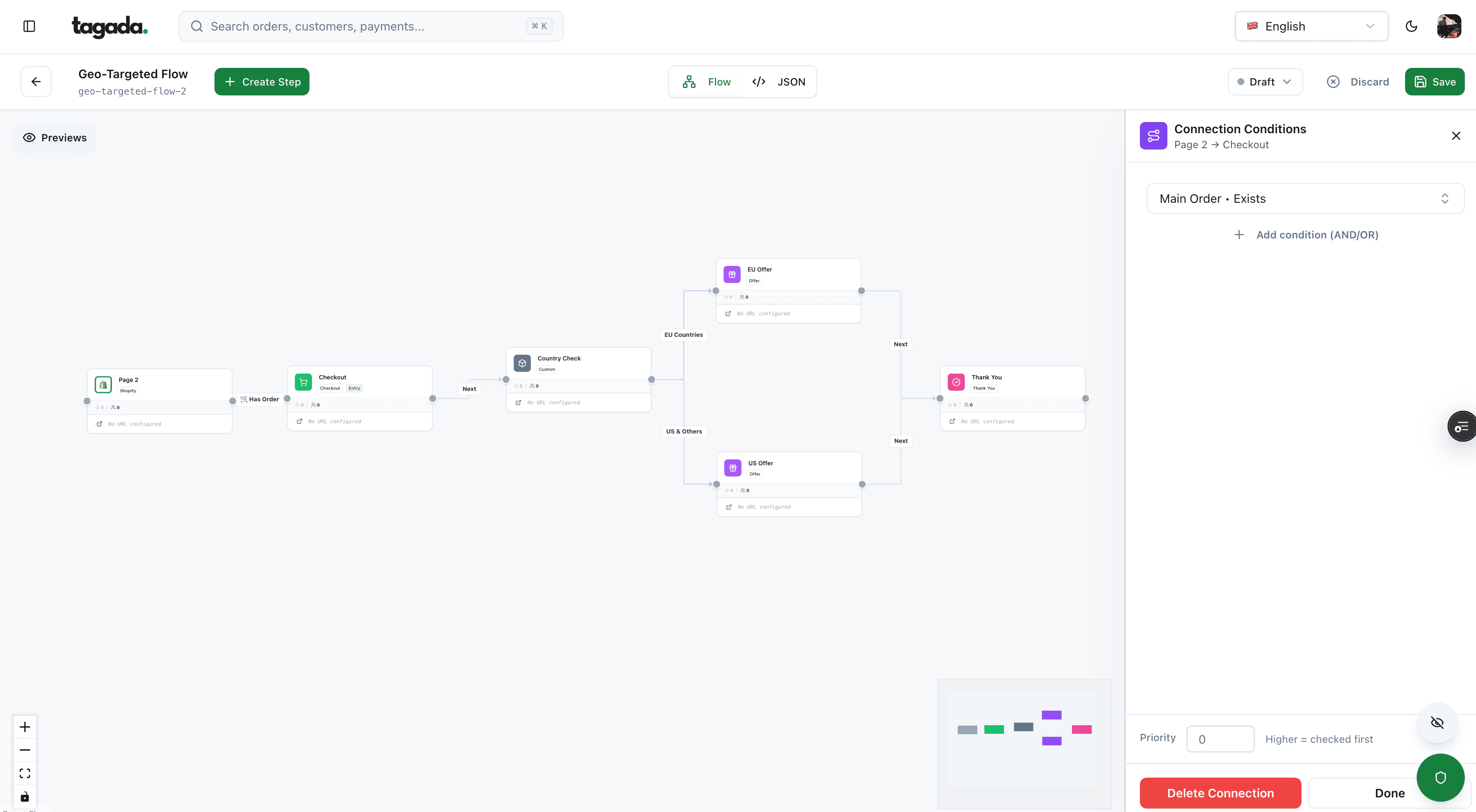
Run offer, bump and upsell tests from one checkout
- A/B tests on offers, pages and checkout
- Order bumps and one-click upsells to test what buyers add
- Subscriptions with trials, cycles and retries, to test subscription offers
- Apple Pay and Google Pay to test express payment
- Server-side tracking to Meta, Google and TikTok, so each version's purchases are counted once
Plans are on the pricing page.
Frequently asked questions
What should a supplement brand A/B test first?
How long should a checkout A/B test run?
Can a small supplement store run A/B tests?
Should I judge an A/B test on conversion rate?
Sources
Checked October 26, 2026- Eevy AI, Shopify conversion rate benchmarks 2026, health and wellness, March 29, 2026
- Baymard Institute, Cart abandonment rate statistics and reasons for abandonment, updated September 22, 2025
- buySAFE, Running effective ecommerce A/B testing, read October 26, 2026
- Stripe, Prohibited and restricted businesses, read October 9, 2026
- Restore Online Shoppers' Confidence Act, 15 U.S.C. § 8403
- 16 CFR 233.1, Former price comparisons
Tagada
Test the offer, not the button color
Funnels, one-click upsells, subscription billing and payment routing, on one customer record.
- 01Create your free account
- 02Connect your store or build a checkout
- 03Launch funnels, upsells and subscriptions