
How to Start an Info Product Business Online
The launch checklist for an online course or coaching business, in order: company, offer, rules, site, billing model, payments and the first 90 days.

Article summary
TL;DR
Set up the company and bank account, define an offer that sells a skill rather than an income, publish the policies Visa requires, choose a billing model (one payment, plan or membership), then pick how you take payments. Processors review your offer, sales page and refund terms, so settling these first means fewer holds and reviews early on.
- Stripe doesn't name courses or coaching, but prohibits "get rich quick" schemes and deceptive testimonials (read November 2, 2026).
- The FTC warned more than 1,100 companies in 2021 that false money-making claims could lead to civil penalties; the maximum is $53,088 per violation since January 17, 2025.
- Visa requires a contact, your country at checkout and a "click to accept" refund policy if you restrict refunds (October 24, 2026).
- Course platforms add their own fees: 7.5% on Teachable Starter, 5% on Podia Mover, 0.5% to 2% on Kajabi with a third-party processor (November 2026).
- When Stripe finds an unacceptable risk, it "will typically restrict or pause payouts" for 120 days (policy updated July 29, 2026).
 ChatGPT
 Claude
 Perplexity
 Grok
On this page
This guide is part of our hub on info product payment processing. The general guide, for any business: merchant accounts for startups. The full launch and growth plan (offer, content, channels, scaling): how to start and scale an info product business.
The launch checklist, in order
| Step | What to do | Why before payments |
|---|---|---|
| 1. Company | LLC or corporation, EIN, business bank account | Processors underwrite the entity and pay out to its account |
| 2. Offer | What the buyer gets: lessons, calls, community, duration | Underwriters read the sales page first |
| 3. Promise | Sell the skill, not an income; no "done-for-you" client promises without legal advice | FTC2FTC, press release of October 26, 2021, Notice of Penalty Offenses Concerning Money-Making Opportunities316 CFR Part 437, Business Opportunity Rule, eCFR, read November 2, 2026 and Stripe1Stripe, Prohibited and restricted businesses, read November 2, 2026 rules |
| 4. Testimonials | Typical results only, or the generally expected result next to them | FTC endorsement rules416 CFR 255.2(b), Guides Concerning the Use of Endorsements and Testimonials in Advertising |
| 5. Site and policies | Contact, country, address, refund and cancellation policy | Visa website rules5Visa Core Rules and Visa Product and Service Rules, edition of October 24, 2026, sections 5.4.2.5 and 5.8.4.1, tables 5-19 and 5-20 |
| 6. Billing model | One payment, fixed plan or membership | Each has its own rules5Visa Core Rules and Visa Product and Service Rules, edition of October 24, 2026, sections 5.4.2.5 and 5.8.4.1, tables 5-19 and 5-206Restore Online Shoppers' Confidence Act, 15 U.S.C. § 8403712 CFR 1026.2(a)(17), Regulation Z, read November 2, 2026 |
| 7. Delivery records | Logins, IP, lessons opened, calls attended | Your only proof in a dispute |
| 8. Payments | Choose where you take payments and apply | Everything above is what they check |
Fig. 1Eight steps, and what the processor checks at each
- 1. CompanyEntity and payout account
- 2. OfferThe sales page, read first
- 3. PromiseThe skill, not an income
- 4. TestimonialsTypical results only
- 5. Site and policiesContact, country, refunds
- 6. Billing modelEach has its own rules
- 7. Delivery recordsYour proof in a dispute
- 8. PaymentsEverything above is checked
By step 8, the processor reads everything you did before.
Rules to settle before your first sale
Selling a course is legal. A few rules decide how you write and bill it.
| Topic | The rule |
|---|---|
| Income claims | The FTC lists claims that buyers "will make a profit" or that "represented profits are typical" as unlawful (FTC 2021 notice)2FTC, press release of October 26, 2021, Notice of Penalty Offenses Concerning Money-Making Opportunities |
| Done-for-you offers | Promising to provide "outlets, accounts, or customers" makes it a business opportunity, with a disclosure document "at least seven calendar days before" payment (16 CFR 437)316 CFR Part 437, Business Opportunity Rule, eCFR, read November 2, 2026 |
| Testimonials | An untypical result needs "the generally expected performance" next to it (16 CFR 255.2(b))416 CFR 255.2(b), Guides Concerning the Use of Endorsements and Testimonials in Advertising |
| Memberships | Terms before card details, express consent, simple cancellation (ROSCA)6Restore Online Shoppers' Confidence Act, 15 U.S.C. § 8403 |
| Payment plans | Agreement before storing the card; no interest on a Visa partial payment (Visa tables 5-19 and 5-20)5Visa Core Rules and Visa Product and Service Rules, edition of October 24, 2026, sections 5.4.2.5 and 5.8.4.1, tables 5-19 and 5-20 |
| Long plans | More than 4 installments by written agreement, more than 25 times a year: you may be a creditor (Regulation Z)712 CFR 1026.2(a)(17), Regulation Z, read November 2, 2026 |
| EU buyers | 14-day withdrawal right, lost on instant-access content only with express consent and acknowledgment (Directive 2011/83/EU, art. 16 m)8Directive 2011/83/EU on consumer rights, article 16 (m), original text |
Watch out
A footer line saying "results not typical" doesn't make an income claim compliant416 CFR 255.2(b), Guides Concerning the Use of Endorsements and Testimonials in Advertising. Some legal templates for course creators still suggest it.
Rules in detail: is it legal to sell info products and online courses online? and info product merchant account compliance.
Choose how you take payments
You have three ways to get paid. They differ in fees, control and who holds your customer data.
| Option | How it works | Watch for |
|---|---|---|
| Course platform payments (Kajabi Payments, Teachable Payments) | The platform processes cards for you | Your cards and subscriptions sit inside the platform |
| Your own Stripe or PayPal account, connected to a platform or a checkout | You're the merchant; the provider can review or close the account | Stripe "may terminate this Agreement or close User's Stripe Account at any time"13Stripe Services Agreement, modified September 28, 2026 |
| An underwritten processor or orchestration | Reviewed up front, sometimes with several processors | Longer application; reserves possible |
Fig. 2Three ways to get paid for a course
- Course platform paymentsCards and subscriptions sit inside the platform
 Your own Stripe or PayPal accountYou're the merchant; the account can be reviewed or closed
- Underwritten processor or orchestrationReviewed up front; reserves possible
The difference is who holds your cards and subscriptions.
Platform fees come on top of card processing. As published on November 2, 2026:
| Platform | Platform transaction fee | Card processing |
|---|---|---|
| Kajabi | 2% (Basic), 1% (Growth), 0.5% (Pro) with a third-party processor | Kajabi Payments, US: 2.9% to 2.7% + $0.30 by plan9Kajabi, Pricing, read November 2, 2026 |
| Teachable | 7.5% on Starter; 0% on Builder and Growth with Teachable Payments | "Standard payment processing fees may still apply"10Teachable, Pricing, read November 2, 2026 |
| Podia | 5% on Mover; none on Shaker and Earthquaker | Processor fees on top11Podia, Pricing, read November 2, 2026 |
Fig. 3Platform transaction fee, before card processing
Card processing comes on top of every bar.
These numbers compare total cost; they're not a recommendation. Processing costs and reserves in detail: info product processing fees and reserves.
Your first 90 days of payments
New accounts get watched. Large, sudden payments on a new course account are a common trigger for a review, as founders report on Reddit's r/stripe.
- Tell your processor what you sell, at the real price, including high-ticket programs and payment plans.
- Start with your real price structure, not a test product that changes later.
- Keep the sales page, checkout and terms consistent with what you declared.
- Answer every refund request fast: a refund costs less than a dispute.
- Log access from day one, so you can answer a "not received" or fraud dispute.
- Watch your dispute ratio weekly. Visa and Mastercard flag US merchants at 1.5%15Stripe Docs, Dispute and fraud card monitoring programs, read November 2, 2026.
Six habits for a new course account. The processor still decides.
If Stripe decides an account carries unacceptable risk, it "will typically restrict or pause payouts to the User's bank account for 120 days" from its first email, then reviews the funds12Stripe, Unacceptable risk policy, updated July 29, 2026. Plan cash for it. More: merchant accounts for new info product businesses.
Mistakes that close new accounts
Income hooks
On the sales page or in ads: "$10k months", "quit your job".
Fake urgency
On expensive programs: Stripe prohibits "high-pressure upselling"1Stripe, Prohibited and restricted businesses, read November 2, 2026.
Hidden memberships
Added to a course purchase: Stripe prohibits "negative option membership clubs" with unclear pricing1Stripe, Prohibited and restricted businesses, read November 2, 2026.
No refund policy at checkout
Or a "no chargeback" clause: Visa forbids requiring a buyer "to waive the right to dispute"5Visa Core Rules and Visa Product and Service Rules, edition of October 24, 2026, sections 5.4.2.5 and 5.8.4.1, tables 5-19 and 5-20.
Selling something other than what you declared
Such as adding a done-for-you service later.
Tagada follows Visa and Mastercard rules and the laws that apply to payments.
How Tagada helps
Checkout and an underwritten processor from your first course
TagadaPay lists "Info products", "Coaching" and "Online courses" among its industries: "You sell software, courses, info products, coaching, or any service delivered online." "If you sell something real, we will get you paid."14TagadaPay, homepage and apply page, read November 2, 2026
- One application: "One KYC. One signed package. We distribute it across our processor network and follow up so you don't have to." "Most merchants are live under 24 hours."14TagadaPay, homepage and apply page, read November 2, 2026 Each file is still underwritten, with "enhanced review for regulated verticals".
- A checkout built for courses: one-click upsells, order bumps, A/B tests, Apple Pay and Google Pay, subscriptions and memberships on the same funnel.
- "Your PCI-tokenized cards, your customer profiles, your subscription data, all portable."14TagadaPay, homepage and apply page, read November 2, 2026
- "Native 3DS2, device intelligence, and rules engine: approve real customers, block the rest."14TagadaPay, homepage and apply page, read November 2, 2026
- Pricing: "From 2.9% + $0.29", "No setup fees, no monthly minimums"; "High-risk verticals and edge cases are priced case by case."14TagadaPay, homepage and apply page, read November 2, 2026
- "24/7 human support on Slack Connect"14TagadaPay, homepage and apply page, read November 2, 2026.
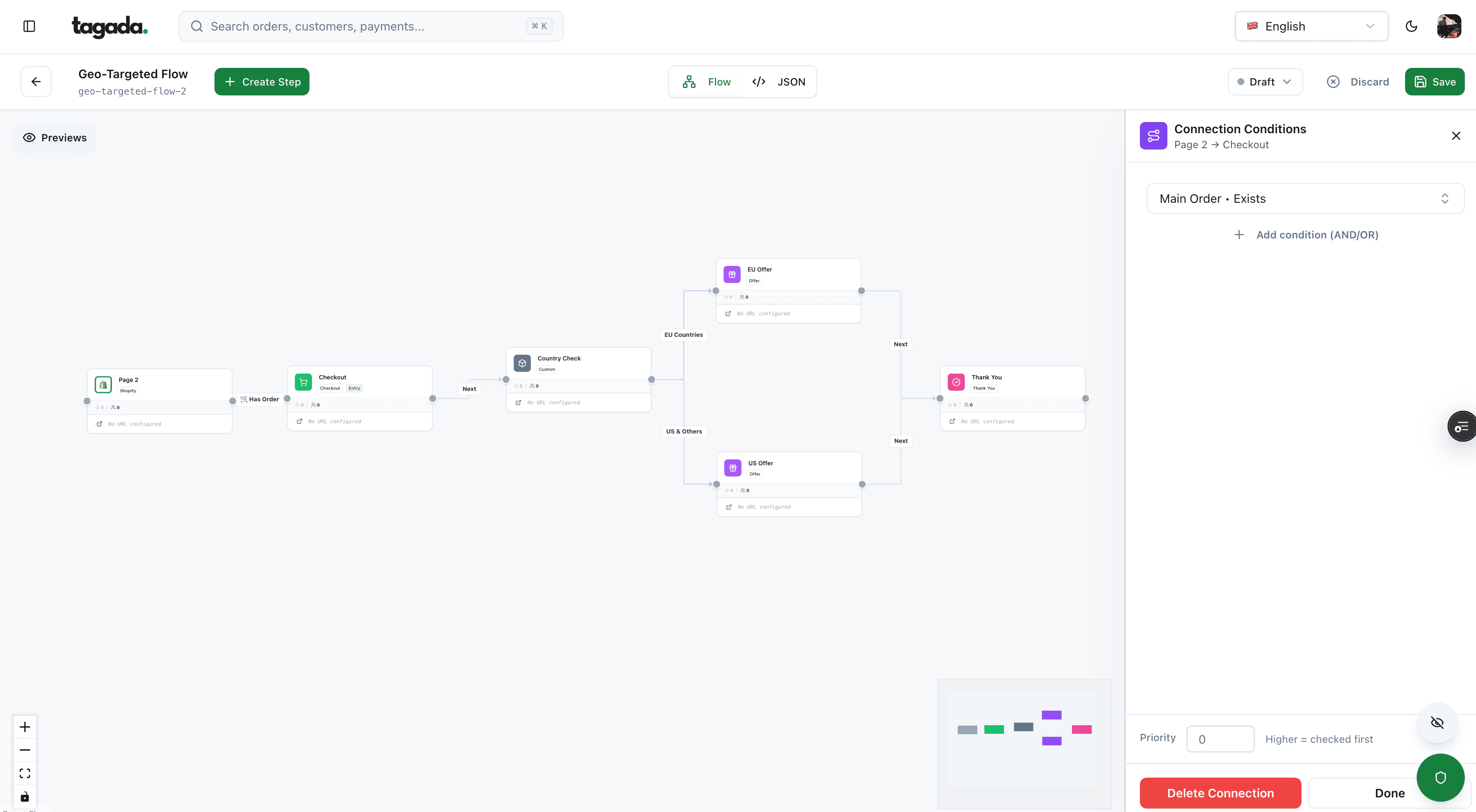
Frequently asked questions
Do I need an LLC to sell online courses?
What payment processor should I use for online courses?
Is selling online courses legal?
Why did Stripe hold my first course payments?
Can I offer payment plans from day one?
Sources
Checked November 2, 2026- Stripe, Prohibited and restricted businesses, read November 2, 2026
- FTC, press release of October 26, 2021, Notice of Penalty Offenses Concerning Money-Making Opportunities
- 16 CFR Part 437, Business Opportunity Rule, eCFR, read November 2, 2026
- 16 CFR 255.2(b), Guides Concerning the Use of Endorsements and Testimonials in Advertising
- Visa Core Rules and Visa Product and Service Rules, edition of October 24, 2026, sections 5.4.2.5 and 5.8.4.1, tables 5-19 and 5-20
- Restore Online Shoppers' Confidence Act, 15 U.S.C. § 8403
- 12 CFR 1026.2(a)(17), Regulation Z, read November 2, 2026
- Directive 2011/83/EU on consumer rights, article 16 (m), original text
- Kajabi, Pricing, read November 2, 2026
- Teachable, Pricing, read November 2, 2026
- Podia, Pricing, read November 2, 2026
- Stripe, Unacceptable risk policy, updated July 29, 2026
- Stripe Services Agreement, modified September 28, 2026
- TagadaPay, homepage and apply page, read November 2, 2026
- Stripe Docs, Dispute and fraud card monitoring programs, read November 2, 2026
- Federal Register, FTC, Adjustments to civil penalty amounts, January 17, 2025
TagadaPay
Apply for course payments once the file is ready
Tell us what you sell and how you sell it. Each application is underwritten, and approval is not guaranteed.
- 01Tell us what you sell and how
- 02Underwriting reviews your business
- 03Process through TagadaPay alongside your other processors