
Friendly Fraud and First-Party Fraud: A Merchant's Guide
Friendly fraud and first-party fraud explained: the disputes they cause, Visa's CE 3.0 rules, the evidence that wins, and the subscription traps.



Article summary
TL;DR
Friendly fraud is a chargeback filed by the real cardholder on a purchase they made, by mistake or on purpose. It is the part of first-party fraud merchants see most. You can't block it at checkout, but you can make it rarer and winnable: a clear descriptor, easy cancellation, alerts, and the data Visa's Compelling Evidence 3.0 needs.
- Friendly fraud means the real cardholder disputes a purchase they made. First-party fraud is the wider family, which also covers refund and free trial abuse.
- Stripe treats an 'unrecognized' dispute as effectively the same as a fraud claim: most friendly fraud arrives as a fraud dispute.
- Visa's Compelling Evidence 3.0 makes a card-absent fraud dispute invalid with two earlier undisputed purchases and matching data. Since October 24, 2026, those purchases can come from other merchants.
- A Visa fraud dispute is also invalid when the payment was fully authenticated with 3D Secure (ECI 5 with a CAVV).
- Most subscription disputes are prevented at signup: terms shown at consent, a reminder 7 days before a trial ends, and online cancellation.
 ChatGPT
 Claude
 Perplexity
 Grok
On this page
A customer orders, receives the parcel, and a few weeks later their bank tells you they never authorized the payment. That's friendly fraud. Sometimes it is a mistake, sometimes it isn't, and the bank rarely knows which. This guide covers how to tell it apart, how to prevent it and how to win the disputes it causes.
What is friendly fraud?
Friendly fraud happens when a customer disputes a valid charge they made themselves. Stripe also calls it chargeback fraud: the customer buys, then tells the bank the payment was fraudulent or unauthorized.1Stripe, What is friendly fraud?, updated June 28, 2023 Mastercard describes it as "genuine transactions" that "are mistakenly or intentionally challenged by cardholders."3Mastercard, Mastercard targets 'friendly' fraud to protect small businesses and merchants, press release, October 23, 2023
The word "friendly" is misleading. Stripe lists four common causes:1Stripe, What is friendly fraud?, updated June 28, 2023
Forgetfulness
The customer doesn't recognize the charge on their statement, often a renewal or an unfamiliar descriptor.
Misunderstanding
The customer misread the terms, the trial or the return policy.
Someone at home
A family member used the card, and the cardholder disputes instead of asking.
Regret
The customer changed their mind and finds a chargeback easier than a return.
The first three are mistakes. The fourth, and the customer who keeps the goods and claims they never arrived, is deliberate. From your side the dispute looks the same, so the response is the same: the evidence that the cardholder took part.
Friendly fraud vs first-party fraud vs third-party fraud
The terms overlap, and sources don't use them the same way. The clearest line runs between who commits the fraud.
| Third-party fraud | First-party fraud | Friendly fraud | |
|---|---|---|---|
| Who | Someone using another person's card or identity | The account holder themselves | The real cardholder |
| Scope | Stolen cards, account takeover | Any fraud by the holder: chargebacks, refund and trial abuse; for banks also false applications and bust-out fraud2Stripe, What is first-party fraud?, updated August 16, 2024 | A dispute on a purchase the cardholder made1Stripe, What is friendly fraud?, updated June 28, 2023 |
| Intent | Always | Usually deliberate | Mistaken or deliberate |
| What stops it | 3D Secure, fraud rules, velocity limits | Policies, history, data | Clear billing, alerts, evidence |
| Dispute you see | Fraud (Visa 10.4) | Fraud, not received, refund requests | Fraud, unrecognized, cancelled subscription |
For a store, first-party fraud mostly means three behaviors that Stripe tracks across its network: multi-account and free trial abuse, refund abuse, and disputes on purchases the customer made.4Stripe Blog, Analyzing first-party fraud trends: account, free trial, and refund abuse, March 10, 2026
Visa's own rules use the term too: an issuer whose cardholder files 5 or more fraud disputes within 12 months must review the account "to determine if first-party fraud abuse is occurring."6Visa Core Rules and Visa Product and Service Rules, edition of October 24, 2026: sections 10.4.2.1 (p. 638) and 10.4.7.3 (p. 644), table 11-29 (pp. 706 to 712), tables 11-98 and 11-99 (p. 763), table 5-20 (pp. 469 to 470)
How common is friendly fraud?
No card network publishes a single rate. The figures that circulate come from studies quoted by networks or processors, each on its own population.
75%
Share of digital goods merchants' card-not-present fraud estimated to be first-party fraud (Datos, quoted by Mastercard, 2023)
62%
Merchants reporting more disputes from first-party fraud over the past year (Merchant Risk Council, quoted by Stripe, 2026)
5
Fraud disputes in 12 months after which a Visa issuer must review the cardholder for first-party fraud
Sources: Mastercard press release, October 23, 20233Mastercard, Mastercard targets 'friendly' fraud to protect small businesses and merchants, press release, October 23, 2023; Stripe Blog, March 10, 20264Stripe Blog, Analyzing first-party fraud trends: account, free trial, and refund abuse, March 10, 2026; Visa Core Rules, October 24, 2026, section 10.4.7.36Visa Core Rules and Visa Product and Service Rules, edition of October 24, 2026: sections 10.4.2.1 (p. 638) and 10.4.7.3 (p. 644), table 11-29 (pp. 706 to 712), tables 11-98 and 11-99 (p. 763), table 5-20 (pp. 469 to 470). Other numbers you'll see online, such as the share of all chargebacks that are friendly fraud, come from dispute-management vendors and vary widely.
How friendly fraud shows up in your disputes
The customer picks a reason, and the reason sets the evidence you need. Stripe says fraud is the most common dispute reason, and that an "unrecognized" claim "is effectively indistinguishable from the Fraudulent reason."5Stripe Docs, Dispute reason code categories, read November 2, 2026
| What the customer claims | Visa code | What answers it |
|---|---|---|
| "I didn't make this purchase" | 10.4, card-absent fraud | Compelling Evidence 3.0, 3D Secure authentication, proof the cardholder used or received the goods5Stripe Docs, Dispute reason code categories, read November 2, 2026 |
| "I don't recognize this charge" | Usually filed as fraud | Same as fraud, plus the receipt and descriptor5Stripe Docs, Dispute reason code categories, read November 2, 2026 |
| "It never arrived" | 13.1 | Tracking to the customer's address, delivery confirmation, usage logs for digital goods5Stripe Docs, Dispute reason code categories, read November 2, 2026 |
| "I cancelled" | 13.2, cancelled recurring | Active subscription, no cancellation on file, terms the customer accepted5Stripe Docs, Dispute reason code categories, read November 2, 2026 |
| "I returned it" or "I'm owed a refund" | 13.6, 13.7 | Refund already issued, or the policy that says none is owed5Stripe Docs, Dispute reason code categories, read November 2, 2026 |
Reason codes one by one: chargeback reason codes. Your options before and after a dispute is filed: chargeback vs refund.
Warning signs of friendly fraud
You can't decline a payment for friendly fraud at checkout: the card and the buyer are real. The signs show up after the order.
- Fraud dispute from a customer with earlier undisputed ordersThe cardholder, not a thiefCheck Compelling Evidence 3.0 eligibility first
- Dispute filed with no message to supportThe customer went straight to the bankSay so in your response; show your contact options
- Not received, but tracking shows deliveredPossible false claim, or a parcel taken at the doorSend tracking, address match and any signature
- Disputes right after each renewalCustomers forget the subscriptionDescriptor, renewal reminders, online cancellation
- Same customer, repeated refund claimsRefund abuseRefund policy limits, block future orders
Inside Tagada
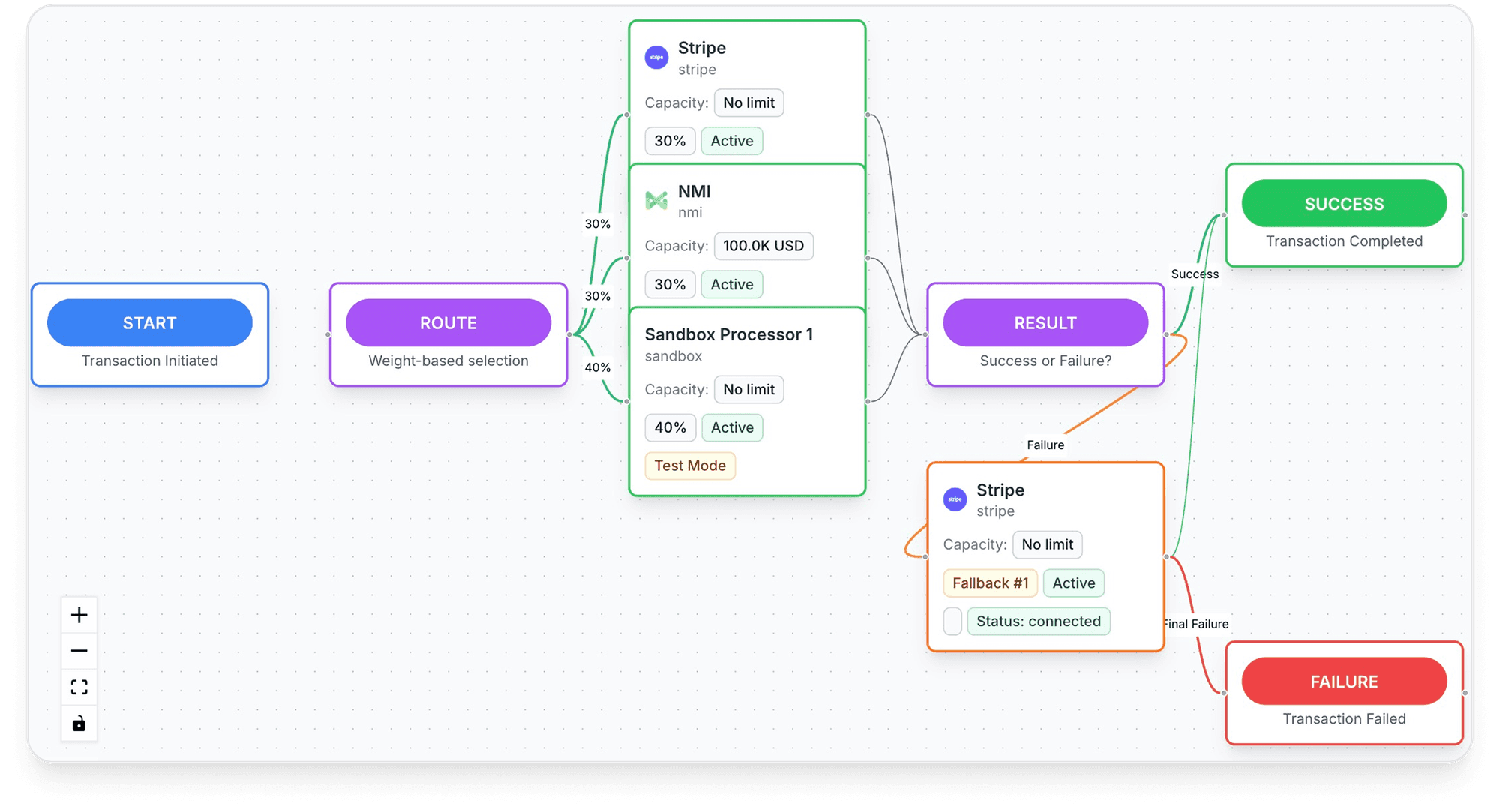
See every payment's route, processor by processor
Set the order your processors are tried in, per store, per country or per product.
Compelling Evidence 3.0: Visa's rule against friendly fraud
Compelling Evidence 3.0 (CE 3.0) turns a customer's history into proof. It applies to Visa condition 10.4, card-absent fraud. Under the rules in force since October 24, 2026, the dispute is invalid when all of these hold:6Visa Core Rules and Visa Product and Service Rules, edition of October 24, 2026: sections 10.4.2.1 (p. 638) and 10.4.7.3 (p. 644), table 11-29 (pp. 706 to 712), tables 11-98 and 11-99 (p. 763), table 5-20 (pp. 469 to 470)
- The same card, or a token linked to it, was used at one or more merchants in 2 earlier transactions the issuer did not report as fraud.
- Those transactions were processed more than 120 days before the dispute and no more than 365 days before it.
- You give a detailed description of what was bought in the disputed and earlier transactions, or a purchase order number in some authenticated flows.
- The device ID or device fingerprint, or the IP address, plus one more element (login ID, full delivery address), match between the earlier and disputed transactions.
Fig. 1A dispute CE 3.0 makes invalid
- Earlier order 1
- March 10, 2026 · 255 days before · undisputed
- Earlier order 2
- May 20, 2026 · 184 days before · undisputed
- IP address
- Same public IP on all three
- Delivery address
- Same full address on all three
- Product descriptions
- Provided for all three
Illustrative record.
two old orders beat one claim
Visa sets strict formats: IP and delivery address in clear text, a device fingerprint of at least 20 characters, and since October 2026 device ID and device fingerprint count as one element, not two.6Visa Core Rules and Visa Product and Service Rules, edition of October 24, 2026: sections 10.4.2.1 (p. 638) and 10.4.7.3 (p. 644), table 11-29 (pp. 706 to 712), tables 11-98 and 11-99 (p. 763), table 5-20 (pp. 469 to 470) The full rule and data table: Compelling Evidence 3.0.
CE 3.0 works at two moments. Before a dispute, through Visa's Order Insight, the issuer sees the earlier orders and the dispute is blocked; Stripe says that adds no dispute fee and no increase in your dispute rate.9Stripe Docs, How dispute prevention works, read October 14, 2026
After a dispute, it becomes your response. Stripe flags eligible disputes and prefills the earlier transactions, but only from charges it processed.8Stripe Docs, Visa Compelling Evidence 3.0 disputes, read October 14, 2026 How the pre-dispute tools work: chargeback alerts.
Other ways a Visa fraud dispute becomes invalid
The same table makes a 10.4 dispute invalid when the payment was fully authenticated with 3D Secure (ECI 5 with a CAVV), or when the issuer has already filed more than 35 disputes on that card within the previous 120 days.6Visa Core Rules and Visa Product and Service Rules, edition of October 24, 2026: sections 10.4.2.1 (p. 638) and 10.4.7.3 (p. 644), table 11-29 (pp. 706 to 712), tables 11-98 and 11-99 (p. 763), table 5-20 (pp. 469 to 470)
Visa also polices the merchant side. Under its Fraud Dispute Monitoring Program, a merchant found falsifying data to qualify loses this protection on future disputes until the problem is fixed and confirmed in writing.6Visa Core Rules and Visa Product and Service Rules, edition of October 24, 2026: sections 10.4.2.1 (p. 638) and 10.4.7.3 (p. 644), table 11-29 (pp. 706 to 712), tables 11-98 and 11-99 (p. 763), table 5-20 (pp. 469 to 470) Send real data, captured at the time of each order.
What Mastercard does about first-party fraud
Mastercard has no CE 3.0. Its answer is the First-Party Trust program, announced on October 23, 2023.
Merchants share extra transaction data, either "as part of the transaction" or "post transaction as part of the disputes process," and Mastercard offers "merchant chargeback protection for disputes that meet First Party Trust data sharing requirements." The rollout started in the US in 2024.3Mastercard, Mastercard targets 'friendly' fraud to protect small businesses and merchants, press release, October 23, 2023 Ask your processor whether it takes part.
Subscriptions: where most friendly fraud starts
A renewal the customer forgot looks, on their statement, like a charge they never made. Visa's rules for recurring payments are written to stop exactly that, and following them is also your best evidence.6Visa Core Rules and Visa Product and Service Rules, edition of October 24, 2026: sections 10.4.2.1 (p. 638) and 10.4.7.3 (p. 644), table 11-29 (pp. 706 to 712), tables 11-98 and 11-99 (p. 763), table 5-20 (pp. 469 to 470)
- At signup, show the terms of the recurring payment, including the fixed dates or interval of the charges.
- Offer a simple way to cancel, and an online one if the customer signed up online.
- At least 7 days before a trial, intro offer or promo ends, email the amount and date of the next charges with a link to cancel online or by text.
- When a renewal is disputed as cancelled (13.2), check whether the claim holds: Visa makes it invalid for a customer-initiated payment, an unscheduled card-on-file charge, a claim of fraud, or a cancellation dated after the transaction.
- Know the limit: a 13.2 dispute only covers the unused part of the service or goods.
Source: Visa Core Rules, October 24, 2026, table 5-20 and tables 11-98 and 11-99.
Trials attract their own abuse. Stripe reported a "significant increase in abusive free trials" across its network from November 2025 to February 2026, mostly people cycling through trials with several accounts.4Stripe Blog, Analyzing first-party fraud trends: account, free trial, and refund abuse, March 10, 2026 The rules for trials and "until cancelled" offers: free trials and negative option billing. Renewals and failed payments: subscription payment processing.
How to prevent friendly fraud
Prevention works on the three things behind most cases: the customer doesn't recognize the charge, can't reach you, or finds the bank easier than your refund process.
| Move | Stops |
|---|---|
| A statement descriptor with the brand name customers know5Stripe Docs, Dispute reason code categories, read November 2, 2026 | "I don't recognize this charge" |
| A receipt by email after every payment and renewal5Stripe Docs, Dispute reason code categories, read November 2, 2026 | Forgotten purchases |
| Renewal reminders and online cancellation, as Visa requires6Visa Core Rules and Visa Product and Service Rules, edition of October 24, 2026: sections 10.4.2.1 (p. 638) and 10.4.7.3 (p. 644), table 11-29 (pp. 706 to 712), tables 11-98 and 11-99 (p. 763), table 5-20 (pp. 469 to 470) | "I cancelled" disputes |
| Fast refunds when the customer has a point | Disputes filed out of frustration |
| Visible support contact on the receipt and the site | Customers going straight to the bank |
| Alerts: Order Insight, RDR, Ethoca | Disputes resolved before they count |
| IP, device, login and full address saved on every order | Lost CE 3.0 eligibility |
| 3D Secure on risky first orders | Fraud claims on authenticated payments |
Eighteen measures ordered by stage and reason code: how to prevent chargebacks. Alerts, costs and setup: chargeback alerts.
How to fight a friendly fraud chargeback
Fight when the evidence answers the reason code. Accept when the customer has a point: a late parcel, a cancellation you missed, a product that didn't match its page.
Fig. 2From dispute to decision
- Read the reasonFraud, not received, cancelled, refund owed
- Check CE 3.0Visa fraud disputes on repeat customers
- Gather proofDelivery, usage, terms, earlier orders
- Respond on timeShort letter, evidence attached
answer the claim, not the customer
For a fraud claim, Stripe's guidance is to show that the legitimate cardholder, or someone they authorized such as a family member, made the payment; that 3D Secure authenticated it; that you already refunded; or that the customer withdrew the dispute or admitted filing it in error.5Stripe Docs, Dispute reason code categories, read November 2, 2026
For physical goods, Stripe lists photos or emails linking the recipient to the cardholder, and proof the cardholder has the products.5Stripe Docs, Dispute reason code categories, read November 2, 2026 For digital goods, usage, logins and downloads tied to the customer.5Stripe Docs, Dispute reason code categories, read November 2, 2026
A customer who admits the mistake can withdraw the dispute through their bank. Ask, in writing, and attach their reply to your evidence. To write the response: chargeback rebuttal letter. Fees and timelines: chargebacks for merchants.
Refund abuse: the quiet form of first-party fraud
Refund abuse never reaches the bank. Stripe defines it as customers who "request refunds for goods or services they've already received and plan to keep": false "not delivered" or "defective" claims, refunds after fully consuming a digital good, repeated refunds on the same card or account.7Stripe Docs, Refund abuse prevention, read November 2, 2026
Stripe's Radar now gives each payment a refund abuse risk level, but warns that it reflects "the likelihood that a payment will result in a refund policy violation," not fraud.7Stripe Docs, Refund abuse prevention, read November 2, 2026
Use it to enforce your refund policy, for example by reviewing refund requests from customers who already had several, not to decline first orders. A written policy, limits on the number of refunds per customer, and proof of delivery do most of the work.
How Tagada helps
Disputes you can answer, on every processor
- Native 3DS2, device intelligence and a rules engine: "approve real customers, block the rest."
- Your vault: "Your PCI-tokenized cards, your customer profiles, your subscription data, all portable."
- Subscriptions with trials, billing cycles, retries and automatic recovery.
- Routing across TagadaPay and processors such as Stripe, NMI and Airwallex, with one logic; switch processors without re-onboarding customers.
- TagadaPay underwrites every file and refuses businesses that try to get around chargeback rules.
- From 2.9% + $0.29, no setup fees, no monthly minimums. High-risk verticals and edge cases are priced case by case.
- 24/7 human support on Slack Connect.
Tagada follows Visa and Mastercard rules and the laws that apply to payments.
Frequently asked questions
What is the difference between friendly fraud and first-party fraud?
Can you win a friendly fraud chargeback?
How do you prove friendly fraud?
Does 3D Secure stop friendly fraud?
Should I block a customer who filed a chargeback?
Do friendly fraud disputes count in my chargeback ratio?
Sources
Checked November 2, 2026- Stripe, What is friendly fraud?, updated June 28, 2023
- Stripe, What is first-party fraud?, updated August 16, 2024
- Mastercard, Mastercard targets 'friendly' fraud to protect small businesses and merchants, press release, October 23, 2023
- Stripe Blog, Analyzing first-party fraud trends: account, free trial, and refund abuse, March 10, 2026
- Stripe Docs, Dispute reason code categories, read November 2, 2026
- Visa Core Rules and Visa Product and Service Rules, edition of October 24, 2026: sections 10.4.2.1 (p. 638) and 10.4.7.3 (p. 644), table 11-29 (pp. 706 to 712), tables 11-98 and 11-99 (p. 763), table 5-20 (pp. 469 to 470)
- Stripe Docs, Refund abuse prevention, read November 2, 2026
- Stripe Docs, Visa Compelling Evidence 3.0 disputes, read October 14, 2026
- Stripe Docs, How dispute prevention works, read October 14, 2026
TagadaPay
Keep the data that wins friendly fraud disputes
Tell us what you sell and how you sell it. Each application is underwritten, and approval is not guaranteed.
- 01Tell us what you sell and how
- 02Underwriting reviews your business
- 03Process through TagadaPay alongside your other processors