
A DTC founder opens the payment dashboard on Monday morning and sees a pre-arbitration notice beside a chargeback the business thought it had already won. The original response went in, the case seemed settled, and now the issuer is challenging it again. The immediate question is practical: what has to happen next, and how much time is left?
A pre-arbitration chargeback is a formal escalation, not just another routine notification. The issuer is saying the merchant's second presentment, also called representment, didn't resolve the dispute or may have failed to meet a network rule. The merchant or acquirer must decide whether to accept the case or contest the issuer's position with relevant evidence.
The stakes include more than the disputed sale. A weak response can carry a case closer to network arbitration, where fees may apply on top of the transaction amount. Understanding how the process works, keeping deadlines visible, and preserving usable records before a notice arrives all help a merchant make a clearer decision. For a useful accounting perspective on recording the financial impact of disputes, see chargeback accounting with Loopfour.
What a Pre Arbitration Chargeback Actually Means for Merchants
The first thing to do when the notice arrives is separate the feeling of “we won” from the procedural status of the case. A successful representment doesn't always end a dispute. If the issuer believes the defense didn't answer the cardholder's claim, or considers the representment invalid, it may file a pre-arbitration case and explain why it rejects the merchant's position. The acquirer then decides whether to accept or reject that case.
That makes pre-arbitration a final bilateral checkpoint before a network may be asked to decide who bears financial liability. It isn't a fresh chargeback from scratch. It's a challenge to the defense already submitted, so copying the original receipt or repeating the same argument may leave the issuer's stated objection unanswered.
For a subscription business, for example, the initial defense might show that a payment was authorized. But if the issuer's concern is that the cardholder says they cancelled before a renewal, authorization alone doesn't explain whether the cancellation was received before billing. The response needs to address the specific dispute reason and connect the transaction to relevant account history, policy disclosures, cancellation records, fulfillment, or customer communications.
First move: Read the issuer's explanation before choosing whether to accept or contest the case. Treat the objection as a specific question your evidence must answer.
The right decision depends on the strength of the records and the cost of taking the case further. A merchant that knows what the notice challenges can assess those factors more calmly than one trying to rebuild a timeline from scattered processor dashboards. The rest of the work is operational: identify the applicable network clock, gather evidence that answers the objection, and make a documented decision about escalation.
How Pre Arbitration Fits Inside the Disputes Lifecycle
Think of a dispute like a support issue that moves up an escalation ladder. A customer raises a concern, the first team reviews it, and a manager takes another look if the first answer doesn't resolve the problem. Pre-arbitration is that formal second review, with network rules governing who submits what and when.
The sequence is easier to understand one handoff at a time:
- The issuer files a chargeback. The cardholder disputes a transaction, and the issuer starts the chargeback process.
- The merchant or acquirer submits representment. The response presents evidence for why the transaction should remain the merchant's responsibility or why the chargeback should be reversed.
- The issuer reviews the second presentment. If the issuer considers the defense inadequate or invalid, it can file pre-arbitration, explaining why it rejects the response and providing supporting documentation.
- The acquirer decides whether to accept or reject the pre-arbitration case. If it rejects the case, the issuer may accept financial responsibility or escalate to network arbitration.
- The network decides at arbitration. The card scheme reviews the matter and makes a binding decision on financial liability.
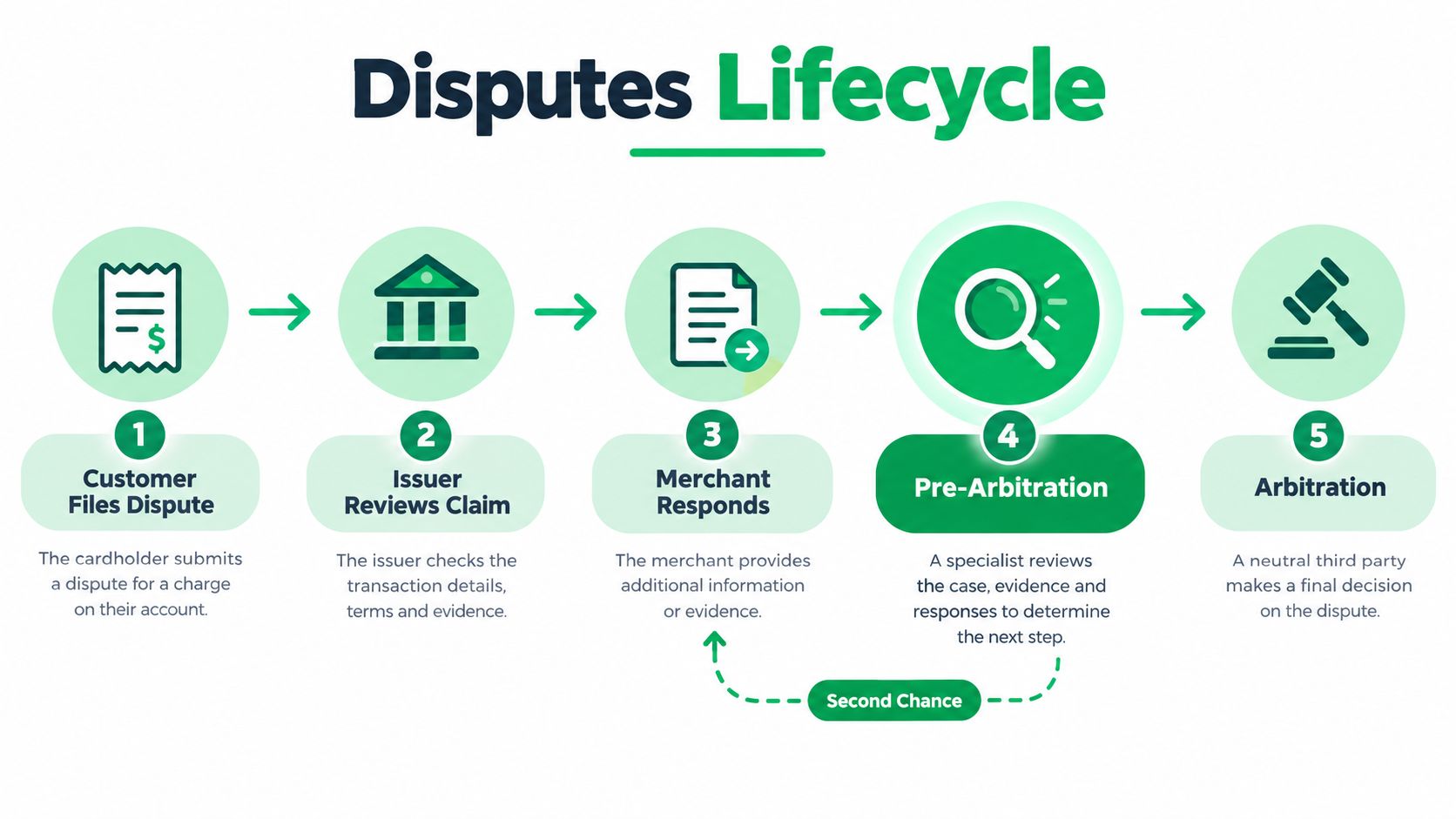
The key distinction is that pre-arbitration is not a new dispute. It is the issuer's formal rejection of the merchant's second presentment. Arbitration is the next escalation, when the network itself decides the case.
The dispute record should travel with each handoff. Customer-service notes can help explain a complaint; complaint software for support teams can help organize those interactions so relevant messages are easier to locate when a dispute arrives.
Mastercard and Visa Timelines Compared Side by Side
A deadline on a processor dashboard may not be the network deadline. Record the dates that anchor the case itself, then confirm which network rules and reason code apply. The clocks below are different, and the Visa timetable described here applies to specific markets and dispute dates.
| Network | Initial defense | Pre-arbitration trigger | Response window | Arbitration clock |
|---|---|---|---|---|
| Mastercard | The issuer generally has 45 days from the date the defense or information was uploaded to file pre-arbitration, subject to reason-code and network rules. Mastercard guidance | The issuer challenges the second presentment and explains why it considers the defense inadequate. | Where pre-arbitration is required, the issuer generally gives the acquirer 10 calendar days to respond. Mastercard merchant guide | Arbitration may be submitted within 45 calendar days of the second-presentment settlement date or Central Site Business Date. An optional pre-arbitration exchange doesn't reset that clock. |
| Visa | For disputes opened on locally processed payments in the United States and Canada beginning July 21, 2025, merchants have 9 days to submit defense documents. Disputes opened before then, and disputes in other regions, generally use 18 days. Visa guidance | The issuer or cardholder's bank may challenge the merchant's evidence with a pre-arbitration, also called a second chargeback. | The bank has 30 days to review the pre-arbitration case and accept or decline it. | The available information here doesn't specify a separate Visa arbitration clock. Confirm the applicable network and processor rules for the case. |
For Mastercard, the issuer's filing period and the acquirer's response period are separate controls. The arbitration clock is tied to the second-presentment settlement date, not necessarily to the date a processor sends a pre-arbitration alert. Visa's initial defense window also depends on market and when the dispute was opened, so don't apply its newer United States and Canada timetable to every case.
Operational rule: Store the second-presentment settlement date, the pre-arbitration submission date, and the response deadline with the transaction record. Check the deadline in the applicable network rules, not only the notification timestamp.
If a case has moved between processors, reconcile their timestamps before acting. For a broader view of dispute duration and the stages that affect it, see Tagada's guide to how long a chargeback takes.
What a Winning Pre Arbitration Response Actually Contains
A strong response answers the issuer's objection with evidence that connects the disputed amount to a customer action and an obligation under the transaction. Authentication is useful, but it doesn't prove every part of the case. A payment can pass authentication checks while the merchant still needs to show what was purchased, whether the customer agreed to recurring billing, or whether the service was delivered.
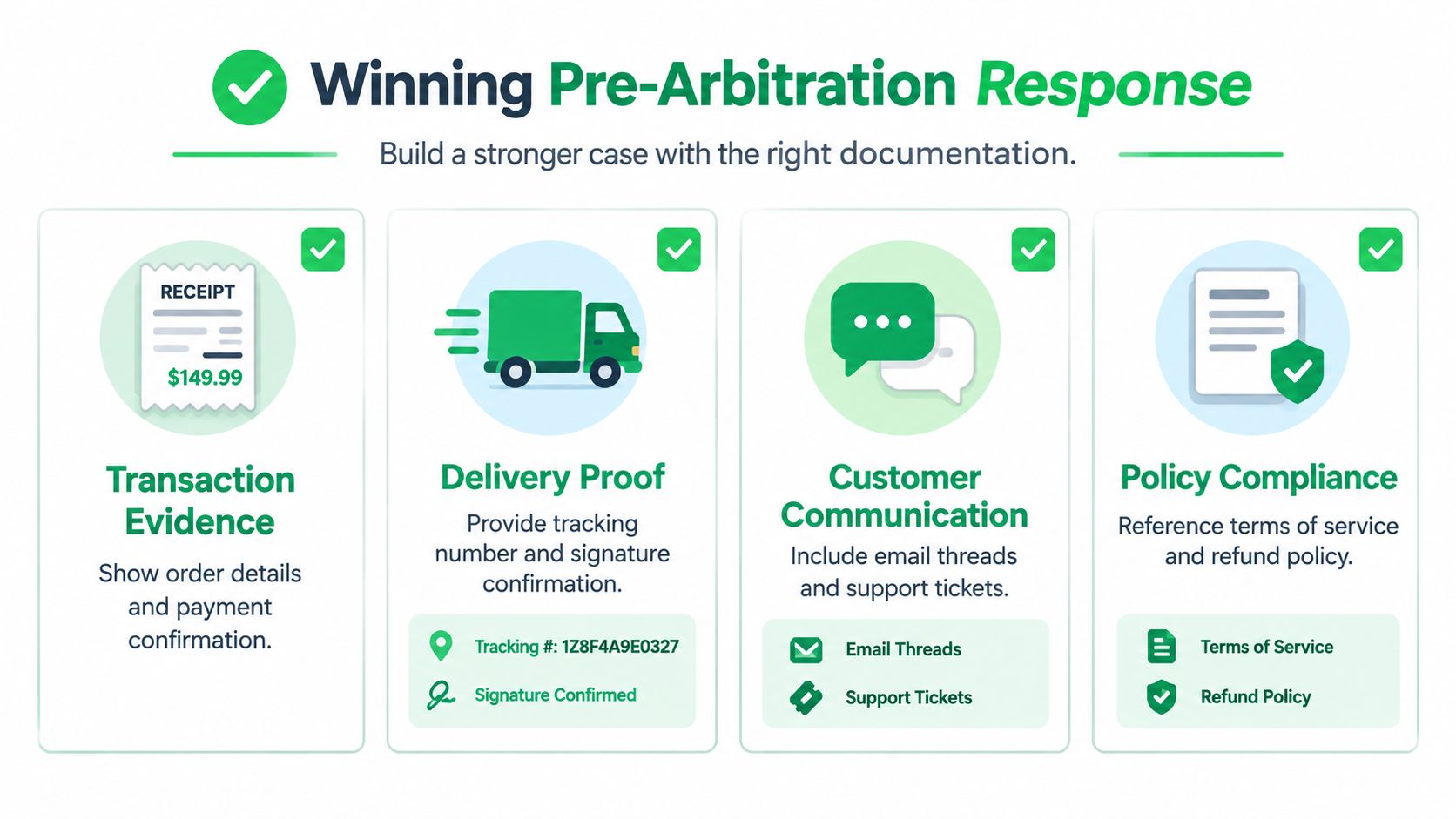
Match the evidence to the dispute:
- Card-not-present fraud: Include AVS and CVV outcomes, device or IP consistency, account history, and fulfillment confirmation. These records help explain how the transaction relates to the customer account and what happened after authorization.
- Recurring payments: Assemble the original authorization, renewal notice, cancellation-policy disclosure, and records showing whether a cancellation request was received before the billing event. A policy by itself doesn't establish what the customer did or when the merchant received a request.
- Physical goods: Provide delivery records tied to the relevant order and timestamps. If a carrier issue appears in the customer-service record, include that context rather than treating delivery status as the whole story.
- Digital goods or services: Use access or delivery logs connected to the customer account and timestamps. A generic statement that a download was available is weaker than records showing the account's access to the purchased item.
Before submitting, compare the issuer's specific reason for rejection with the evidence already sent. If the original representment repeated a receipt and the issuer raised a missing policy disclosure or new cardholder information, sending the receipt again won't close that gap. Mastercard's published process requires supporting documentation to be linked when the pre-arbitration case is filed, so the records should be organized and ready to attach.
For a useful structure for presenting evidence and arguments, refer to Tagada's guide to writing letters of rebuttal. Keep the final submission focused: state the point at issue, identify the relevant record, and explain how that record answers the issuer's objection.
What It Costs to Let a Case Reach Arbitration
Take a $39 renewal dispute where the issuer has already rejected the representment and the cancellation log is thin. A win is still possible, yet the question that matters has changed: what does losing cost at the next stage? Published network rules put the arbitration case-ruling fee at approximately $600 for Visa and $575 for Mastercard, payable by the losing party on top of the disputed amount and any associated processing fees (Visa Core Rules; Mastercard's Chargeback Guide).
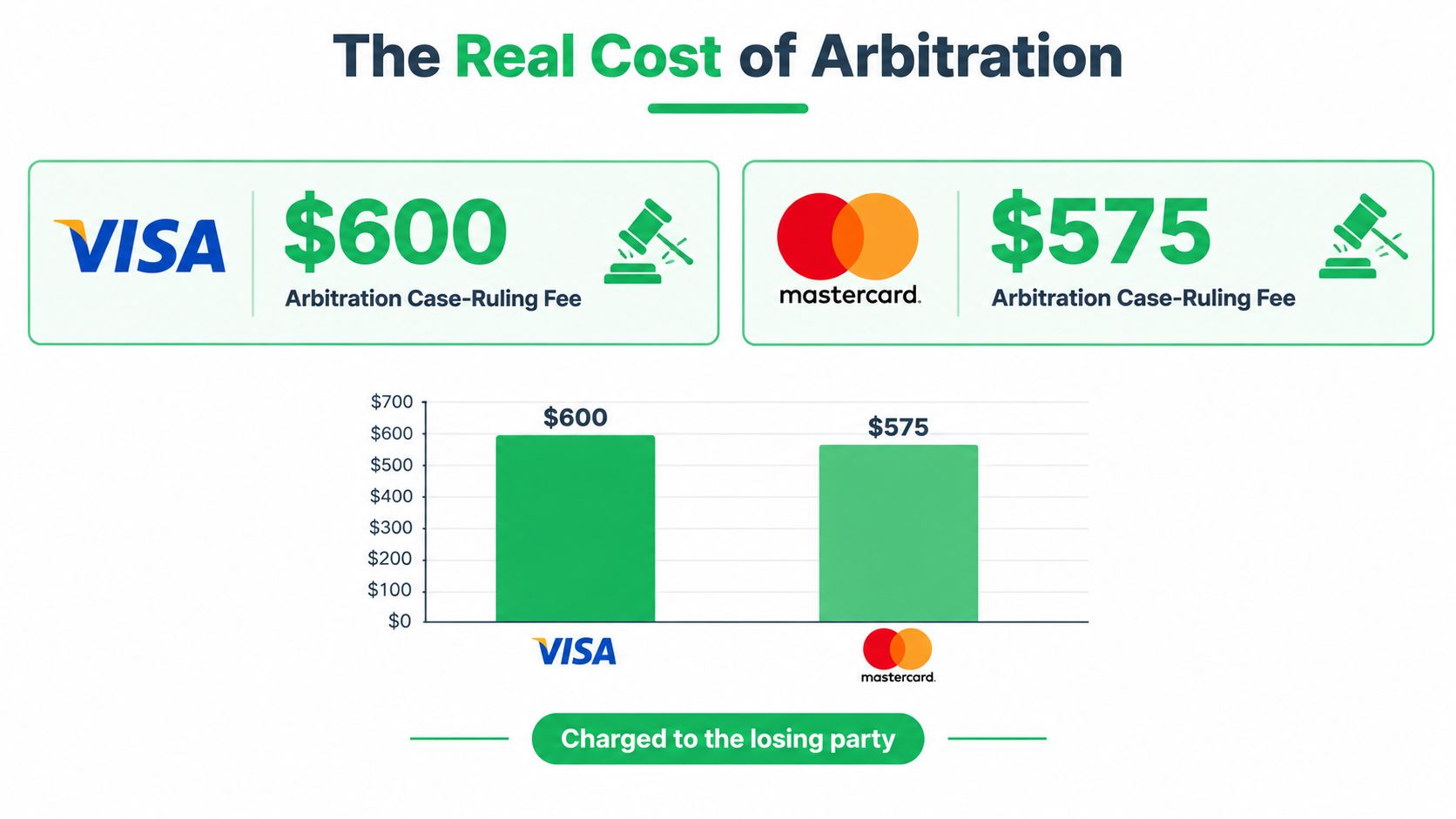
The math reframes the decision. A lost $39 case at arbitration costs many times the transaction value in ruling fees alone, and a handful of borderline cases per quarter turns arbitration into an unbudgeted operating expense. These fees apply once a case reaches arbitration, so the pre-arbitration window is the last point where a merchant controls the cost side of the ledger.
The second variable is whether the records can hold up. When traffic routes through multiple PSPs, the authorization trace may sit in one gateway while the renewal event and the cancellation request live in another. Conflicting timestamps, or an event that was never captured at all, will surface at arbitration where the other side's case gets weighed in full. Before letting a case roll forward, an ops lead should check three things: whether the evidence answers the issuer's specific objection or just recycles the first response, whether the transaction value justifies the fee exposure, and whether every record agrees with the rest.
If all three check out, pressing ahead can be defensible. If the records are weak or contradict one another, accepting liability or negotiating a resolution before arbitration will often cost less than defending a fragile case. Encode that judgment as a standing review rule so the call is driven by the file itself, consistently, regardless of who opens the notice.
<iframe width="100%" style="aspect-ratio: 16 / 9;" src="https://www.youtube.com/embed/q7Qe2b9n5lk" frameborder="0" allow="autoplay; encrypted-media" allowfullscreen></iframe>
Prevention Strategies by Merchant Type
Prevention depends on how a business sells. A recurring charge, a delivered package, and a high-risk payment create different evidence needs, so capture the records that answer the disputes most likely to arise in your model.

Subscription and rebill merchants
Make consent and billing expectations easy to verify. Store the original authorization, the terms shown at checkout, renewal notices, and the customer's cancellation history together. If a customer cancels, preserve the timestamp and make sure it can be compared with the next billing event. Clear cancellation-policy disclosure matters, but a timestamped record helps establish whether the request reached the business before renewal.
DTC and physical-goods merchants
Connect the order to the payment and the shipment. Keep delivery confirmation and customer-service messages together, particularly when a buyer reports a delay, a missing parcel, or a carrier problem. AVS and CVV outcomes can support the transaction record, but they don't substitute for evidence that the order was fulfilled.
High-risk merchants
Make the billing descriptor recognizable and check that transaction details match across the relevant domains. Review decline-and-retry logic so repeated attempts don't turn an uncertain payment into a dispute-prone transaction. For any business model, maintain a customer contact route that's easy to find and preserve the exchange when support addresses a billing or fulfillment concern.
These are distinct prevention plays, but they share a requirement: preserve the event as it happens. A team that needs to reconstruct consent, renewal, delivery, or cancellation from unrelated systems may not have a complete response when the notice arrives. For additional prevention practices across dispute workflows, see Tagada's guidance on chargeback prevention.
Turning the Playbook into an Operating Model
Pre-arbitration is best managed as a deadline-driven data-integrity problem. Payment and commerce records need to line up, deadlines must stay attached to the transaction, and the evidence has to be retrievable without relying on someone's memory of which processor handled the payment.
Start by recording a normalized event timeline for each transaction. It should connect payment authorization, order and fulfillment activity, customer messages, refunds, representment, pre-arbitration notices, and their deadlines. Keep processor-specific responses, but use stable identifiers so a single merchant-level view can connect events from multiple PSPs.
That structure helps catch contradictions before they reach a response. For example, a refund recorded in one PSP shouldn't be represented elsewhere as if the customer remains unpaid. A timeline can flag the mismatch for review, so the team checks the underlying record before submitting evidence.
Treat every deadline as transaction data. A notification timestamp is useful, but it doesn't replace the network date that controls the filing window.
Once events are consistent, the same information can support prevention and recovery. A cancellation timestamp can help prevent an inappropriate renewal, while also providing evidence if a later dispute challenges that charge. Payment outcomes can also trigger customer messaging, such as a service notice or a billing clarification, when the underlying event supports it.
Tagada is one orchestration option for this model. Its multi-PSP layer can retain processor-specific responses while presenting a merchant-level timeline for dispute review, helping payment teams work with connected transaction events across processors. The value of an orchestration layer depends on the quality of the records it receives, so merchants should still define which events, identifiers, and deadlines must be preserved.
Prevention, evidence capture, and dispute response aren't separate projects. They're parts of one operating loop: record what happened, spot inconsistent data, communicate at the right moment, and make an informed decision when a case escalates.
Pre Arbitration Chargeback Questions, Answered Plain
Is there a separate pre-arbitration fee?
The cited guidance identifies arbitration case-ruling fees, not a separate pre-arbitration fee of the same kind. A pre-arbitration case still takes staff time and may require payment operations or engineering work to locate, reconcile, and submit the right records.
Can a merchant respond without records from the cardholder?
The merchant can respond using its own transaction and customer records, but it can't assume those records will settle every issue. Start with the issuer's stated reason for rejecting representment, then gather evidence that addresses that reason. If the merchant's records can't support the defense, consider the cost and strength of continuing before rejecting liability.
What's the difference between pre-arbitration and arbitration?
Pre-arbitration is the issuer's formal challenge to the merchant's second presentment, followed by the acquirer's decision to accept or reject the case. Arbitration is the next stage: the network reviews the dispute and makes a binding decision on financial liability.
How long does a merchant have to respond?
There isn't one universal response window. Under Mastercard guidance, the issuer generally gives the acquirer 10 calendar days to respond when pre-arbitration is required, while Visa's timing depends on the market, the dispute date, and the applicable process. Check the network rules and case details immediately, then record the response deadline with the transaction.
If a notice is open now, identify the network and reason code, confirm the controlling deadline, and compare the issuer's objection with the records you already have. Make the accept-or-contest decision based on the evidence and potential costs, not on the fact that the first response appeared successful.
Tagada offers an orchestration layer that connects payment processing across multiple PSPs and helps teams work from a unified view of payment and dispute events. If your team needs a clearer way to connect processor records, deadlines, and dispute workflows, visit Tagada to explore how its payment orchestration fits your operations.