
Payment Routing and Backup Processors for Fitness Brands
How payment routing and a backup processor protect a fitness brand's equipment sales and nutrition renewals, with cascade rules and setup steps.



Article summary
TL;DR
Payment routing sends each payment to the right processor, and a backup takes over when the first one is down or times out. For a fitness brand, it protects large equipment orders and nutrition renewals. A payment the bank declined stays put: Visa forbids moving it to another acquirer. Never route to hide what you sell.
- Stripe "may terminate this Agreement or close User's Stripe Account at any time", and a reserve "may be required indefinitely".
- A seller of Pilates reformers reported in November 2023 that Shopify Payments was "holding $28,000 for 120 days" after three orders of $9,000 to $10,000.
- Shopify allows one card processor at a time, so a backup usually needs a checkout or payment layer that supports several.
- Cascade to another processor only when one is down or times out. Visa forbids changing the acquiring identifier to retry a payment the bank declined.
- Retries of a bank decline stay on the same processor: never for category 1 codes, and up to 20 attempts in 30 days for the others (Visa Core Rules, 2026).
- Routing protects sales; it is not a way to spread disputes across accounts to stay under monitoring thresholds.
 ChatGPT
 Claude
 Perplexity
 Grok
On this page
This guide is part of our playbook on the best ecommerce platform for fitness brands. The general guide, for any business: multiple merchant accounts: backup, routing and what is allowed. The processor side is covered in fitness payment processing.
What payment routing does
| Routing type | How it works | Use for a fitness brand |
|---|---|---|
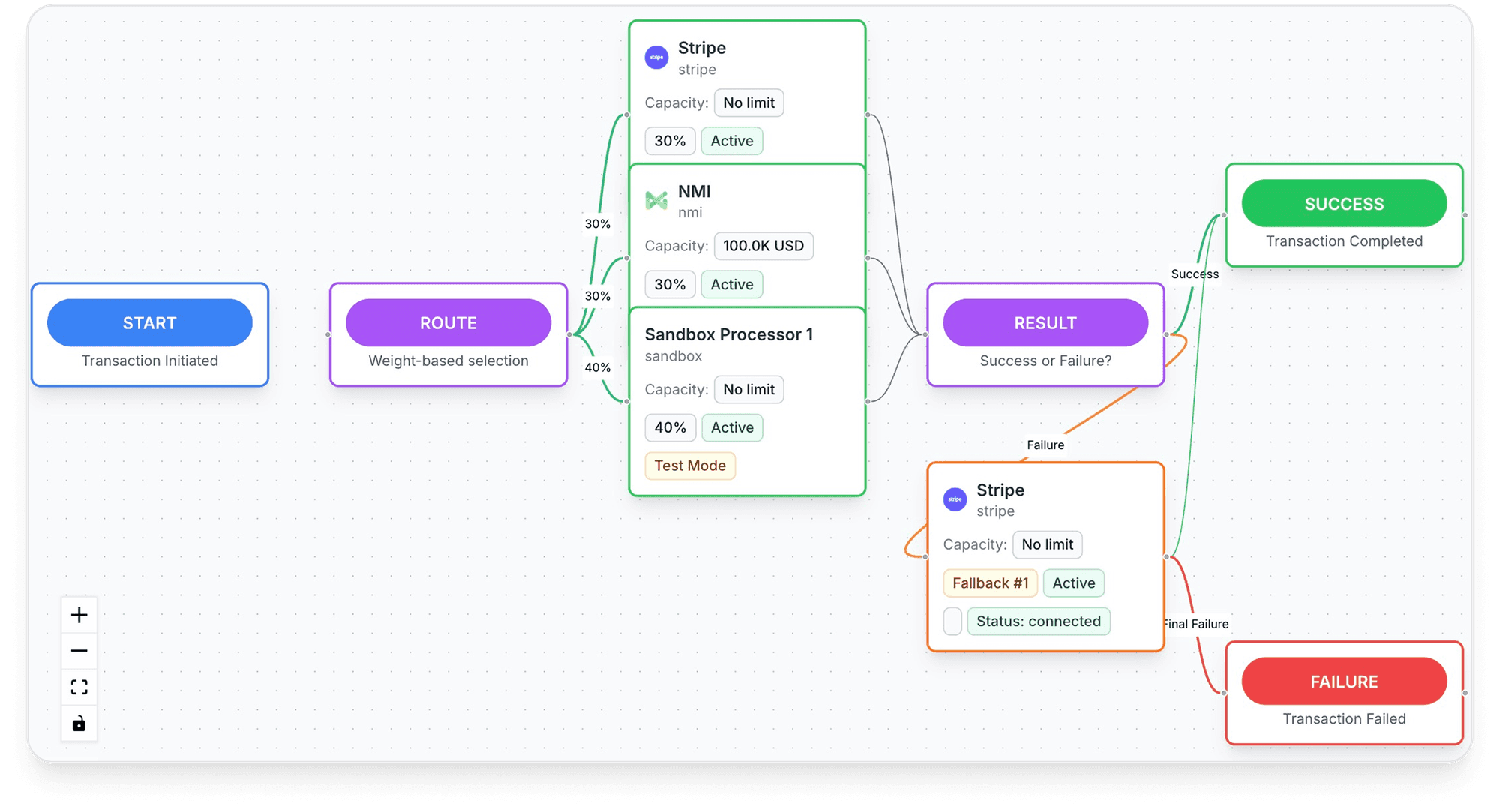
| Cascade | If processor A is down or times out, send the payment to processor B | Recover sales lost to a processor failure |
| Backup on outage | If processor A is down or the account is paused, send payments to B | Keep selling during an outage or a review |
| Rules-based | Choose the processor by country, currency, card type or order size | Use each processor where it accepts and performs best |
| Renewal routing | Renewals run on a processor that can charge the saved card | Keep protein and program subscriptions running |
Fig. 1One checkout, a routing rule, three processors
A is down or times out: the payment goes to B. A bank decline or a fraud block stays where it is.
Why fitness brands need a backup
- Accounts can close at any time. Stripe's agreement says so1Stripe Services Agreement, modified September 28, 2026.
- Reserves can be held indefinitely on Stripe2Stripe Support, Reserves FAQ, read October 9, 2026, which ties up the cash you need for stock and ads.
- Large equipment orders draw reviews. A new store selling high-ticket items can see payouts held, as merchants report8Shopify Community, Shopify Payment / Stripe suspension, high value items, November 15, 2023 (merchant's account, not verified).
- Sports nutrition is reviewed like supplements. Stripe's line on "Pseudo-pharmaceuticals or nutraceuticals that are not safe or make harmful claims" applies to it; no Stripe line names fitness equipment9Stripe, Prohibited and restricted businesses, read November 2, 2026.
- Card declines cost sales. 10% of US shoppers who abandon a checkout cite a declined card7Baymard Institute, Cart abandonment rate statistics and reasons for abandonment, updated September 22, 2025.
- Renewals stop with the account if every subscriber's card sits with one processor.
Example
In a Shopify Community thread from November 2023, a new seller of home fitness equipment (Pilates reformers) made three sales averaging $9,000 to $10,000 in its first month. The seller reported: "Shopify Payments flagged our business as high risk, suspended payments and is now holding $28,000 for 120 days"8Shopify Community, Shopify Payment / Stripe suspension, high value items, November 15, 2023 (merchant's account, not verified). With no second processor live, every new order stopped at once.
Fig. 2Three reformer orders, one processor
What each message means
- Suspended: three sales averaging $9,000 to $10,000 in the first month drew the review.
- On hold: with no second processor live, every new order stopped at once.
 Shopify PaymentsMonth 1Payments suspendedYour business was flagged as high risk.
- Shopify PaymentsMonth 1Funds on holdHolding $28,000 for 120 days.
Cascade rules that respect the card networks
| Do | Don't |
|---|---|
| Cascade to another processor when one is down or times out | Send a payment the bank declined to another processor: Visa forbids changing the acquiring identifier on a reattempt11Visa Core Rules and Visa Product and Service Rules, editions of April 18 and October 24, 2026, section 1.7.2.1 and table 7-2 |
| Retry a soft decline on the same processor, within network limits | Retry hard declines such as closed accounts or lost and stolen cards: Visa category 1 codes must never be retried3Payway, Visa excessive reattempts rule and fees (rule effective April 2022), read October 26, 2026 (secondary source) |
| Keep total attempts within network limits | Exceed 20 attempts in 30 days11Visa Core Rules and Visa Product and Service Rules, editions of April 18 and October 24, 2026, section 1.7.2.1 and table 7-2; Visa charges a fee per excess attempt3Payway, Visa excessive reattempts rule and fees (rule effective April 2022), read October 26, 2026 (secondary source) |
| Confirm the first attempt really failed before trying the backup | Charge the same order twice on two processors after a timeout5Paysight, Payment gateway failover for ecommerce, read November 2, 2026 |
| Keep failed 3D Secure and fraud blocks where they are | Reroute a payment to bypass a risk check5Paysight, Payment gateway failover for ecommerce, read November 2, 2026 |
| Use the same merchant name on all descriptors | Use descriptors the customer won't recognize |
- Processor down or timed outThe problem is on the processor's side.Confirm the first attempt really failed, then cascade to another processor.
- Soft decline from the bankThe bank said no for now.Retry on the same processor, within network limits; never on another one.
- Hard decline (closed account, lost or stolen card)Visa category 1: never retried.Stop, on every processor.
- Failed 3D Secure or fraud blockA risk check stopped the payment.Keep it where it is; never reroute to bypass it.
Tagada follows Visa and Mastercard rules and the laws that apply to payments.
Watch out
A timeout does not mean the payment failed. On a high-ticket rower or rack, a duplicate charge is a dispute waiting to happen. Check the status of the first attempt before you send the payment anywhere else5Paysight, Payment gateway failover for ecommerce, read November 2, 2026.
Renewals and saved cards
Subscriptions are where routing matters most, because renewals happen without the customer.
- Saved cards are stored as tokens by the processor that collected them.
- Renewals need a processor that can charge those cards. Test renewals on every route before you need them5Paysight, Payment gateway failover for ecommerce, read November 2, 2026.
- Retries, card updates and routing work together: see failed payment recovery for fitness brands.
- Changing processor without losing subscribers is covered on the payment side: switching payment processor for fitness brands.
What routing is not
Routing is a resilience tool. It is not a way around the rules.
Not a way to dilute disputes
Card networks monitor dispute and fraud ratios; Visa's VAMP threshold for US merchants is 1.5% since April 1, 20266Visa, Acquirer Monitoring Program (VAMP) fact sheet, 2025 v2. Spreading volume to stay under a threshold does not fix the cause and puts every account at risk.
Not a way to hide a product line
If you sell equipment and sports nutrition, each processor must know both.
Not a replacement for low disputes
Delivery proof, clear return instructions and recognizable descriptors reduce chargebacks: chargebacks for fitness brands.
Setup checklist
- Choose a second processor that has reviewed your whole business, equipment and nutrition.
- Connect both to a checkout that can route between them (Shopify's own checkout allows one card processor at a time4Shopify Help Center, Configuring third-party payment providers, read October 26, 2026).
- Define the rules: cascade when a processor is down or times out, failover on outages, any rules by country, card type or order size.
- Send live traffic to the backup every day, even a small share, so it stays tested.
- Align descriptors and customer emails across processors.
- Review decline rates by processor and by reason every month.
Keep every route in use, and keep bank declines on their route.
Measure routing
| Metric | What it tells you |
|---|---|
| Approval rate by processor | Which processor performs best for which cards and order sizes |
| Sales recovered by cascade | Revenue a single processor would have lost |
| Decline reasons by processor | Issuer vs. processor-side problems |
| Share of volume on backup | Whether the backup is really live |
| Renewal success rate | Whether subscriptions survive failed payments |
| Duplicate charges | Should be zero |
How Tagada helps
Routing and backup processors behind one fitness checkout
- Routing across TagadaPay and processors such as Stripe, NMI and Airwallex, with one logic, cascading to another processor when one is down or times out: "Every transaction is scored against your live MID network in real time." TagadaPay lists "Automatic cascade, weighted routing, sticky MID": the cascade goes to another processor only when one is down or times out, never after a bank decline. TagadaPay reports a "+18% approval uplift."
- Two modes: TagadaPay managed, or bring your own processor, where "You keep the acquiring relationship, the settlement and the risk"10Tagada docs, Payment processors, read November 2, 2026
- Connected processors include Airwallex, Authorize.Net, Checkout.com, NMI, Paysafe and Stripe10Tagada docs, Payment processors, read November 2, 2026
- Subscriptions with retries and automatic recovery
- 3DS2, device intelligence and a rules engine against fraud
- A vault you own: "Switch processors without re-onboarding customers. No vendor lock-in. Ever."
Each file is still underwritten, with enhanced review on regulated verticals. Plans are on the pricing page. To take payments with TagadaPay, apply today: "Most merchants are live under 24 hours," according to TagadaPay.
Frequently asked questions
What is a backup payment processor?
What should I do if my processor holds my funds?
Can I use two payment processors on Shopify?
Is using multiple merchant accounts allowed?
Sources
Checked November 2, 2026- Stripe Services Agreement, modified September 28, 2026
- Stripe Support, Reserves FAQ, read October 9, 2026
- Payway, Visa excessive reattempts rule and fees (rule effective April 2022), read October 26, 2026 (secondary source)
- Shopify Help Center, Configuring third-party payment providers, read October 26, 2026
- Paysight, Payment gateway failover for ecommerce, read November 2, 2026
- Visa, Acquirer Monitoring Program (VAMP) fact sheet, 2025 v2
- Baymard Institute, Cart abandonment rate statistics and reasons for abandonment, updated September 22, 2025
- Shopify Community, Shopify Payment / Stripe suspension, high value items, November 15, 2023 (merchant's account, not verified)
- Stripe, Prohibited and restricted businesses, read November 2, 2026
- Tagada docs, Payment processors, read November 2, 2026
- Visa Core Rules and Visa Product and Service Rules, editions of April 18 and October 24, 2026, section 1.7.2.1 and table 7-2
Tagada
Keep equipment orders and renewals running when a processor fails
Funnels, one-click upsells, subscription billing and payment routing, on one customer record.
- 01Create your free account
- 02Connect your store or build a checkout
- 03Launch funnels, upsells and subscriptions