
Checkout A/B Testing for Info Product Businesses
Why course creators should A/B test the checkout, bumps and upsells before the sales page, the sample sizes involved, and tests not to run.

Article summary
TL;DR
Most course sellers don't have the traffic to A/B test a sales page properly. Start where conversion rates are high and every buyer counts: the order bump, the one-click upsell, the payment plan offer and the checkout form. Judge each test on revenue per visitor after refunds, and never test a fake discount, a resetting timer or a hidden renewal.
- To detect a 20% lift on a sales page converting at 3%, you need about 13,900 visitors per variation; on an order bump taken by 30% of buyers, about 960 buyers (standard calculation, 95% confidence, 80% power).
- SamCart reports that order bumps convert at "30-40% on average" on its platform, a vendor figure.
- A "was" price in a test must be the "actual, bona fide price" you charged "for a reasonably substantial period of time" (16 CFR 233.1).
- For memberships, ROSCA requires all material terms to be disclosed "before obtaining the consumer's billing information" in every variant.
 ChatGPT
 Claude
 Perplexity
 Grok
On this page
This guide is part of our playbook on the best ecommerce platform for info product businesses. The general guide, for any business: custom ecommerce checkout.
Why test the checkout before the sales page
Sample size depends on the conversion rate you test. A sales page converts a small share of visitors, so small lifts take huge traffic to detect. A bump or an upsell is seen only by buyers, but a large share of them say yes.
| What you test | Baseline rate (example) | Lift to detect | Needed per variation |
|---|---|---|---|
| Sales page, visitor to buyer | 3% | +20% (to 3.6%) | about 13,900 visitors |
| Sales page, visitor to buyer | 3% | +50% (to 4.5%) | about 2,500 visitors |
| Checkout, visitor to buyer | 10% | +20% (to 12%) | about 3,800 checkout visitors |
| Order bump take rate | 30% | +20% (to 36%) | about 960 buyers |
| Upsell take rate | 30% | +10% (to 33%) | about 3,800 buyers |
Calculated with the standard two-proportion formula, 95% confidence and 80% power. The baseline rates are illustrative, not benchmarks: use your own.
Fig. 1Thousands needed per variation, from sales page to bump
The higher the base rate, the smaller the sample.
So a creator selling 600 courses a month can finish a two-variant bump test in about three months (about 1,920 buyers), but would need far more traffic to test a sales page headline for a modest lift. Before that point, use qualitative research on the sales page: recordings, buyer surveys, support questions.
What to test, in order
| # | Element | Variant to try | Metric |
|---|---|---|---|
| 1 | Order bump | Workbook vs templates pack; price; one bump vs two | Bump take rate, revenue per buyer |
| 2 | One-click upsell | Next course vs coaching call; order of offers; a downsell on decline | Upsell take rate, refunds at 30 days |
| 3 | Payment plan offer | Pay in full shown first vs plan shown first; 3 vs 4 payments | Revenue per visitor, installments collected |
| 4 | Checkout form | Fewer fields; Apple Pay and Google Pay on top | Checkout completion rate |
| 5 | Sales page | Headline; proof placement; price block | Visitor to checkout rate, only with enough traffic |
How to design the bump and the upsell: order bumps and one-click upsells for info product businesses.
Example
A $297 course tests two bumps at $27: "Workbook" vs "Templates pack". With 1,000 buyers per variant, the templates bump is taken by 34% against 28%. That is $1.62 more revenue per buyer at the same traffic, which you then check against refunds.
Fig. 2Two $27 bumps on a $297 course
Workbook bump
- Checkout$297 course
- offersBumpWorkbook, $27
Taken by 28% of buyers
Templates pack bump
- Checkout$297 course
- offersBumpTemplates pack, $27Approved
Taken by 34% of buyers, $1.62 more per buyer
Same traffic, $1.62 more per buyer.
Testing price and payment plans
Price tests are the most valuable and the easiest to get wrong.
Test the presentation before the price
Pay-in-full first or plan first, total shown or monthly shown.
Test real prices only
Each variant must be a price you are willing to honor for every buyer who sees it.
Keep plan totals equal to pay-in-full
In every variant. Visa forbids "interest, or imputed interest" on merchant plans6Visa Core Rules and Visa Product and Service Rules, edition of October 24, 2026, Table 5-20. Plan design: payment plans for info product businesses.
Measure collected revenue
A plan variant that sells more but collects less is a loss.
Tests you should not run
A variant that wins by misleading buyers wins sales and loses them later as refunds, disputes or a processor review.
| Variant | Why not |
|---|---|
| A "regular price" you never charged | A former price must be "the actual, bona fide price" offered "for a reasonably substantial period of time" (16 CFR 233.1)216 CFR § 233.1, Former price comparisons, via Cornell LII, read November 2, 2026 |
| A timer that resets on reload | The FTC lists "countdown timers designed to make consumers believe they only have a limited time to purchase" as a dark pattern (FTC, September 2022)3FTC, "FTC Report Shows Rise in Sophisticated Dark Patterns Designed to Trick and Trap Consumers", September 15, 2022 |
| Membership terms moved below the button | ROSCA requires material terms disclosed "before obtaining the consumer's billing information" and "simple mechanisms" to stop charges (15 U.S.C. § 8403)4Restore Online Shoppers' Confidence Act, 15 U.S.C. § 8403, read November 2, 2026 |
| An upsell with no visible "No thanks" | Stripe prohibits "high-pressure upselling" (Stripe)5Stripe, Prohibited and restricted businesses, read November 2, 2026 |
| A testimonial that promises income | Stripe prohibits "deceptive testimonials" and "sites that promise fast and easy money" (Stripe)5Stripe, Prohibited and restricted businesses, read November 2, 2026 |
How to read a result
- Fix the sample size before you start, and don't stop early because a variant looks ahead.
- Split by buyer, not by session, so a returning visitor sees the same variant.
- Count purchases from the server, deduplicated with the browser pixel, so each variant's sales are counted once7Meta for Developers, Deduplicate Pixel and server events, read October 26, 2026.
- Compare revenue per visitor, not only conversion rate: a cheaper variant can convert more and earn less.
- Check refunds and disputes 30 days later before you roll the winner out.
Decide the sample, the split and the metric before the test starts; check refunds before the rollout.
Where testing fits in the funnel: sales funnels for info product businesses and landing pages.
How Tagada helps
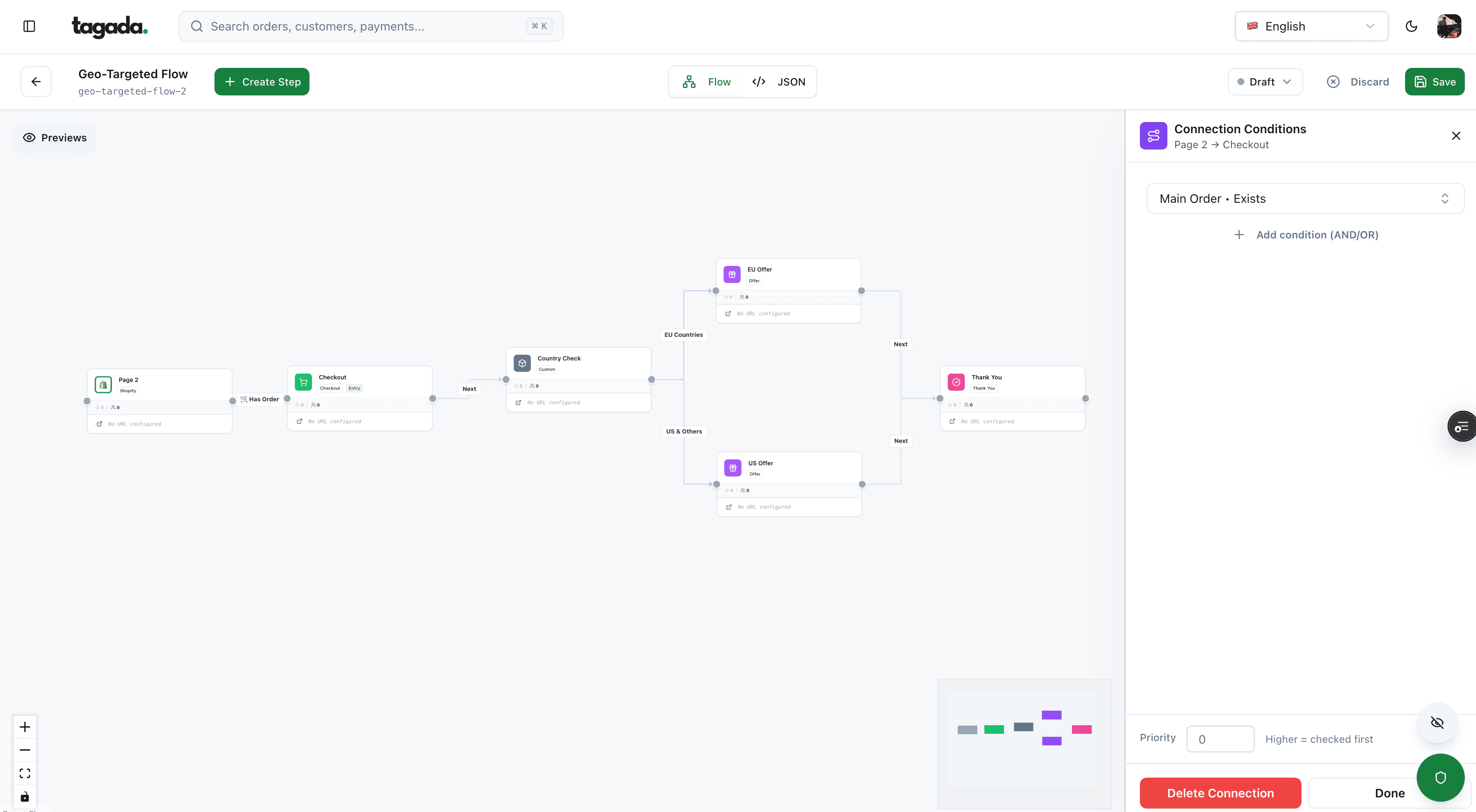
Run bump, upsell and checkout tests where the payment happens
- A/B tests built into the checkout, on order bumps, one-click upsells and the checkout itself, in the same system that takes the payment.
- Order bumps and one-click upsells "charged on the card just used, with no form", with "upsell on accept, downsell on decline".
- Server-side events to Meta, Google and TikTok, so each variant's purchases count once.
- Payments that keep test traffic converting: TagadaPay reports a "+18% approval uplift" from routing: "Route to the processor most likely to approve it, retry on decline"8TagadaPay, tagadapay.io, read November 2, 2026. "If you sell something real, we will get you paid."
- Pricing: "From 2.9% + $0.29", "No setup fees, no monthly minimums"8TagadaPay, tagadapay.io, read November 2, 2026.
"Live in 24h. You own your vault." Apply today and go live in under 24 hours on TagadaPay; CRM plans are on the pricing page.
Frequently asked questions
How much traffic do I need to A/B test a course sales page?
What should I test first as a course creator?
Can I A/B test my course price?
Is A/B testing worth it for a small audience?
Should I test one order bump or two?
Sources
Checked November 2, 2026- SamCart, The complete guide to order bumps, 2026, read November 2, 2026
- 16 CFR § 233.1, Former price comparisons, via Cornell LII, read November 2, 2026
- FTC, "FTC Report Shows Rise in Sophisticated Dark Patterns Designed to Trick and Trap Consumers", September 15, 2022
- Restore Online Shoppers' Confidence Act, 15 U.S.C. § 8403, read November 2, 2026
- Stripe, Prohibited and restricted businesses, read November 2, 2026
- Visa Core Rules and Visa Product and Service Rules, edition of October 24, 2026, Table 5-20
- Meta for Developers, Deduplicate Pixel and server events, read October 26, 2026
- TagadaPay, tagadapay.io, read November 2, 2026
Tagada
Test the bump and the upsell before the sales page
Funnels, one-click upsells, subscription billing and payment routing, on one customer record.
- 01Create your free account
- 02Connect your store or build a checkout
- 03Launch funnels, upsells and subscriptions