
One-Click Upsells for Info Product Businesses
What to upsell after a course, coaching or membership sale, how upsells and downsells work, how the card is charged, which offers lead to disputes.

Article summary
TL;DR
A one-click upsell is an offer shown right after payment that the buyer adds without typing their card again. After a course, offer the next step: an advanced course, a coaching package, a membership, an implementation kit. Show one offer, a downsell on decline, the price and a clear "No thanks". Never sell the upgrade on future income.
- Visa dispute 13.5 covers business opportunities where the merchant "recommends that the Cardholder purchases additional items… to generate more income" (October 2026 rules).
- Stripe prohibits businesses that "use high-pressure upselling".
- In September 2024 the FTC sued a seller whose training programs "can cost almost $2,000" and whose "done for you" online stores sold for "tens of thousands of dollars".
- Post-purchase offers averaged a 4.7% take rate in ReConvert's 2023 ecommerce data; no course-specific figure is published with a method.
- An upsell into a membership needs clear terms and express consent under ROSCA.
 ChatGPT
 Claude
 Perplexity
 Grok
On this page
This guide is part of our playbook on the best ecommerce platform for info product businesses. The general guide, for any store: one-click upsells. Upsells come after the order bump in the info product sales funnel.
Upsell offers by what the buyer just bought
The best upsell helps the buyer get more out of what they just paid for. It follows the product, not the other way around.
| Just bought | Upsell offer | Downsell if they decline | Why it fits |
|---|---|---|---|
| Low-ticket ebook or mini-course | The full course | A workbook or a single module | The buyer already chose the topic |
| Recorded course | Advanced course or the next level | The same course with templates | Natural next step |
| Recorded course | Group coaching for 8 weeks | One recorded Q&A bundle | Adds support to self-study |
| Course or workshop | Membership, monthly or annual | A one-month pass | Ongoing learning and community |
| Coaching package | Done-with-you review or an extra month | A written audit | More of what they bought |
| Live event ticket | VIP seat or recording package | Recording only | Same event, more access |
Fig. 1One upsell, one downsell, then the thank-you page
approved declined or closed routing step
- CoursePaid, $197Approved
- offersUpsell8 weeks of group coaching, $600
- on No thanksDownsell3 recorded Q&A sessions, $97
- thenThank-you pageAccess link, receipt, next stepsApproved
A visible No thanks link on every screen.
Teachable's guide gives the rule in one image: an ice cream course followed by a whipped cream course, not a bookshelf-building course (April 2021)11Teachable, Upsells: how to increase your revenue, April 7, 2021. Thinkific suggests the same: a related course on the thank-you page (September 2025)12Thinkific, 5 tricks to upsell your online course, updated September 12, 2025.
Upsell, then downsell
A downsell is a smaller offer shown when the buyer declines the upsell. It catches buyers who wanted the result but not the price.
- Upsell: the full offer, with price and what's included.
- Downsell on "No thanks": a lighter version, fewer modules, or the same offer in installments.
- Thank-you page: access link, receipt, what happens next.
Keep it to one upsell and one downsell. A third screen reads as pressure, and Stripe lists "high-pressure upselling" among prohibited practices2Stripe, Prohibited and restricted businesses, read November 2, 2026.
Example
A buyer pays $197 for a course. Upsell: "Add 8 weeks of group coaching for $600." On "No thanks", downsell: "Or get the 3 recorded Q&A sessions for $97." Each screen has a visible "No thanks" link.
A downsell in installments is a payment plan: Visa requires a separate agreement with the schedule and total, and no interest10Visa Core Rules and Visa Product and Service Rules, edition of October 24, 2026: tables 5-19 and 5-20 (installments). Details in payment plans for info product businesses.
The upsell ladder and the income trap
Info products have one risk other verticals don't: the upsell sold as the way to "make your money back". Regulators, card networks and processors all target it.
| Practice | Why it's a problem |
|---|---|
| "Upgrade to start earning faster" | Visa 13.5 covers merchants who suggest "an income will be generated" or recommend buying more "to generate more income"1Visa Core Rules and Visa Product and Service Rules, edition of October 24, 2026: tables 11-93 (13.1) and 11-118 (13.5) |
| A ladder from course to costly done-for-you service | The FTC's Operation AI Comply targeted a seller of trainings that also sold "done for you" stores for "tens of thousands of dollars"3FTC, FTC Announces Crackdown on Deceptive AI Claims and Schemes, September 25, 2024 |
| Countdown timers that reset | Stripe prohibits "high-pressure upselling"2Stripe, Prohibited and restricted businesses, read November 2, 2026 |
| Student income screenshots on the offer | A result testimonial needs the "generally expected performance", not "results not typical"4FTC, Guides Concerning the Use of Endorsements and Testimonials in Advertising, 16 CFR 255.2(b) |
| Coaching sold now, delivered months later | A "not received" dispute can come 120 days after the expected service date, up to 540 days1Visa Core Rules and Visa Product and Service Rules, edition of October 24, 2026: tables 11-93 (13.1) and 11-118 (13.5) |
Fig. 2Upsell copy that draws disputes and reviews
- Upgrade to start earning fasterVisa 13.5: a suggestion that an income will be generatedSell what the upgrade includes
- A ladder up to a costly done-for-you serviceThe pattern of the FTC's Operation AI Comply caseKeep the next step close to the course
- A countdown timer that resetsHigh-pressure upselling, prohibited by StripeOne upsell, one downsell, no timer
- Coaching delivered months laterA not received dispute, up to 540 daysGrant access right away
Sell the upgrade on what it includes: more lessons, more feedback, more access. That copy also works better on buyers who already trust you.
Tagada follows Visa and Mastercard rules and the laws that apply to payments. On the payment side: chargebacks for info product businesses.
How the payment works
The upsell charges the card the buyer just used. The way it is set up decides whether the charge looks legitimate to the issuer and to the buyer.
| Question | What to check |
|---|---|
| Who starts the charge? | A buyer clicking "Yes" is customer-initiated (CIT); a charge without that action is merchant-initiated (MIT) and follows stored-credential rules5Merchant Risk Council, Card on file done right: how to stay compliant with the stored credential mandate, October 22, 2025 |
| Consent to reuse the card | The stored-credential framework expects an indication that customer consent was obtained5Merchant Risk Council, Card on file done right: how to stay compliant with the stored credential mandate, October 22, 2025 |
| One charge or two? | Some setups add the upsell to the order, others create a second charge; show both on the receipt |
| Descriptor | The statement name should match your brand, not your platform |
| Access | Grant access to the upsell right away, in the same student area, so it is logged |
Fig. 3An upsell charge the buyer and the issuer recognize
- Who started it
- The buyer clicked Yes (CIT)
- Card
- The card just used, consent logged
- Receipt
- Course $197 · group coaching $600
- Descriptor
- Your brand, not your platform
- Access
- Coaching added to the student area
Illustrative record.
A second charge the buyer doesn't recognize is a common start of an "unauthorized" dispute. Say exactly what was charged on the thank-you page and in the receipt.
Upsells into a membership
A membership after a course is a strong offer. It is also a recurring charge, so the rules for negative options apply.
Fig. 4A membership upsell, the way ROSCA expects it
Terms on the offer screen
Price, billing frequency, next charge date and how to cancel6Restore Online Shoppers' Confidence Act, 15 U.S.C. § 8403.
Express consent
A clear "Yes, start my membership" action6Restore Online Shoppers' Confidence Act, 15 U.S.C. § 8403.
A third-party offer
(A partner's software, for example) needs its own disclosure, the buyer's full card number and an extra affirmative action under ROSCA6Restore Online Shoppers' Confidence Act, 15 U.S.C. § 8403.
Confirmation email
With the terms and a cancellation link.
Membership billing in detail: memberships for info product businesses.
Measure your upsells
| Metric | Formula | Watch for |
|---|---|---|
| Take rate | Upsells accepted ÷ buyers who saw the offer | Low: wrong offer or price |
| Downsell rate | Downsells accepted ÷ upsell declines | High: the upsell is overpriced |
| Revenue per buyer | Upsell and downsell revenue ÷ buyers | The real gain |
| Refunds on upsells | Upsell refunds ÷ upsells sold | High: buyers didn't mean it |
| Disputes on upsell charges | Disputes ÷ upsell charges | Unclear descriptor or consent |
For reference, ReConvert measured a 4.7% average take rate on post-purchase offers across ecommerce stores in 20237ReConvert, The impact of post-purchase upselling in 2023, and Zipify reports 16.2% for merchants who optimize their offers (July 2026)8Zipify, Post-purchase upsells on Shopify 2026, July 16, 2026. Both are physical ecommerce figures. No course platform publishes a comparable figure with its method.
Fig. 5Post-purchase take rates, physical ecommerce
No course platform publishes its own.
How Tagada helps
Upsells and downsells after payment, on the card just used
- One-click upsells after payment: "Charged on the card just used, with no form."
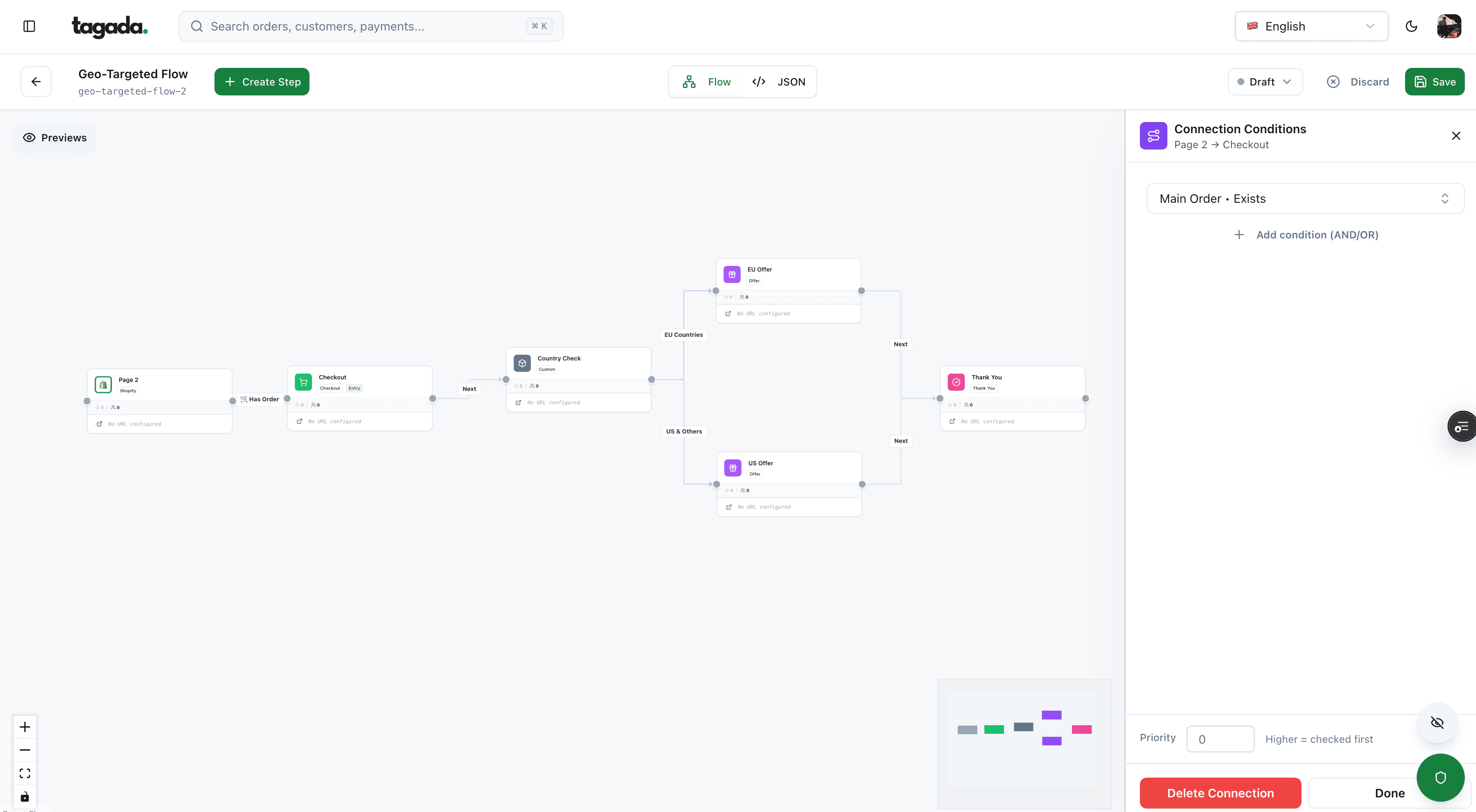
- Upsell and downsell steps: "upsell on accept, downsell on decline", with native checkout, offer and thank-you pages9Tagada docs, Upsell / downsell funnel, read November 2, 2026
- Offers as a bundle, a subscription or a membership, then "route each yes and each no"
- Order bumps before payment and A/B tests on offers
- Native 3DS2, device intelligence and a rules engine on the first payment
It runs standalone, on Shopify, on WooCommerce or headless. "If you sell something real, we will get you paid." TagadaPay lists info products, coaching and online courses among its industries, with "enhanced review for regulated verticals"; "Most merchants are live under 24 hours."
Pricing starts "From 2.9% + $0.29", with "No setup fees, no monthly minimums"13TagadaPay, homepage, read November 2, 2026. Plans are on the pricing page.
Frequently asked questions
What should I upsell after an online course?
Should I show the upsell before or after payment?
What is a downsell?
What is a good upsell take rate for a course?
Can I promise more income with the upgrade?
Sources
Checked November 2, 2026- Visa Core Rules and Visa Product and Service Rules, edition of October 24, 2026: tables 11-93 (13.1) and 11-118 (13.5)
- Stripe, Prohibited and restricted businesses, read November 2, 2026
- FTC, FTC Announces Crackdown on Deceptive AI Claims and Schemes, September 25, 2024
- FTC, Guides Concerning the Use of Endorsements and Testimonials in Advertising, 16 CFR 255.2(b)
- Merchant Risk Council, Card on file done right: how to stay compliant with the stored credential mandate, October 22, 2025
- Restore Online Shoppers' Confidence Act, 15 U.S.C. § 8403
- ReConvert, The impact of post-purchase upselling in 2023
- Zipify, Post-purchase upsells on Shopify 2026, July 16, 2026
- Tagada docs, Upsell / downsell funnel, read November 2, 2026
- Visa Core Rules and Visa Product and Service Rules, edition of October 24, 2026: tables 5-19 and 5-20 (installments)
- Teachable, Upsells: how to increase your revenue, April 7, 2021
- Thinkific, 5 tricks to upsell your online course, updated September 12, 2025
- TagadaPay, homepage, read November 2, 2026
Tagada
Offer the next step right after they pay, without the pressure
Funnels, one-click upsells, subscription billing and payment routing, on one customer record.
- 01Create your free account
- 02Connect your store or build a checkout
- 03Launch funnels, upsells and subscriptions