
The Info Product Business Sales Funnel: Offer and Page Structure
How to build a course or coaching funnel: the offer, sales page, checkout, order bumps, upsells, payment plans and memberships, within the rules.

Article summary
TL;DR
An online course sales funnel is the path from ad to access: one page selling one offer, a short checkout, an order bump, a one-click upsell or downsell, then access and follow-up emails. Build the offer first. Under about $200, buyers can purchase from the page; a high-ticket program usually needs a webinar or a call, and a payment plan.
- SamCart reports that order bumps "convert at 30-40% on average" across "$7B+ in processed transactions" (its own data, 2026).
- Teachable allows "up to three published order bumps", and coupons do not apply to them (July 2025).
- Stripe bans businesses that "use high-pressure upselling" or "deceptive testimonials" (read November 2, 2026).
- Visa forbids interest on merchant payment plans; a late fee must be flat (rules of October 24, 2026).
- In the US, more than four installments by written agreement, offered more than 25 times a year, can make you a "creditor" under Regulation Z.
 ChatGPT
 Claude
 Perplexity
 Grok
On this page
This guide is part of our playbook on the best ecommerce platform for info product businesses. For checkout in general, any industry, see our checkout guide.
The info product funnel, step by step
Each step has one job. If a step has two, split it.
| Step | Its job | What your tools must do |
|---|---|---|
| Ad, post or email | Bring the right person to one offer | Send traffic to a page about that offer, not to your homepage |
| Sales page (or webinar) | Explain who it is for, what they will be able to do, the price | Load fast on mobile, link to checkout in one click |
| Checkout | Take the payment | Email and card only, wallets, payment plan option, full price visible |
| Order bump | Add a small, related item before payment | One checkbox on the checkout, rules by product |
| Upsell or downsell | Offer the next step after payment | Charge the same card in one click; downsell if declined |
| Access | Deliver right away | Create the student account and send the login by email |
| Follow-up | Get the course started, sell the next level | Emails triggered by purchase, login and progress |
Fig. 1Seven steps, one job each
- Ad, post or emailBring the right person to one offer
- Sales page or webinarWho it is for, what they will do, the price
- CheckoutTake the payment
- Order bumpA small, related item before payment
- Upsell or downsellThe next step after payment
- AccessDeliver right away
- Follow-upGet the course started, sell the next level
If a step has two jobs, split it.
Match the funnel to the product
The price decides the path. A $27 ebook and a $3,000 coaching program do not sell the same way.
| Product | Typical path | Payment | Second offer |
|---|---|---|---|
| Ebook, template, mini-course | Ad or post, short page, checkout | One payment | Bump: workbook or bonus pack; upsell: the full course |
| Self-paced course | Page or short video series, checkout | One payment, or 2 to 3 payments | Bump: templates; upsell: group calls or a community |
| Coaching or high-ticket program | Webinar or application, then a call, then checkout link | Payment plan or one payment | Downsell: a self-paced version |
| Membership or community | Page with a preview, checkout | Monthly or yearly | Upsell: yearly plan at checkout or after |
Fig. 2The price decides the path
- Ebook, template, mini-courseAd or post, short page, checkout; one payment
- Self-paced coursePage or short video series, checkout; one payment, or 2 to 3
- Coaching or high-ticket programWebinar or application, a call, then a checkout link; payment plan
- Membership or communityPage with a preview, checkout; monthly or yearly
For the high-ticket path, the checkout link comes after the call. It still needs the bump, the plan and the agreement shown below.
Build the offer before the page
A page cannot fix a vague offer. Write the offer on one page of text first.
The skill, in one sentence
What the buyer will be able to do, and in what time, described as a skill, not as income.
What is inside
Modules, live calls, community, templates, length of access.
Who it is not for
It cuts refund requests and disputes.
Price and plan
One price, and one payment plan if the price is high. The plan total is shown in full.
Guarantee, in writing
Its exact conditions, honored as written.
Watch out
Never build the offer on the buyer's future earnings. Visa's "Misrepresentation" dispute covers "Business opportunities in which the Merchant suggests that an income will be generated"4Visa Core Rules and Visa Product and Service Rules, edition of October 24, 2026: Installment Transactions (Tables 5-19 to 5-21), dispute condition 13.5. The FTC treats statements like "earn a six-figure income" as earnings claims5FTC, Business Opportunity Rule, 16 CFR Part 437, eCFR, read November 2, 2026. Stripe bans "get rich quick" schemes3Stripe, Prohibited and restricted businesses, read November 2, 2026. A course sells a skill.
Anatomy of the sales page
Most course pages list modules and stop there. Use this order, top to bottom.
- Headline: the skill and the person ("Edit your podcast in under an hour, even if you have never used an audio editor").
- Who it is for, and who it is not for.
- What they get: modules, format, live or recorded, access length, a sample lesson.
- Who teaches it, and why that person.
- Proof: real student reviews, typical, with permission. Results that are not typical need the results people can generally expect.
- Price and payment plan, with the full total.
- Guarantee and refund terms.
- FAQ: time needed, level, refunds, access after the end.
- Buy button, repeated after each block.
Top to bottom, with the buy button repeated after each block.
Page design and testing are covered in landing pages for info product businesses and checkout A/B testing.
Checkout, order bump, upsell and downsell
The bump goes before payment; the upsell after. That split decides what you put where.
- Order bump: a small item tied to the course (workbook, templates, recordings), priced well under the main offer. Teachable caps it at three bumps per product1Teachable Help Center, Order bumps, July 11, 2025.
- One-click upsell: the next step after payment (group coaching, an advanced course, a yearly membership). The card is charged again only after a clear "yes".
- Downsell: shown if they decline the upsell, for example a self-paced version of the coaching.
- Keep it short: one upsell and one downsell. Stripe bans "high-pressure upselling"3Stripe, Prohibited and restricted businesses, read November 2, 2026.
Fig. 3Bump before payment, upsell after
approved declined or closed routing step
- CheckoutEmail and card, full price visible
- addsOrder bumpWorkbook, templates or recordings
- paysPaymentCourse paidApproved
- offersOne-click upsellGroup coaching, charged after a clear yes
- if declinedDownsellSelf-paced version, if they decline
One upsell, one downsell, each after a clear answer.
SamCart reports order bump take rates of 30 to 40% on its own platform; treat that as a vendor figure, not a target2SamCart, Order bumps guide, 2026 (platform data, not audited). Setup details: order bumps and one-click upsells.
Payment plans and memberships without breaking the rules
Payment plans and memberships lift sales of expensive programs. They also carry the strictest rules in the funnel.
| Rule | What it says | Source | What it changes in your funnel |
|---|---|---|---|
| Visa, Installment Transactions | NoInterest; a late fee must be flat; a separate agreement with the total, schedule and refund policy before storing the card | 4Visa Core Rules and Visa Product and Service Rules, edition of October 24, 2026: Installment Transactions (Tables 5-19 to 5-21), dispute condition 13.5 | Show the plan terms on their own, apart from the general terms |
| Regulation Z (US) | A "creditor" includes anyone who regularly extends credit "payable by written agreement in more than four installments"; "regularly" means more than 25 times a year | 6CFPB, Regulation Z, 12 CFR 1026.2(a)(17), read November 2, 2026 | Stay at four payments or fewer, or ask a lawyer |
| ROSCA (US) | Ongoing charges need clear terms before billing, express consent and a simple way to stop | 7Restore Online Shoppers' Confidence Act, 15 U.S.C. 8403, read November 2, 2026 | Membership checkout needs a consent line and easy cancellation |
| EU consumer rights | The 14-day withdrawal right on digital content ends only if the buyer gave prior express consent and acknowledged losing it | 8Directive 2011/83/EU on consumer rights, Article 16(m), original text (amended by Directive (EU) 2019/2161) | Add a consent checkbox for EU buyers of instant-access courses |
The setup is in payment plans for info products and memberships.
Measure each step
Track each step on its own. We give no "good" rate here: published course funnel rates have no stated method.
| Metric | Where to read it | The question it answers |
|---|---|---|
| Page to checkout clicks | Analytics | Does the page sell the offer? |
| Checkout completion | Checkout | Is the checkout too long or too expensive? |
| Bump take rate | Checkout | Is the bump relevant to this buyer? |
| Upsell take rate | Upsell step | Is the next step right for them? |
| Declines by amount | Payment logs | Do large charges fail? |
| First login within 48 hours | Course platform | Did access work, and is a dispute coming? |
| Refunds and disputes | Processor | Does the page promise what the course delivers? |
How Tagada helps
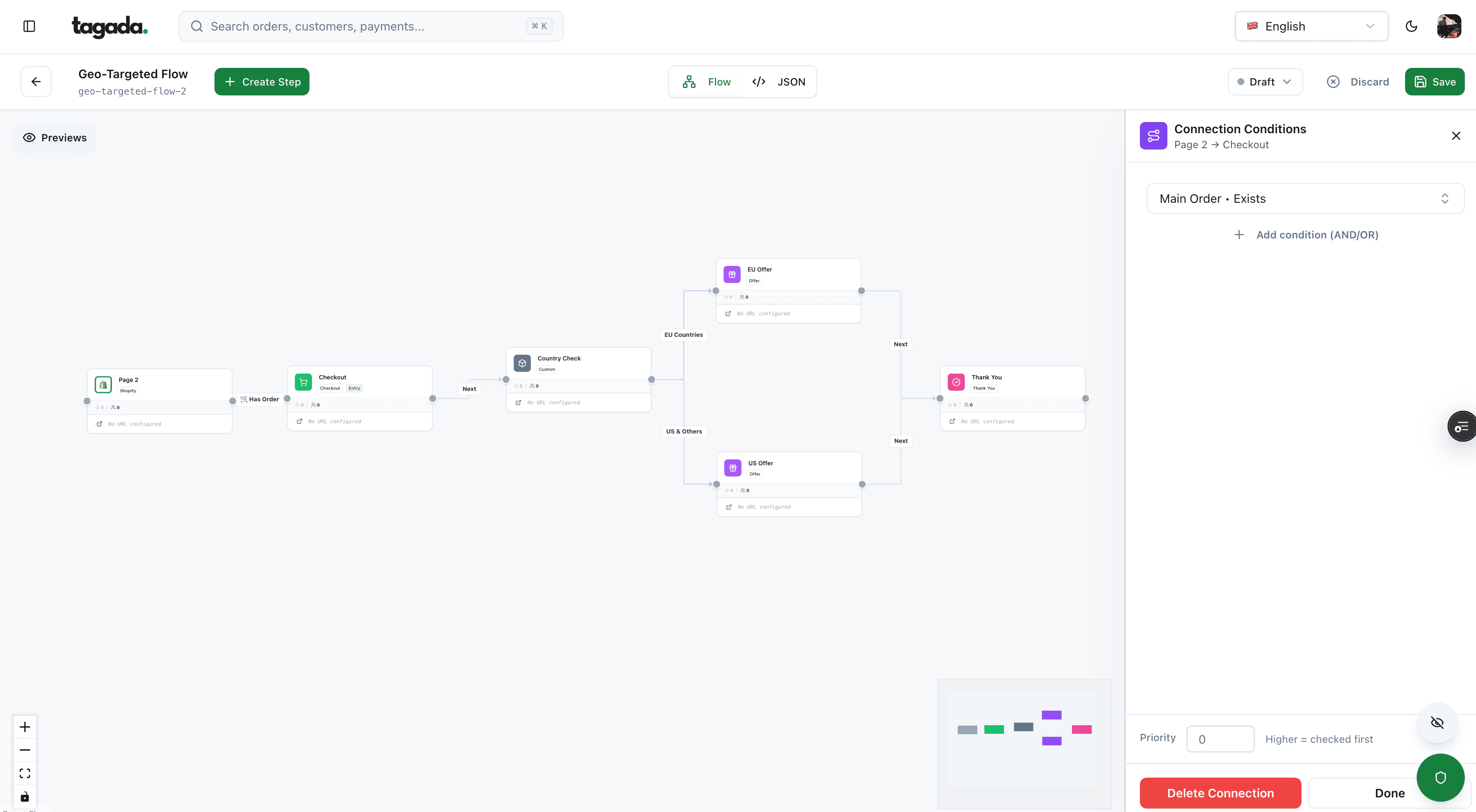
How Tagada runs the checkout side of the funnel
Tagada is the checkout and offer layer; your course platform keeps hosting the content. "If you sell something real, we will get you paid." TagadaPay lists info products, coaching and online courses among its industries, with "enhanced review for regulated verticals." "Most merchants are live under 24 hours."11TagadaPay, homepage, read November 2, 2026
- Order bumps shown before payment, with rules by product or cart total9Tagada docs, Order bumps, read November 2, 2026.
- One-click upsells and downsells: "upsell on accept, downsell on decline", charged on the card just used10Tagada docs, Upsell and downsell funnel, read November 2, 2026.
- Memberships and subscriptions: "Checkout, one-click upsells, subscriptions and membership on the same funnel", with automatic retries on failed rebills.
- Server-side events to Meta, Google and TikTok, and Apple Pay and Google Pay at checkout.
Already on ClickFunnels, Shopify or WooCommerce? You can drop TagadaPay in. Plans are on the pricing page.
Tagada follows Visa and Mastercard rules and the laws that apply to payments.
Frequently asked questions
What is a sales funnel for an online course?
Should I sell my course with a webinar, a sales page or a call?
How many upsells should a course funnel have?
Can I offer a payment plan for my course or coaching program?
Should I offer a money-back guarantee or a free trial?
Sources
Checked November 2, 2026- Teachable Help Center, Order bumps, July 11, 2025
- SamCart, Order bumps guide, 2026 (platform data, not audited)
- Stripe, Prohibited and restricted businesses, read November 2, 2026
- Visa Core Rules and Visa Product and Service Rules, edition of October 24, 2026: Installment Transactions (Tables 5-19 to 5-21), dispute condition 13.5
- FTC, Business Opportunity Rule, 16 CFR Part 437, eCFR, read November 2, 2026
- CFPB, Regulation Z, 12 CFR 1026.2(a)(17), read November 2, 2026
- Restore Online Shoppers' Confidence Act, 15 U.S.C. 8403, read November 2, 2026
- Directive 2011/83/EU on consumer rights, Article 16(m), original text (amended by Directive (EU) 2019/2161)
- Tagada docs, Order bumps, read November 2, 2026
- Tagada docs, Upsell and downsell funnel, read November 2, 2026
- TagadaPay, homepage, read November 2, 2026
Tagada
Build the course funnel around the offer, not the page
Funnels, one-click upsells, subscription billing and payment routing, on one customer record.
- 01Create your free account
- 02Connect your store or build a checkout
- 03Launch funnels, upsells and subscriptions