
Bundles and Quantity Breaks for Info Product Businesses: Pricing and Discounts
4 bundle formats for courses and coaching, how to price them, team seat tiers, and the FTC rules behind "total value" and "bonus" claims.


Article summary
TL;DR
Info product businesses bundle in four ways: a learning path of related courses, an all-access library, good-better-best tiers that add coaching or community, and team seats at a lower price per seat. Price the bundle below the sum of its parts, show a real saving, and offer it where the buyer decides: sales page, order bump or upsell.
- The FTC treats a "was" price as fair only if it is the "actual, bona fide price" offered "for a reasonably substantial period of time" (16 CFR 233.1).
- For "free" bonus offers, "all the terms and conditions of the offer should be made clear at the outset" (16 CFR 233.4).
- Stripe prohibits "unrealistic incentives or rewards as an inducement to purchase" (read November 2, 2026).
- A 2026 guide by Learnybox suggests seat tiers from 20% off (5 to 14 seats) to 50% off (50 to 99 seats); an example, not a benchmark.
 ChatGPT
 Claude
 Perplexity
 Grok
On this page
This guide is part of our playbook on the best ecommerce platform for info product businesses. The general guide, for any business: order bumps.
4 bundle formats for info products
Each format answers a different buyer. Pick one per offer, not all four.
| Format | What's inside | Best for | Metric to watch |
|---|---|---|---|
| Learning path | 2 or 3 courses in a logical order (basics, then advanced) | A buyer who wants the full skill | Share of buyers who take the bundle over the single course |
| All-access library | Every course, often as a membership | A catalog of 5+ courses | Monthly churn and lessons opened |
| Good, better, best tiers | Course alone; course + templates or community; course + group or 1:1 coaching | One flagship course | Tier mix and refunds per tier |
| Team seats | The same course for several named users | Companies, agencies, schools | Seats bought and seats activated |
Fig. 14 bundle formats, one metric each
Learning path
2 or 3 courses in a logical order (basics, then advanced). Watch the share of buyers who take the bundle over the single course.
All-access library
Every course, often as a membership. Watch monthly churn and lessons opened.
Good, better, best tiers
Course alone; course + templates or community; course + group or 1:1 coaching. Watch the tier mix and refunds per tier.
Team seats
The same course for several named users. Watch seats bought and seats activated.
Pick one per offer, not all four.
Example
A $297 course sells alone. Tier 2 adds templates and a community for $397. Tier 3 adds six group calls for $797. The middle tier gives most buyers a reason to step up without a coaching cost you must deliver.
How to price a bundle
- Start from the parts. List what each item sells for on its own today. Only items you actually sell separately can show a "regular price".
- Set the discount by margin, not by habit. A digital add-on costs you almost nothing to deliver; a coaching call costs your time. Discount the first more than the second.
- Make the saving readable in one glance. "Both courses: $447 instead of $594" beats a percentage buried in small print.
- Keep one anchor. Show the bundle next to the single course, so the buyer compares two real prices.
- Decide the refund rule before launch. If a buyer refunds one part, what do they keep? Write it in your terms.
Only items you actually sell separately can show a regular price.
Illustrative: two courses at $297 each, sold together for $447, is a 25% saving. The bundle earns $150 more than one course sold alone.
Quantity breaks: team seats
For info products, the quantity break is the team license. A company buys several seats of one course, and the price per seat falls with volume.
| Seats | Example price per seat ($500 course) | Discount |
|---|---|---|
| 1 | $500 | None |
| 5 to 14 | $400 | 20% |
| 15 to 49 | $325 | 35% |
| 50 to 99 | $250 | 50% |
| 100+ | Custom quote | Negotiated |
Example tiers published by Learnybox, September 20264Learnybox, How to Sell Bulk Online Course Access to Companies (2026 Guide), September 9, 2026. Your own tiers depend on support load and on whether seats can be reassigned.
Fig. 2Price per seat of a $500 course, in dollars
The price per seat falls with volume; 100+ seats is a custom quote.
Set these terms on the order or the contract:
- Named or reassignable seats: can a seat move when an employee leaves?
- License period: start and end dates, and renewal notice.
- Who activates: the buyer invites users, or you do. Track seats activated, not only seats sold.
- How they pay: card at checkout for small teams; an invoice for larger accounts, which often expect payment terms.
The "value stack" and FTC pricing rules
Course sales pages often list each component with a "value" and add them up to a "total value" far above the price. That is a price comparison, and US rules apply.
| Claim on the page | What the rule says | Safe version |
|---|---|---|
| "Regular price $997, today $497" | Fair only if $997 is the "actual, bona fide price" offered "for a reasonably substantial period of time"116 CFR § 233.1, Former price comparisons, FTC Guides Against Deceptive Pricing, via Cornell LII, read November 2, 2026 | Show a price you really charged, for a real period |
| "Free bonus with your order" | "All the terms and conditions of the offer should be made clear at the outset"216 CFR § 233.4, Bargain offers based upon the purchase of other merchandise, via Cornell LII, read November 2, 2026 | State what the bonus is, when it is delivered, and any condition |
| "Total value $4,997" | Same logic as a former price: the parts must sell at those prices | Value only items you sell separately, at those prices |
| "Bonus: done-for-you clients" or income figures | Stripe prohibits "unrealistic incentives or rewards"3Stripe, Prohibited and restricted businesses, read November 2, 2026; income claims draw FTC action | Describe what the bonus contains, not what it will earn |
Fig. 3Value stack claims, and the safe version
- "Regular price $997, today $497"Fair only if $997 is the "actual, bona fide price" offered "for a reasonably substantial period of time".Show a price you really charged, for a real period.
- "Free bonus with your order""All the terms and conditions of the offer should be made clear at the outset".State what the bonus is, when it is delivered, and any condition.
- "Total value $4,997"Same logic as a former price: the parts must sell at those prices.Value only items you sell separately, at those prices.
- "Bonus: done-for-you clients" or income figuresStripe prohibits "unrealistic incentives or rewards"; income claims draw FTC action.Describe what the bonus contains, not what it will earn.
Watch out
A bundle that over-promises raises disputes. Visa's misrepresentation dispute (13.5) covers "business opportunities" where the merchant "suggests that an income will be generated"6Visa Core Rules and Visa Product and Service Rules, edition of October 24, 2026, dispute condition 13.5, Table 11-118. A bundle should describe what the buyer gets, never what they will earn.
Where to sell the bundle in the funnel
| Placement | How it works | Good for |
|---|---|---|
| Sales page | Tiers side by side, the middle one highlighted | Good-better-best tiers |
| Order bump | A checkbox before payment: "Add the templates pack for $47" | Low-priced digital add-ons |
| One-click upsell | After payment: "Upgrade to the full path for $150 more" | Learning paths, coaching tiers |
| Email after purchase | Offer the next course at a bundle price within a set window | Library or membership |
SamCart reports that order bumps convert at "30-40% on average" across its platform; a vendor figure, not an audited benchmark5SamCart, The complete guide to order bumps, 2026, read November 2, 2026. Details: order bumps for info product businesses and one-click upsells. For the bigger picture on order value, see how to increase AOV.
How Tagada helps
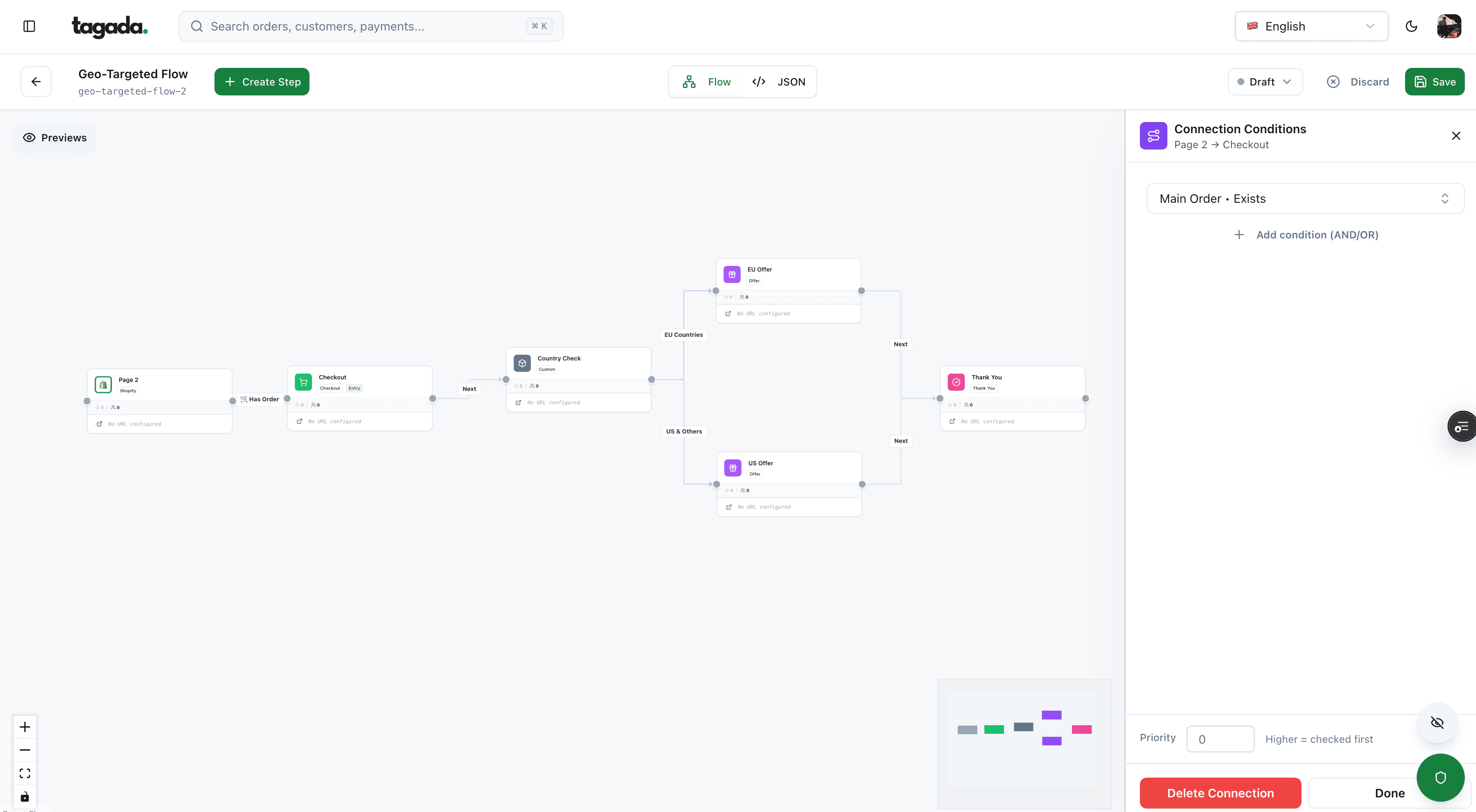
Bundles, tiers and add-ons offered where the buyer decides
"If you sell something real, we will get you paid." TagadaPay lists info products, coaching and online courses among its industries, with "enhanced review for regulated verticals." "Most merchants are live under 24 hours."8TagadaPay, homepage, read November 2, 2026
- Order bumps with rules: show an add-on for any cart or a given product, or only when the cart total is above or below an amount (
CartContainsProduct,CartTotalAbove,CartTotalBelow)7Tagada docs, Order bumps (Node SDK), read November 2, 2026. - One-click upsells "charged on the card just used, with no form." Make the offer "a bundle, a subscription or a membership", then route each yes and each no.
- A/B tests on the bump, the upsell and the tier layout, in the same checkout.
- Memberships for an all-access library, with retries on failed renewals.
Plans are on the pricing page. On the payment side: info product payment processing.
Frequently asked questions
How much discount should a course bundle have?
Should I bundle my courses or sell them separately?
How much should I charge per seat for team licenses?
Can I list a "total value" on my sales page?
Are bonuses better than discounts?
Sources
Checked November 2, 2026- 16 CFR § 233.1, Former price comparisons, FTC Guides Against Deceptive Pricing, via Cornell LII, read November 2, 2026
- 16 CFR § 233.4, Bargain offers based upon the purchase of other merchandise, via Cornell LII, read November 2, 2026
- Stripe, Prohibited and restricted businesses, read November 2, 2026
- Learnybox, How to Sell Bulk Online Course Access to Companies (2026 Guide), September 9, 2026
- SamCart, The complete guide to order bumps, 2026, read November 2, 2026
- Visa Core Rules and Visa Product and Service Rules, edition of October 24, 2026, dispute condition 13.5, Table 11-118
- Tagada docs, Order bumps (Node SDK), read November 2, 2026
- TagadaPay, homepage, read November 2, 2026
Tagada
Bundle courses on real prices, not on a value stack
Funnels, one-click upsells, subscription billing and payment routing, on one customer record.
- 01Create your free account
- 02Connect your store or build a checkout
- 03Launch funnels, upsells and subscriptions