
How to Increase AOV for an Info Product Business
Raise order value on courses, coaching and memberships: order bumps, one-click upsells, tiers, payment plans and memberships, with sourced numbers.



Article summary
TL;DR
To raise order value on a course or coaching offer, add an order bump at checkout, one upsell and one downsell after payment, and a higher tier with live support. Then add a payment plan on high prices and a membership after the course. Measure revenue collected per buyer, not only per order, because plans and memberships pay over time.
- Stan reports $96 per course sale and $51 per digital download in 2025 (80,000+ creators).
- SamCart reports order bump take rates of 30 to 40% across "$7B+ in processed transactions" (its own data, 2026).
- Teachable schools with an order bump saw about 8% higher AOV (nearly 600 schools, 2021).
- Under Visa rules, a merchant payment plan carries no interest, and a late fee must be flat (October 2026 edition).
- Stripe bans businesses that "use high-pressure upselling" (read November 2, 2026).
 ChatGPT
 Claude
 Perplexity
 Grok
On this page
This guide is part of our playbook on the best ecommerce platform for info product businesses. For the order bump in general, any industry, see our order bump guide.
Where your AOV stands
Your order value starts with your price. Two public datasets give a reference point.
- Stan: $67 per sale on average in 2025, $96 for courses, $61 for memberships and $51 for digital downloads1Stan, State of the Creator Economy, 2025 data from 80,000+ creators, updated July 21, 2026.
- Ruzuku: a $150 median one-time course price, with the middle half between $49 and $357 (August 2026)2Ruzuku, Course pricing benchmarks, Ruzuku platform data, August 2026.
$67
Average sale, all creator products, Stan, 2025
$96
Average sale for courses, Stan, 2025
$51
Average sale for digital downloads, Stan, 2025
$150
Median one-time course price, Ruzuku, August 2026
If your course sells at $97 and buyers add nothing, your AOV is $97. Every lever below adds to that number without new traffic. More references are in info product business benchmarks.
The levers, by offer type
Not every lever fits every product. Pick the two that match what you sell.
| Lever | Ebook or template | Self-paced course | Coaching or program | Membership | Where it sits |
|---|---|---|---|---|---|
| Order bump | YesSecond template pack | YesWorkbook, swipe files | YesRecordings, a toolkit | Rarely | Checkout, before payment |
| One-click upsell | YesThe full course | YesGroup calls, advanced course | Yes1:1 sessions | Yearly plan | After payment |
| Downsell | Rarely | YesA smaller module | YesSelf-paced version | Monthly instead of yearly | After a declined upsell |
| Tiers | No | YesCourse, course + community, course + coaching | Yes | YesMonthly, yearly | Sales page |
| Payment plan | No | On higher prices | Yes | No | Checkout |
| Membership after the course | Rarely | YesCommunity, new lessons | YesAlumni group | n/a | After access, by email |
Fig. 1Where each lever sits in a course purchase
- Sales pageTiers: course, community, coaching
- CheckoutOrder bump; payment plan on higher prices
- After paymentOne-click upsell
- Upsell declinedDownsell
- After accessMembership, by email
Bump before payment, upsell after, membership once the course is running.
Order bump: price and offer
An order bump is a checkbox on the checkout that adds a small item before payment. It works when it completes the course.
Make it the obvious add-on
Templates, a workbook, recordings, a checklist pack. Something the buyer will use in week one.
Price it low against the course
Ruzuku suggests 10 to 30% of the course price, and says it is "a rule of thumb, not a measured benchmark"5Ruzuku, Order bumps for courses, updated November 2026.
Leave it unchecked
The buyer opts in. A pre-checked bump looks like a hidden charge and invites disputes.
Expect a range, not a promise
SamCart reports 30 to 40% take rates on its platform3SamCart, The complete guide to order bumps, 2026 (platform data, not audited); Teachable found about 8% higher AOV in schools with a bump4Teachable, Order bumps drive sales, June 3, 2021. Both are vendor figures.
Setup details: order bumps for info product businesses.
One-click upsell and downsell
After payment, offer the next step, charged to the same card in one click. Buyers have just said yes, and they do not retype a card.
- Upsell the next level: group coaching, a 1:1 session, an advanced course, a yearly membership.
- Downsell on a no: a lighter version, fewer sessions, a single module.
- Stop at one of each. Each extra step delays access to what they bought.
We found no published upsell take rate for courses. In ecommerce, ReConvert reports 4.7% average acceptance for post-purchase upsells (2023) and Zipify 16.2% among merchants who optimize them (July 2026)6ReConvert, The impact of post-purchase upselling in 20237Zipify, Post-purchase upsells on Shopify 2026, July 16, 2026. See one-click upsells for info product businesses.
Fig. 2Post-purchase upsell acceptance, ecommerce
No published rate exists for courses: track your own.
Order bump or upsell?
Both raise AOV. They do not do the same job.
| Order bump | One-click upsell | |
|---|---|---|
| When | On the checkout, before payment | After payment, on its own page |
| Price | Small against the main offer | Can be larger than the main offer |
| Effect on checkout | One more choice on the page | None: the sale is already done |
| Best for | Templates, workbooks, recordings | Coaching, advanced course, yearly plan |
| Decision | Instant | Considered, with a short page or video |
Tiers and bundles
A sales page with two or three tiers lets buyers choose how much help they want. It often lifts AOV more than any checkout add-on.
| Tier | What it includes | Who it is for |
|---|---|---|
| Course | The lessons and templates | Self-starters |
| Course + community | Lessons, plus a group and monthly Q&A calls | Buyers who want feedback |
| Course + coaching | All of the above, plus 1:1 sessions | Buyers who want accountability |
Example (illustrative): a course at $297, a community tier at $497 and a coaching tier at $1,497. If 70% of buyers take the base tier, 25% the middle one and 5% the top one, the average sale is about $407, against $297 with a single price.
Fig. 3One price or three tiers
Single price
- Sales pageCourse, $297
- buysBuyerCourse only
$297 average sale
Three tiers
- Sales page$297, $497 and $1,497 tiers
- chooseBuyers70% base, 25% middle, 5% topApproved
About $407 average sale
Same course, a higher average sale.
Course bundles (two or three courses at a lower total) work the same way for creators with a catalog. See bundles for info product businesses.
Payment plans: higher total, lower first order
A payment plan lowers the first charge and opens your top tier to more buyers. Many creators set the plan total a little above the one-time price.
- Keep it interest-free. Visa: "the Merchant does not charge any interest, or imputed interest"; a late fee "must be a flat fee"8Visa Core Rules and Visa Product and Service Rules, edition of October 24, 2026: Installment Transactions (Tables 5-19 and 5-20), dispute condition 13.5.
- Show the plan terms on their own. Total, number of payments, dates, refund policy, agreed before the card is stored8Visa Core Rules and Visa Product and Service Rules, edition of October 24, 2026: Installment Transactions (Tables 5-19 and 5-20), dispute condition 13.5.
- Stay at four payments or fewer, or ask a lawyer. A plan "payable by written agreement in more than four installments", offered more than 25 times a year, can make you a creditor under Regulation Z9CFPB, Regulation Z, 12 CFR 1026.2(a)(17), read November 2, 2026.
- Measure what you collect. Track installments collected against installments due, not only plan sales.
Higher total, lower first charge, within Visa's and Regulation Z's limits.
Plans are covered in payment plans for info products.
Memberships after the course
A course ends; a community or a library of new lessons can go on. Offered after the course, a membership adds revenue every month.
- Get express consent. ROSCA requires clear terms before billing, express consent and a simple way to stop10Restore Online Shoppers' Confidence Act, 15 U.S.C. 8403, read November 2, 2026.
- Offer a yearly plan. Recurly's data shows lower churn at higher monthly revenue per customer: 2.87% at $100 to $250 against 4.29% at $10 to $25 (July 2026 data)11Recurly, Churn rate benchmarks, July 2026 data.
- Never hide it in a bump. A recurring charge must be chosen as one.
See memberships for info product businesses.
What not to do
These tactics raise AOV for a week and cost you refunds, disputes or your processor.
- High-pressure upsells: fake countdowns, "this page will never be shown again" when it will. Stripe bans "high-pressure upselling"12Stripe, Prohibited and restricted businesses, read November 2, 2026.
- Upsells sold on income: "the advanced program pays for itself in a month". Visa's "Misrepresentation" dispute covers merchants that suggest "an income will be generated" or recommend buying "additional items … to generate more income"8Visa Core Rules and Visa Product and Service Rules, edition of October 24, 2026: Installment Transactions (Tables 5-19 and 5-20), dispute condition 13.5.
- Pre-checked bumps and hidden memberships.
- Five upsells in a row before the buyer can access the course.
In what order to set it up
- Order bump on your best-selling offer.
- One upsell and one downsell after payment.
- Tiers on the sales page.
- Payment plan on the top tier.
- Membership offered after the course, by email.
Test one change at a time, for at least two full weeks. See A/B testing for info product businesses.
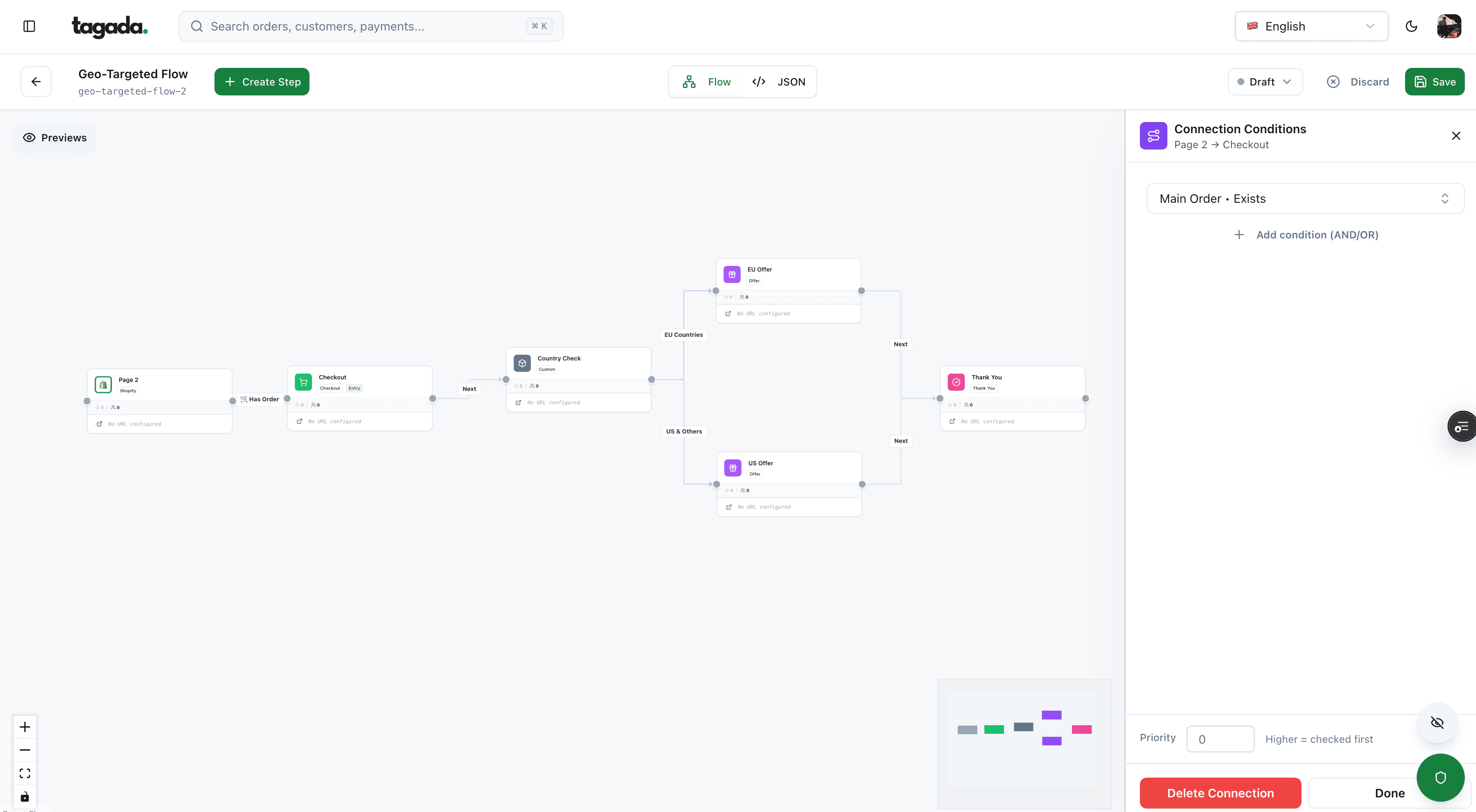
How Tagada helps
Bumps, upsells and memberships in one course checkout
- Order bumps before payment, shown for any cart or a given product, with rules such as
CartContainsProductorCartTotalAbove13Tagada docs, Order bumps, read November 2, 2026. - One-click upsells: "Charged on the card just used, with no form." Upsell on accept, downsell on decline14Tagada docs, Upsell and downsell funnel, read November 2, 2026.
- Memberships and subscriptions: "Checkout, one-click upsells, subscriptions and membership on the same funnel."
- A/B tests on the checkout, plus Apple Pay and Google Pay.
"If you sell something real, we will get you paid." TagadaPay lists info products, coaching and online courses among its industries, with "enhanced review for regulated verticals". "Most merchants are live under 24 hours."
Pricing starts "From 2.9% + $0.29", with "No setup fees, no monthly minimums"15TagadaPay, homepage, read November 2, 2026. Already on ClickFunnels, Shopify or WooCommerce? You can drop TagadaPay in. Plans are on the pricing page.
Tagada follows Visa and Mastercard rules and the laws that apply to payments.
Frequently asked questions
What is a good order bump take rate for a course?
How much should I charge for an order bump?
Do payment plans increase AOV?
Should I add an order bump or an upsell first?
Should I bundle my courses?
Sources
Checked November 2, 2026- Stan, State of the Creator Economy, 2025 data from 80,000+ creators, updated July 21, 2026
- Ruzuku, Course pricing benchmarks, Ruzuku platform data, August 2026
- SamCart, The complete guide to order bumps, 2026 (platform data, not audited)
- Teachable, Order bumps drive sales, June 3, 2021
- Ruzuku, Order bumps for courses, updated November 2026
- ReConvert, The impact of post-purchase upselling in 2023
- Zipify, Post-purchase upsells on Shopify 2026, July 16, 2026
- Visa Core Rules and Visa Product and Service Rules, edition of October 24, 2026: Installment Transactions (Tables 5-19 and 5-20), dispute condition 13.5
- CFPB, Regulation Z, 12 CFR 1026.2(a)(17), read November 2, 2026
- Restore Online Shoppers' Confidence Act, 15 U.S.C. 8403, read November 2, 2026
- Recurly, Churn rate benchmarks, July 2026 data
- Stripe, Prohibited and restricted businesses, read November 2, 2026
- Tagada docs, Order bumps, read November 2, 2026
- Tagada docs, Upsell and downsell funnel, read November 2, 2026
- TagadaPay, homepage, read November 2, 2026
Tagada
Raise course order value without high-pressure upsells
Funnels, one-click upsells, subscription billing and payment routing, on one customer record.
- 01Create your free account
- 02Connect your store or build a checkout
- 03Launch funnels, upsells and subscriptions