
High-Risk Payment Gateway: How It Works and How to Keep Payments Running
What a high-risk payment gateway does, who needs one, what it costs, and how routing and a backup processor keep sales running within card network rules.

Article summary
TL;DR
A high-risk payment gateway is the software that sends your card payments to an acquirer willing to take a business mainstream processors turn down. The gateway alone doesn't approve you: the merchant account behind it does. The useful part is what sits around it: several acquirers behind one checkout, a cascade only when a processor is down or times out, dispute and fraud tools, and saved cards you can move.
- "High-risk" has two sources: Visa's list of 13 registered MCCs, and each processor's own criteria, such as dispute rate, refund rate and industry.
- A gateway is software you can swap. The merchant account behind it is the relationship that underwriters approve, hold or close.
- Only technical failures cascade freely to another processor. A Visa Category 1 decline is never retried, on any processor.
- Resilience is built before the problem: a second processor live on a share of traffic, card data you can export, and cash that survives a reserve.
- Spreading volume over several accounts to stay under Visa's monitoring is circumvention: Visa can fine the acquirer USD 25,000 a month and disqualify the merchant for good.
 ChatGPT
 Claude
 Perplexity
 Grok
On this page
This guide is about the gateway and what keeps payments running behind it. How to get and keep the account itself is in our guide to the high-risk merchant account, and what each fee line means in high-risk processing fees. Ten providers compared on what they publish: best high-risk payment processors.
What is a high-risk payment gateway?
A high-risk payment gateway is usually a package: a gateway connected to one or more acquirers that accept businesses mainstream processors turn down. What you're really buying is the high-risk merchant account behind it, and the way the gateway handles the day one of those accounts stops.
Ecommerce payment processing is a chain that turns a card entered at checkout into money in your bank account. Each link can say no, and only one of them is the customer's bank.
Fig. 1Five parties between the click and the payout
approved declined or closed routing step
- CheckoutCustomer pays
- encryptsGatewaySends the payment
- routes toProcessor and acquirerHolds your merchant account
- passes to

 Card networkVisa, Mastercard
- asksIssuerApproves or declinesApproved
For a high-risk merchant, the acquirer and the processor are the links that break.
- The issuer decides each payment. A decline is about one card, one time.
- The acquirer and processor decide whether you can take payments at all, and when you get the money. That's where reviews, reserves and closures happen.
- The card network sets the rules both must follow, and watches your dispute and fraud ratios every month through programs such as Visa's VAMP.5Visa, Visa Acquirer Monitoring Program fact sheet, 2025
That's why the difference between a payment gateway and a payment processor matters here: a gateway is software and can usually be swapped; the merchant account is the relationship that underwriters approve or end. More on the parties in our guide to payment service providers.
Who needs a high-risk payment gateway?
There's no single definition of high-risk. Two sources decide, and they don't use the same criteria.
| Who decides | On what basis | What follows |
|---|---|---|
| Visa | Your merchant category code. 13 codes in three tiers form the High-Integrity Risk group | Your acquirer must be approved by Visa and register you before your first card-absent sale |
| Mastercard | Its own registration program for overlapping categories | Registration and fees, set by Mastercard and your acquirer |
| Your processor | Its own prohibited and restricted lists, plus your account's history | Refusal, review, reserve, slower payouts or closure |
Sources: Visa Integrity Risk Program9Visa, Visa Integrity Risk Program guide for acquirers, April 6, 2023 and Visa Core Rules, section 10.4.5.1.7Visa Core Rules and Visa Product and Service Rules, April 18, 2026 The full Visa list, tier by tier, is in our guide to high-risk MCC codes.
Most merchants who call themselves high-risk aren't on Visa's list at all. They're high-risk for their processor. Stripe states what it weighs when it sizes a reserve: "industry conditions, payment activity, dispute rate, refund rate, and financial stability."1Stripe Support, Reserves FAQ In practice, these patterns raise a file's risk:
- Payment long before deliveryDisputes can arrive months after the saleShow delivery dates, send tracking, keep proof of delivery
- Subscriptions and trialsCustomers forget they signed up, then disputeTerms shown at sign-up, reminders before renewal, online cancellation
- A sudden jump in volumeFraud and bust-out schemes look like growth at firstTell your processor before a launch or a big promotion
- Rising refunds or disputesLosses the processor may have to coverRefund fast, answer alerts, fix the product page behind the complaints
- Product claims a regulator could challengeRegulatory and refund exposureProduct pages without medical or income claims
Check the processor's public list before anything else. Stripe, for example, prohibits gambling, adult content and negative-option marketing, and reviews online pharmacies, dating and tobacco before accepting them.10Stripe, Prohibited and restricted businesses No gateway feature fixes a business the processor won't take. Processor by processor: Stripe, PayPal and Shopify Payments for high-risk businesses.
What a high-risk payment gateway should do
Reach an acquirer that takes your category
For the 13 Visa codes, the acquirer must be approved for your tier. Ask directly which tiers it's approved for. A no means it can't register you.
Connect more than one acquirer
One checkout, several merchant accounts, each underwritten for your real business. Routing rules decide which one takes each payment, and a second account keeps you selling if the first one pauses.
Dispute and fraud tools
3-D Secure, fraud screening, and alerts that let you refund before a dispute is filed. These keep your ratios under the network thresholds.
Saved cards you can move
The right to export your customers' saved cards to another PCI DSS compliant processor, or a vault not tied to one processor. Ask for it before you sign.
A high-risk line of business must also run on its own MCC, separate from the rest of your sales, under Visa's April 2026 manual.8Visa, Merchant Data Standards Manual, April 2026 If you sell two kinds of products and one is higher risk, expect two codes, sometimes two accounts, and a gateway that can route each product to the right one.
Fraud tools score every payment and apply rules you set. In Stripe Radar, scores run from 0 to 99, and by default payments scored 75 or more are blocked.15Stripe Docs, Transaction risk prevention (Radar risk evaluation) Every good order you block is lost revenue that no dispute report shows, so tune the rules on your own traffic. The method is in our guide to ecommerce fraud prevention, and the alert services in chargeback alerts.
What a high-risk payment gateway costs
Card networks and regulators don't publish a "high-risk rate". Brokers publish ranges, but your price comes from your file. What the rules do explain is why it costs more.
Before an acquirer can process for high-integrity risk merchants, Visa requires it to apply and be approved, pass a financial review, hold the required equity capital and, where Visa decides, commit to compensating controls such as collateral.7Visa Core Rules and Visa Product and Service Rules, April 18, 2026 It then has to monitor each of those merchants daily, from the 31st day after the first deposit, on gross volume, average ticket, number of sales and disputes.7Visa Core Rules and Visa Product and Service Rules, April 18, 2026 That's why fewer acquirers serve these merchants, why they price higher, and why a volume spike triggers a call fast.
| Line item | What to ask | Where the published facts are |
|---|---|---|
| Processing rate | Rate per transaction, by card type and country, plus any fixed fee | Your quote only |
| Gateway fee | Per transaction or monthly, and whether it's charged per connected account | Your quote only |
| Reserve | Fixed or rolling, what share, how long, how it's released | Stripe reserves FAQ1Stripe Support, Reserves FAQ |
| Dispute fee | Per dispute, and per response if you contest | See below |
| Monitoring program fees | Whether network fines are passed on to you | Stripe monitoring programs4Stripe Docs, Dispute and fraud card monitoring programs |
| Exit terms | Notice period, how long funds are held after closure, card data export | Your agreement |
Dispute fees are public for the large processors, and they show how a high dispute rate adds up:
$15 + $15
Stripe, US: fee per dispute, plus a fee to contest that's returned if you win, for disputes opened after June 17, 2025
$15
Shopify Payments, US: chargeback fee, returned if you win
$20
PayPal, US: card chargeback fee
Sources: Stripe,12Stripe Support, June 2025 pricing updates for disputes Shopify,13Shopify Help Center, Overview of the chargeback and inquiry process PayPal.14PayPal, Merchant and business fees (US) Rates, reserves and network fees in detail: high-risk processing fees and merchant account reserves.
Routing and cascading: what may go to another processor
Cascading sends a failed payment to the next processor. It's what keeps checkout working during an outage. It's also where a gateway turns into a rule violation if it's set up blindly.
- Timeout, processor error, issuer unavailableNobody. The issuer never answeredYes, after checking the first attempt didn't go through
- Generic decline, such as 05 do not honorThe issuer said no, without a reasonOnce at most, within Visa's limit of 20 attempts in 30 days
- Lost card, stolen card, closed accountVisa Category 1: the issuer will never approveNever, on any processor. Ask for another payment method
- Your fraud tool blocked the paymentA screen judged it fraudNo. A second screen won't make it a good order
Limits from Visa Core Rules, section 1.7.2.1 and table 7-2;7Visa Core Rules and Visa Product and Service Rules, April 18, 2026 the "once at most" on generic declines is our recommendation, not a Visa rule. When you do retry a declined payment, section 1.7.2.1 also forbids changing data elements of the original request, such as the MCC, the merchant country or the e-commerce indicator, to get a different answer. How the rules engine picks a processor for each payment is in dynamic payment routing, and retry limits in payment acceptance rate.
Keep payments running when a processor stops
Resilience isn't avoiding every review. Processors review accounts as part of normal business. It means a review, a hold or a closure doesn't stop your sales or your cash.
Fig. 2How an account problem escalates
- ReviewDocuments requested, payouts may pause
- ReservePart of your balance held for a set period
- ClosureNew payments stop. Stripe typically restricts payouts for 120 days
- ListingMATCH or VMSS for 5 years, if criteria are met
Each step has its own fix. The backup must exist before step 1.
Your contract decides how much warning you get. Stripe's agreement says it may close an account "at any time", with 30 days' notice only in the UK, Switzerland, Gibraltar and Australia.3Stripe, Stripe Services Agreement When Stripe decides an account has become an unacceptable risk, it "will typically restrict or pause payouts" for 120 days, then runs a formal review of the balance.2Stripe, Unacceptable Risk Policy A closure for excessive chargebacks can also put you on Mastercard MATCH or Visa VMSS for 5 years, and only the acquirer that listed you can remove the entry, mainly if it was an error.6Stripe Docs, Terminated merchant files (MATCH and VMSS)
A backup opened after a closure is an application with a closure on file. Set it up while your record is clean:
- Apply while your record is clean. Same business, same products, same MCC, disclosed openly. Tell the second processor you already process elsewhere and why you want a second account.
- Send it real volume from day one. An account that has never processed tells the underwriter nothing. A small, steady share of traffic builds a history.
- Write down which traffic goes where. By country, card type or product, with a reason for each rule. If a processor asks why its share changed, you have the answer.
- Test refunds, webhooks and reconciliation. A backup that takes payments but can't refund them creates disputes.
- Track each account separately. Approval rate, dispute rate, refund rate and reserve, per processor, every month.
Run the switch once on real traffic, then keep the backup live.
For a subscription business, the saved cards are the business. If they sit in one processor's vault and that account closes, every renewal stops until customers type their card again.
Fig. 3Same closure, two vaults
Cards locked in one processor
- Renewal dueMonthly plan
- charges onProcessor AAccount closedDeclined
Renewals stop, customers asked to re-enter cards
Cards exported or held independently
- Renewal dueMonthly plan
- charges onProcessor AAccount closedDeclined
- moves toProcessor BCard already on fileApproved
Renewals continue on the new account
The card number is what moves. Payment history and subscription objects don't.
Either your processor exports card data to the next one: Stripe does it on request, to another PCI DSS Level 1 compliant processor, but the export doesn't include payment history, subscriptions or cards saved with Link.11Stripe Docs, Request a payment data export Or the cards sit in a token vault that isn't tied to a single processor, so moving a customer is a routing change. The full move is in how to switch payment processors and token vault migration.
Plan cash for a reserve too. A reserve holds part of your funds for a period set in advance; Stripe reviews it a few days before it ends and can remove, reduce, increase or extend it.1Stripe Support, Reserves FAQ Model one bad quarter, keep a buffer outside the processor, and ask for the release terms in writing. After a closure: merchant account closed and funds held.
The line not to cross
Several processors behind one gateway is resilience. Several accounts used to hide from the card networks is circumvention, and the networks treat it more harshly than the high dispute rate it was meant to hide.
If Visa determines that an Acquirer, a Merchant, a Sponsored Merchant, or a Third Party Agent changed, modified, or altered the Merchant name, Merchant data, or Merchant performance in any way to circumvent the Visa Acquirer Monitoring Program (VAMP) or the Visa Integrity Risk Program (VIRP), Visa may do either or both: Impose a non-compliance assessment of USD 25,000 per Merchant or Sponsored Merchant, per month to the Acquirer. Permanently disqualify the Merchant, or Sponsored Merchant, and its principals from participating in the Visa system.
| Practice | Status | Why |
|---|---|---|
| Two or three processors, each underwritten for your real business | Allowed | Each account is declared and processes your own sales |
| Routing traffic by country, card type or cost, with written rules | Allowed | Routing on business criteria, not to avoid monitoring |
| A separate MCC for a higher-risk product line | Allowed | Required by Visa's manual for a high-risk line8Visa, Merchant Data Standards Manual, April 2026 |
| Splitting volume so each account stays under VAMP thresholds | Prohibited | Visa section 12.5.3.2: altering merchant performance to circumvent VAMP |
| Processing another merchant's sales through your account | Prohibited | Laundering: Visa section 1.9.1.4, MATCH code 3, VMSS code 236Stripe Docs, Terminated merchant files (MATCH and VMSS) |
| Reapplying under a new company name after a termination | Prohibited | Visa section 1.9.1.4: new agreement under a new name to circumvent the rules |
Sources: Visa Core Rules7Visa Core Rules and Visa Product and Service Rules, April 18, 2026 and Merchant Data Standards Manual.8Visa, Merchant Data Standards Manual, April 2026 What is allowed, account by account: multiple merchant accounts. To lower the ratio instead: chargeback prevention.
Shopify, WooCommerce or your own checkout
Where your store runs decides how a high-risk gateway plugs in. On Shopify, a third-party gateway carries an extra Shopify fee and Shopify Payments has its own restricted list: high-risk payment processing for Shopify. On WooCommerce, the gateway is a plugin and you choose the processor: high-risk payment processing for WooCommerce. On a custom or headless checkout, the gateway is an API, and the routing logic can sit in a payment orchestration layer that ties several processors together.
By industry
| Industry | What changes | Guide |
|---|---|---|
| Supplements | Health claims, the FDA disclaimer, trials that roll into auto-ship | Supplement and nutraceutical merchant accounts |
| Skincare | Cosmetic claims that read as drug claims, before-and-after photos, refills | Skincare merchant accounts |
| Online pharmacy | An acquirer registers the pharmacy with Visa and Mastercard, backed by state licenses and LegitScript or NABP | Online pharmacy merchant accounts |
| Telehealth | Stripe restricts telehealth and reviews each business; once you sell the medication yourself, pharmacy rules apply | Telehealth merchant accounts |
| Fitness | Sports nutrition is judged like a supplement, and delivery disputes on equipment are the real risk | Fitness merchant accounts |
| Info products | Income claims, fake testimonials and pressure upsells close accounts; login records are the proof of delivery | Info product merchant accounts |
Tagada follows Visa and Mastercard rules and the laws that apply to payments.
How Tagada helps
Several processors behind one checkout
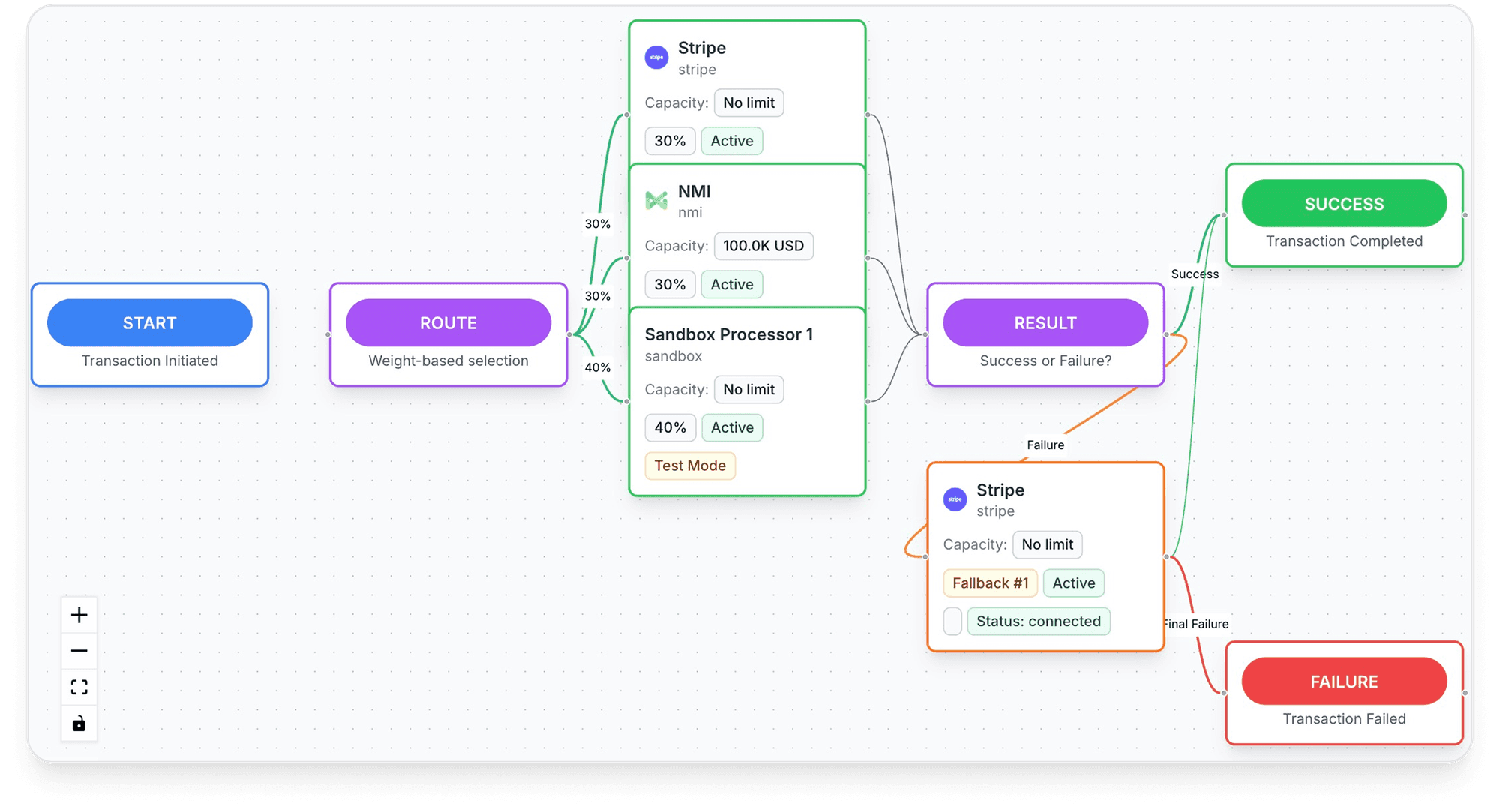
- Routing across TagadaPay and processors such as Stripe, NMI and Airwallex with one logic, and cascade to another processor when one is down or times out. A payment the bank declined is never sent to another processor.
- A vault you own: "Your PCI-tokenized cards, your customer profiles, your subscription data, all portable." Switch processors without re-onboarding customers, so running subscriptions keep charging.
- Native 3DS2, device intelligence and a rules engine to approve real customers and block the rest.
- Every file is reviewed: "Each file is still underwritten, with enhanced review on regulated verticals." Refusals stated upfront: falsified documents, counterfeits, chargeback circumvention, deceptive marketing around trials, subscriptions and cancellation, and MATCH-listed merchants.
- Live in 24h: "One KYC. One signed package." TagadaPay distributes it across its processor network and follows up, and most merchants are live in under 24 hours.
- From 2.9% + $0.29, no setup fees, no monthly minimums. High-risk verticals and edge cases are priced case by case.
- Already on Shopify, WooCommerce, ClickFunnels or BigCommerce? Drop TagadaPay in. Already on Stripe, NMI or Airwallex? Tagada orchestrates those too.
Frequently asked questions
What is a payment gateway for high-risk merchants?
What is the difference between a high-risk payment gateway and a high-risk payment processor?
Why is a high-risk payment gateway more expensive?
Can a gateway retry a declined payment on another processor?
Is it legal to use several merchant accounts behind one gateway?
Sources
Checked November 9, 2026- Stripe Support, Reserves FAQ
- Stripe, Unacceptable Risk Policy
- Stripe, Stripe Services Agreement
- Stripe Docs, Dispute and fraud card monitoring programs
- Visa, Visa Acquirer Monitoring Program fact sheet, 2025
- Stripe Docs, Terminated merchant files (MATCH and VMSS)
- Visa Core Rules and Visa Product and Service Rules, April 18, 2026
- Visa, Merchant Data Standards Manual, April 2026
- Visa, Visa Integrity Risk Program guide for acquirers, April 6, 2023
- Stripe, Prohibited and restricted businesses
- Stripe Docs, Request a payment data export
- Stripe Support, June 2025 pricing updates for disputes
- Shopify Help Center, Overview of the chargeback and inquiry process
- PayPal, Merchant and business fees (US)
- Stripe Docs, Transaction risk prevention (Radar risk evaluation)
TagadaPay
Keep selling when one processor stops
Tell us what you sell and how you sell it. Each application is underwritten, and approval is not guaranteed.
- 01Tell us what you sell and how
- 02Underwriting reviews your business
- 03Process through TagadaPay alongside your other processors